Gorokhovaya St., 4, Saint Petersburg, Russia, 191186
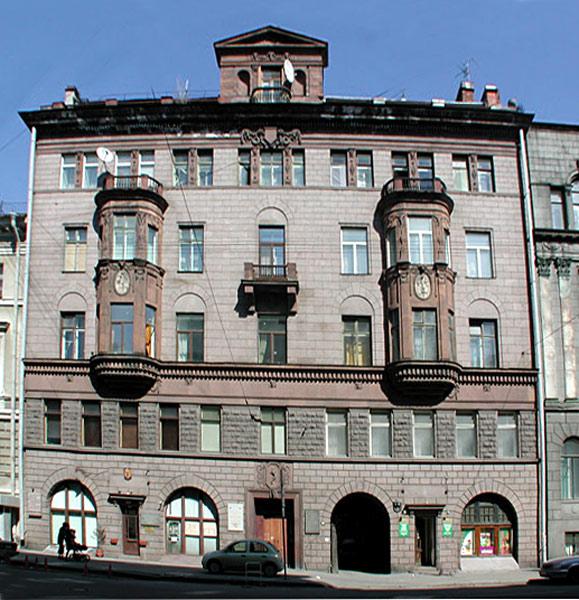

The building belonged to the insurance company "Salamandra." It was constructed between 1907 and 1909 by architect Nikolay Nikolayevich Veryovkin, together with architect Marian Marianovich Peretyatkovich, as a multi-apartment income house.
The first owner — court saddler Johan Bilert — received an undeveloped plot from the Main Police in 1762. By 1769, a two-story stone house with service rooms had already been built. The house still belonged to Bilert’s heirs in 1804. According to the 1822 register, the owner of the house was jeweler Samuel (Samuil) Arnd. He owned the house for more than 30 years; it was extended by two floors, plastered with molding, rustication, and stucco details. Two stone wings were built in the courtyard. In 1855, by deed of gift, the house passed to Samuel Arnd’s sons, merchants of the 2nd–1st guild, Karl and Samuel. In 1877, Samuel Samuilovich Arnd became the sole owner of the house. At that time, the house had 25 apartments (2–5 rooms), four of which were occupied by the owner himself. In 1880, Arnd made a will according to which the house passed to his wife Sofia Karlovna, and after her death, the property was to be divided among the children. In 1903, Sofia Arnd still owned the house, but soon it was sold to the Fire Insurance Society "Salamandra."
The insurance company "Salamandra" was founded in 1846 and insured against fire. It was believed that the mythical creature Salamander is not afraid of fire because it can extinguish it with the cold of its body. Later, life insurance, transport accident insurance, and accident insurance were added to fire insurance.
Between 1907 and 1909, according to the project by architects Veryovkin and Peretyatkovich, a new building was constructed for the "Salamandra" Insurance Society.
The facade of the five-story building is distinguished by its laconic style, created by smooth walls pierced by windows of various sizes. The 1st floor is tall with large display windows. There is a small balcony on the 4th floor. The facade’s elegance is enhanced by the cladding. Several types of stone were used for the exterior finish: red Gangut granite, red Radom sandstone, and white marble. The walls are clad in granite from bottom to top; architectural details — bay window, balcony, cornice, ornaments — are made of sandstone. The sandstone has a brownish tint compared to the granite. The range of red tones in the cladding is expanded by the method of surface finishing of the slabs. The tall first floor is laid with slabs of coarse-point processing, and the granite here has a dark pink color. The cladding of the second floor is done in a "rock" texture and appears darker, pinkish-red. The lightest pink color is found in the granite slabs with fine-point texture, which clad the walls of the third, fourth, and fifth floors.
Two symmetrical two-tier bay windows decorate the building’s facade. The facade is richly decorated with various carved details — mascarons depicting human and animal heads, horns of plenty, garlands, wreaths. In the spandrels between the windows of the upper floor are plates with female heads. All these decorations are carved from sandstone. The main entrance is framed by a strict portal made of polished granite with a carved plant ornament and a stern bas-relief mask. The carving here is not as delicate as in the sandstone details, due to the coarser grain texture of the granite. Above the portal is a red sandstone oval bas-relief depicting a salamander — the symbol of the insurance company. Oval medallions with bas-reliefs of dancers made of white marble complement the facade decoration.
On the doors, one can find a small figure of the mythical creature: the salamander was also used to "brand" buildings insured by the company.
Several rooms in the new building were occupied by the office of a trading house specializing in the production and sale of wine and vodka products. The founder of the firm was Emil-Ludwig Albertovich Totin (Totien).
In 1918, the house was vacated by residents and handed over to the Cheka. In the 1920s–1930s, the house was occupied by the Administrative Office of the Petrograd Cheka. It housed staff offices and detention cells. After the OGPU authorities moved to a new building on Liteyny Avenue, the house was converted back into residential use.
From 1937 to 1966, the house was home to the People's Artist of the USSR, laureate of State Prizes, and conservatory professor Sofia Petrovna Preobrazhenskaya. There is a memorial plaque in her honor.
From 1937 to 1951, Agrippina Yakovlevna Vaganova (1879–1951), professor and a leading figure in Russian choreography, lived here. A memorial plaque on the facade commemorates her.
From 1936 to 1941, the outstanding composer Isaak Osipovich Dunayevsky lived and worked here.
Since 2003, the building has housed the Consulate General of Romania.
Sources:
https://www.citywalls.ru/house3730.html

