Pushkinskaya, Saint Petersburg, Russia, 191180

The "Pushkinskaya" station is located on the Kirovsko-Vyborgskaya line (M1) between the "Tekhnologichesky Institut" and "Vladimirskaya" stations, and is part of the first metro line section from "Avtovo" to "Ploshchad Vosstaniya" (which was opened on November 15, 1955).
In 1949, in connection with the celebration of the 150th anniversary of the birth of A.S. Pushkin, it was decided to name the under-construction "Vitebsky Vokzal" station after the poet and completely change its design. It became "Pushkinskaya," without any toponymic connection to the area. However, there is some logic to this. Firstly, it is from Vitebsky railway station that suburban trains depart to the town of Pushkin (the Tsarskoye Selo station). Secondly, the first trains of the railway ran from the station precisely to Tsarskoye Selo, where the great poet lived and studied at the Lyceum from 1811 to 1817. Although the railway was started during his lifetime, Alexander Sergeyevich could not use it—he died several months before its opening. I think there is no need to recount Pushkin’s biography, but it is worth mentioning some interesting facts about his life and personality, including those related to the metro. Perhaps many do not know that the great poet was born not in Saint Petersburg, but in Moscow, despite gaining wide fame while living in the northern capital.
Pushkin is often portrayed as a Slavophile and patriot, but this is not true. Like most nobles of his time, the poet had a fondness for everything French and even wrote poems and prose in a foreign language. This may have been influenced by his childhood spent in the German Quarter of Moscow, where his first teachers were French tutors. At the age of 12, Pushkin entered the Tsarskoye Selo Lyceum, where he seriously engaged in poetry, especially French poetry, earning him the nickname "the Frenchman." In childhood, the poet was not diligent in acquiring knowledge, was a hooligan and restless, and got into the elite Tsarskoye Selo Lyceum only thanks to the efforts of his influential uncle Vasily Lvovich, who was personally acquainted with Speransky.
Pushkin participated in duels many times, never missing an opportunity. He was the initiator of fifteen duels, of which four took place; the rest were prevented by reconciliation, mostly thanks to Pushkin’s friends. In six cases, the duel challenge came not from Pushkin but from his opponents. Pushkin’s first duel took place at the Lyceum. The fatal duel with Dantes was the twenty-first.
There is a certain logic here. The first trains of the railway ran from the station to the town of Tsarskoye Selo (now Pushkin), where Pushkin lived and studied at the Lyceum from 1811 to 1817. Although the railway was started during the great poet’s lifetime, Alexander Sergeyevich could not use it, as he died several months before its opening.
During the excavation of the inclined tunnel for the "Pushkinskaya" station, technical difficulties arose—the freezing contour did not produce the expected effect, resulting in part of the constructed inclined tunnel being flooded with groundwater. Additional time was required to eliminate the consequences of the quicksand breakthrough and to re-freeze the area, so although the station formally belongs to the first line section, it was opened six months later—on April 30, 1956.
On the day of the metro opening, November 15, 1955, as well as during trial runs, trains stopped at the station, and the first metro passengers, as well as those lucky enough to ride the metro by invitation tickets before its official opening, could step onto the station platform and admire its beauty; however, exit to the city was understandably impossible. It is quite likely that the station was open for viewing for the first few days, after which it was closed for completion until April the following year.
The station is located in the central part of the city, in the Admiralteysky District. The above-ground vestibule of the station is situated on Zagorodny Prospekt, in close proximity to Vitebsky railway station, and also has exits to Podyezdny Lane, Vinokurtsevsky Drive, and Vitebskaya Square. Unlike other station complexes near railway stations, "Pushkinskaya" is the only one not integrated into the overall station ensemble—you must first exit to the street to access the railway station. It is from Vitebsky railway station that suburban trains depart to the town of Pushkin (Tsarskoye Selo station). Nearby, at Pionerskaya Square, is the A.A. Bryantsev Theatre for Young Spectators. At one time, the metro cars even had an announcement: "Next station: Pushkinskaya, Vitebsky railway station and Theatre for Young Spectators." This was done especially for schoolchildren heading to the theater so they could prepare to exit. Near the "Pushkinskaya" station are the Military Medical Museum and the "Raznochinny Petersburg" museum.
With the opening of the Frunzensko-Primorskaya line and the new "Zvenigorodskaya" station in 2008, "Pushkinskaya" became a transfer station, with transition bridges and stairs appearing over one of the tracks. A feature of the new station is escalators with a 27-degree incline (instead of the standard 30 degrees) due to engineering features and repair technology. The section from "Pushkinskaya" to "Tekhnologichesky Institut" is one of the shortest in the Saint Petersburg metro.
The underground hall of "Pushkinskaya" station closely resembles the Moscow "Oktyabrskaya" station, whose project was also designed by architect L.M. Polyakov.
Moscow's "Oktyabrskaya," located on the Circle line between "Dobryninskaya" and "Park Kultury," was opened in 1950 and was originally called "Kaluzhskaya." But there is a significant difference in the decoration of the stations: at the end of "Oktyabrskaya," instead of a statue of Pushkin, there is an empty apse illuminated with bluish light and enclosed by an Empire-style wrought iron fence.
The similarity of the two stations was successfully used in Valery Todorovsky's film "Stilyagi," where "Pushkinskaya" played the role of one of the Moscow stations. Undoubtedly, the main decoration of the Saint Petersburg station is the sculpture of Alexander Sergeyevich Pushkin, installed at the end of the central underground hall.

The monument was created by sculptor Mikhail Konstantinovich Anikushin. At "Pushkinskaya," the sculptor depicted the poet sitting by a pond on a stone, thoughtfully dropping onto his knee a hand holding a freshly picked lilac branch. The sculpture refers to the period in the poet’s life when, in the summer of 1831, he settled with his young wife in Tsarskoye Selo at the Kitaeva dacha.
Behind the monument is a panel on which artist M.A. Engelke depicted a corner of the Tsarskoye Selo park with a pond, on the opposite shore of which the famous Cameron Gallery is visible. In the foreground is a tree branch seemingly brought closer to the viewer. Thanks to the arched composition and skillfully selected lighting, it creates the impression that behind the monument there is not a panel but a real park where Pushkin loved to spend time.
According to local historians Misha Kraynov and Ksyusha Samarina, the monument’s story is not so simple. Let’s look carefully at the photos again. Notice what Pushkin holds in his hand from the 1950s up to the 1980s? Well, it is definitely not two lilac branches. And what lilac is there in autumn? Correct, it is a rowan branch. The current Pushkin monument is a copy, reproduced with minor changes—compare also the hand brush of the "original" monument and the "new" one.

Modern poet’s hand with lilac, and the original hand brush of the monument with a rowan branch in hand. As suggested by the Anikushin museum workshop, the original statue was damaged in the 1980s: the poet lost his hand. For some reason, the copy of the monument was not ordered from the author. The sculptors paid insufficient attention to details, so "our everything" sits against the background of yellow foliage with spring flowers. Anikushin took his work back to the workshop in Vyazemsky Lane, where it remains today. For the master’s anniversary, modern specialists restored the statue but did not restore the hand with the branch, as the fine details are not visible in old photographs.
The original Pushkin monument from the "Pushkinskaya" station is currently in Anikushin’s workshop, without the hand and rowan branches.
The skill of the architects, sculptor, and artist made it possible to create a very expressive and memorable composition at "Pushkinskaya" station, although at the time the panel caused mixed impressions. Newspapers wrote: "Among architects, the panel at 'Pushkinskaya' station caused debates. Everyone acknowledges the artistic taste and expressiveness of the painting, but there is also an opinion that for monumental painting it is too soft, intimate, resembling theatrical scenery."
There is a belief that "Pushkinskaya" is the first memorial in the Soviet metro—allegedly the first underground monument installed at such a great depth in the country (and possibly in the world).
This claim is quite debatable, as underground monuments had already been installed at Moscow metro stations earlier. Until the 1950s, the Moscow metro had many compositions depicting Stalin, but since they were created during his lifetime, they cannot be called monuments. Also, for example, the "Ploshchad Revolyutsii" station is full of sculptural compositions, which are also not monuments.
The author of the panel is Maria Alexandrovna Engelke, a well-known Saint Petersburg artist who was responsible for the camouflage of Leningrad during the Siege. She is the author of the decorative design of Moscow metro stations "Arbatskaya" and "Avtozavodskaya," interiors of the Moscow hotel "Leningradskaya," the cinema-concert hall "Russia," and much more. In 2000, at the age of 82, Engelke participated in the restoration of the Cathedral of Christ the Savior in Moscow, authoring the wall and vault paintings of the White Hall (the large refectory) in the church’s basement. This monument is not the only Pushkin monument in the Saint Petersburg metro. Another is installed at the "Chyornaya Rechka" station.
The color scheme of the station’s decoration is interesting, dominated by white and cream tones, black metal combined with golden decorations, light marble, white ceramic tiles, and red granite flooring. The pylons, which incorporate pilasters into their composition, are clad with light Ural marble from the now-abandoned Prokhorovo-Balandino deposit located in the Chelyabinsk region.
In semicircular niches on round marble pedestals with applied wreaths stand original tall floor lamps made of black metal with gilded details, decorated with stylized shields and spears. The spear tips support large crystal bowls from which soft light flows. The light from the lamps seems to spread across the vault. The authors skillfully created this effect. The arches on the vault of the central hall are decorated with artistic stucco in the form of laurel wreaths made from special mastic. The floor is laid with dark red Leznikovsky granite from the Tokovsky deposits near the village of Tok in the Apostolovsky district of the Dnipropetrovsk region of Ukraine. Originally, along the edge of the red granite was a wavy pattern made of light Gazgan and dark gray Georgian "Sadakhlo" marble, framed by Metlakh tiles near the pylons.
Since 2006, floor coverings have been updated with materials of similar shades, and the wavy ornament and light areas previously laid with Metlakh tiles were replaced. The machine-cut waves look better than the previous hand-cut ones.
On December 20, 2008, a transfer to the "Zvenigorodskaya" station of the fifth line opened in the center of the hall, becoming one of the shortest in the Saint Petersburg metro due to the parallel location of the stations. This is also the second transfer without escalators (the first is "Tekhnologichesky Institut").
Construction work began in 2007. Many residents feared that the A.S. Pushkin monument would be removed during construction, but this did not happen. The transfer stairs are located in the center of the hall between the pylons, above the tracks towards "Devyatkino." Two chandeliers that hung here were moved to the transfer corridor after restoration.
The station’s track walls are clad with ceramic tiles of two colors: black in the socle part and white in the rest. Initially, the walls were planned to be clad with marble. The side halls are illuminated by chandeliers, with a large central bowl surrounded by six smaller ones.
In 2013, it was decided to clean the chandeliers from decades of dust buildup. Nothing foreshadowed trouble, but as soon as the work began, it turned out that the dirt flying from the train brake pads had literally fused with the glass. Neither chemical nor mechanical cleaning methods helped, so they had to be replaced. Moreover, some shades were broken, and there were no spares. Saint Petersburg once had an art glass factory, but it closed in the 1990s. The lamps were restored at the former Mukhin Art School, where masters brilliantly coped with the task. They also restore or make missing parts for other Saint Petersburg metro stations.
In 2006, during reconstruction, the floor was replaced with dark red granite similar to that laid in the central hall. The pylons are decorated with elegant ventilation grilles, the pattern of which echoes the central hall’s lighting fixtures.

On the track walls are doors with decorative grilles, adorned with the opening date "1955" (although the station fully opened in 1956).
The above-ground vestibule of the station is located on Zagorodny Prospekt, very close to Vitebsky railway station, and also has exits to Podyezdny Lane, Vinokurtsevsky Drive, and Vitebskaya Square. "Pushkinskaya" is the only station near a railway station in the Saint Petersburg metro whose vestibule is not integrated into the station complex. To get to the railway station, you must exit to the street.
The above-ground vestibule of "Pushkinskaya" was designed after the underground station hall project was completed and recommended for implementation. The vestibule was incorporated into a significantly rebuilt 1901 building designed by architect A.K. Zverev to house officer barracks of the Life Guards Semyonovsky Regiment. Due to its proximity to the railway station, before the revolution, the building housed the management of the Tsarskoye Selo Railway and the management of the Petersburg network of the Moscow-Vindava-Rybinsk Railway. In the 1930s, a fourth floor was added, and in the early 1950s, it was substantially rebuilt to accommodate the metro station vestibule. Essentially, the old building was almost completely dismantled and replaced with a new, completely separate structure unrelated to the railway. Since its opening, all floors of the vestibule except the first have been occupied by "Metrostroy."

Vestibule and station square in 1974. The Vvedensky Canal, which was located behind the station (perpendicular to the tram line), had already been filled in. Photo: L.A. Korolyov. Source: pastvu.com.
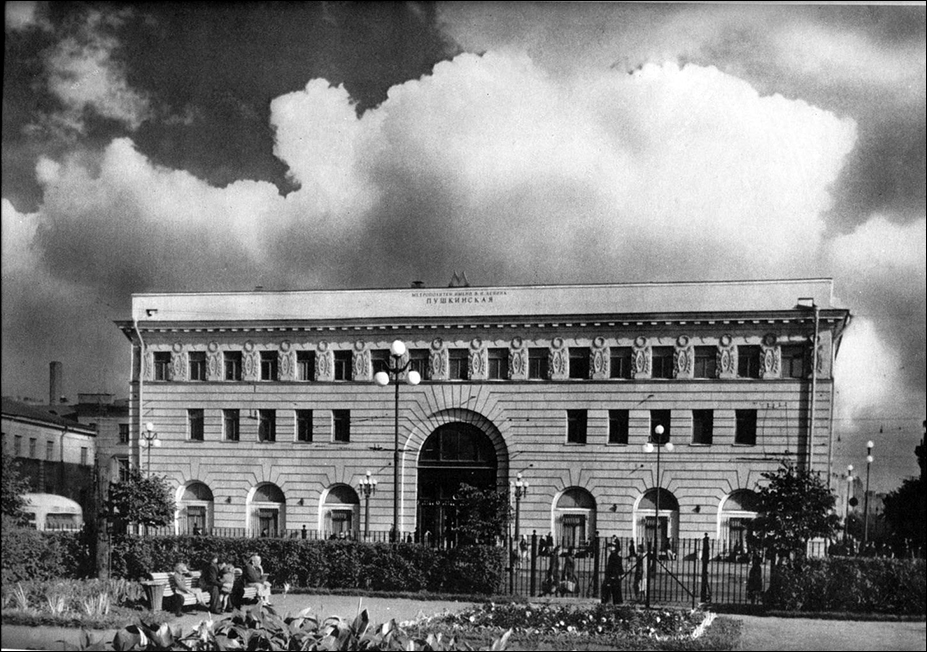
The authors of the above-ground vestibule are architects A.A. Grushke, A.S. Getskin, and V.P. Shuvalova, and structural engineer S.M. Epstein.
Andrey Alexandrovich Grushke graduated from the Leningrad Institute of Municipal Engineers, where one of his teachers was the famous architect E.A. Levinson, who later became his co-author in designing the "Avtovo" station and many other buildings, including the complex of buildings at the station square in the town of Pushkin (including the railway station itself), completed for the 150th anniversary of A.S. Pushkin’s birth.
Aron Solomonovich Getskin worked for over three decades in the architectural department of "Lenmetproekt," participating as author or team leader in the design of many metro objects. For example, he was entrusted with the architectural design of the "Avtovo" depot and the above-ground vestibule of "Pushkinskaya" station in collaboration with Shuvalova. Later, Getskin repeatedly collaborated with Valentina Petrovna, and in total participated in the creation of at least 32 metro stations in our city. He mainly specialized in above-ground vestibules, with the exception of five underground station halls. For the first section of the Moscow-Petrograd line, Getskin developed a standard design for an above-ground vestibule in the form of a round pavilion with an integrated kiosk. Besides above-ground vestibules, he designed vestibules recessed into the ground with underground passage systems and worked on projects of above-ground stations included in railway platform complexes. Above-ground pavilions in those years became more spacious due to increased hall height and full glazing.
Valentina Petrovna Shuvalova worked on metro construction during summer practice in May 1941 (Construction No. 5 NKPS). Since April 1953, she worked at "Lenmetproekt." She usually worked with architect Getskin; together they created vestibules for twenty stations. Their first joint work was the pavilion of "Pushkinskaya" station (1955), then in 1960, the second exit to the Moscow railway station at "Ploshchad Vosstaniya." Valentina Petrovna worked at "Lenmetproekt" until April 1976, when she retired due to age.
Engineer Samuil Mikhailovich Epstein worked at "Lenmetproekt" from 1947 to 1971. Together with colleagues, he justified and implemented "rings of variable rigidity" for station tunnels, which, considering Leningrad conditions, significantly eased finishing in the lower, less stressed part. Besides "Pushkinskaya," Epstein was the structural engineer for "Avtovo," "Baltiyskaya," and "Tekhnologichesky Institut-1" stations.
Along with escalator replacement, the facade of the "Pushkinskaya" vestibule was restored, and restoration work was carried out to preserve decoration and decorative and applied art objects, including historic lighting fixtures and small architectural forms. The most challenging task was to ensure convenient metro access for passengers with limited mobility while preserving the architectural appearance of "Pushkinskaya." The station entrance was equipped with a ramp, the middle impost (the door’s projecting cornice) was completely dismantled, and instead, a double door was installed in the center. The ceiling of the escalator hall, richly decorated with stucco, was cleaned of dirt, and the wall and floor finishes were refreshed.
To dismantle the old escalators and then bring in and install new ones, a large fragment of the escalator hall wall was removed to create a through technological opening oriented toward Zagorodny Prospekt. Considering that the vestibule was built to serve as a bomb shelter and withstand airstrike explosions—you can imagine how hard the metro builders had to work replacing the escalators. The walls are over a meter thick! This explains why some of the vestibule walls have new marble.
This is how the ticket offices looked before reconstruction. The dark stone under the windows was replaced with light marble, and the decorative wooden columns disappeared.
After reconstruction, the ticket office decoration noticeably improved. All castings were restored and brought closer to the original appearance, decorative wooden columns returned, and the lower part was clad with "Spanish Maron Imperial" stone of swamp color with white veins, closest to the original. Near the ticket offices on the wall are triple torch-shaped lamps. The turnstile line is located in a semicircular hall illuminated by cornice lighting. Additionally, the hall is lit by floor lamps placed along the walls.
The hall walls are clad with pinkish "Gazgan" marble. The Gazgan colored marble deposit is located in the Nurata district of Navoi region, Uzbekistan. The Gazgan settlement is on the edge of the Kyzylkum desert, at the western foot of the Nuratau mountains, 90 kilometers from the city of Navoi. Gazgan marble is unique in its decorative properties and has more than thirty shades and colors from white to yellow, pink, bluish-gray, and black. It polishes well and has low abrasion. Gazgan marble decorates many large structures, including some stations of the Moscow, Tashkent, Kharkov, and Baku metros. Currently, the deposit is abandoned, and this type of marble is not mined. The escalator hall ceiling is richly decorated with stucco. Elongated hexagonal coffers narrow and converge toward the center, forming a pattern similar to the vaults of ancient Roman temples. The semicircular hall before reconstruction. Loudspeaker speakers are located behind a grille covered with a decorative metal wreath. Decorative ornamentation of the large arch above the pediment. Above the escalator ascent is a square hall separated from the round one by a pediment resting on columns. Directly above the escalator descent is a bas-relief marble medallion with the profile of A.S. Pushkin, reminiscent of ancient Greek gods and heroes’ gems.
The square hall before restoration, during which the marble was polished and given a fresher look. Originally, the square hall was illuminated by four chandeliers, now dismantled. The bas-relief author is sculptor M.T. Litovchenko, who also worked on the artistic design of the "Narvskaya" and "Mayakovskaya" metro stations.
For escalator lighting, torch-like lamps were used. Such lamps were common in stations of the first metro line.
The station design began at the end of 1946, when it was still called "Vitebskaya" or "Vitebsky Vokzal." The first prize in the architectural design competition for underground stations was awarded to architect V.D. Kirkhoglani, the second to I.I. Fomin and B.N. Zhuravlev. In the second round of the closed competition, projects by O.I. Guryev and V.M. Fromzel, I.I. Fomin and B.N. Zhuravlev, V.D. Kirkhoglani, N.G. Chilingarov and E.I. Chilingarova participated.
For further development, the project by Guryev and Fromzel was recommended, "containing a simple, concise solution and better conveying the character of the Leningrad metro." However, the bronze decorations of the frieze and the treatment of the pylon corners were considered unsuccessful, and the lighting was poorly thought out. Guryev and Fromzel began more detailed work on their project, taking into account the noted comments.
During the work, Nikolai Varfolomeevich Baranov, the city’s chief architect, joined them as a co-author. This proved fatal for the project’s fate. Due to the "Leningrad Affair," Baranov fell into disgrace, and the project with his participation was sharply criticized. It was decided to hold another open competition (third round) for the station project, in which projects by B.N. Zhuravlev, N.V. Baranov, O.I. Guryev and V.M. Fromzel (in two versions), and A.V. Zhuk participated. The first prize was awarded to Zhuk’s project. However, shortcomings of the winning project were also noted: "The presented station project gave the impression of being unfinished and only provided a general idea of the author’s concept. Despite the simple architectural character, the project insufficiently reveals the station’s ideological content and thus does not meet the thematic assignment. The proposed torch decoration is clearly unsuccessful, with a pattern contradicting the station’s overall monumental character."
Perhaps for this reason, simultaneously on the instructions of "Lenmetproekt," architect L.M. Polyakov, who had extensive experience in Moscow metro station construction, began working on the station project. His project, "highly appreciated by the public," was recommended for further implementation. Initially, the pylons were to be decorated with quotes from Pushkin’s works, but this was later abandoned.
Leonid Mikhailovich Polyakov was born on August 21, 1906, in Petersburg. He graduated from the architecture faculty of the former Academy of Arts and was the author of many architectural projects. He participated in the development of the Palace of Soviets in Moscow, designed residential buildings in the current Dorogomilovo district. After the war, Polyakov was the chief architect of Sevastopol, author of the city’s restoration project, turning it into the beautiful city it is today with grand staircases. He also participated in the design and construction of the Volga-Don Canal and many other structures.
Starting to design (together with architect V.A. Petrov) the Saint Petersburg "Pushkinskaya" station, Polyakov already had considerable experience in designing complex engineering structures, including metro stations. "Pushkinskaya" was far from his first metro work. After the death of his teacher, architect I.A. Fomin (also from Petersburg), he completed the design of the Moscow "Ploshchad Sverdlova" station (now "Teatralnaya"). In 1938, the "Kurskaya-Radialnaya" station opened, in 1950 - "Kaluzhskaya" (now "Oktyabrskaya-Koltsevaya"), and in 1953 - "Arbatskaya" of the Arbatsko-Pokrovskaya line, all designed by L.M. Polyakov. The "Kaluzhskaya" station project received the Stalin Prize in 1950. He received another Stalin Prize (together with A.B. Boretsky) in 1949 for the architecture of the 17-story "Leningradskaya" hotel building on Kalanchevskaya Square in Moscow.
Unfortunately, after the start of Khrushchev’s campaign against "architectural excesses," Polyakov fell into disgrace. He was personally held responsible for the architectural "excesses" of the previous era. On November 4, 1955, the CPSU Central Committee and USSR Council of Ministers issued Resolution No. 1871 "On eliminating excesses in design and construction," signed by Khrushchev and Bulganin. Soon followed the decision: "To deprive architects Polyakov and Boretsky of the Stalin Prize laureate title… To oblige the Moscow City Executive Committee to dismiss Polyakov from the position of head of the Architectural Workshop of the 'Mosproekt' institute for allowed excesses and waste of state funds in design and construction and for improper management of construction organizations." Soon he was asked to vacate his four-room Moscow apartment. Fortunately, he was not imprisoned, as many expected. The professional path was closed for the 49-year-old master. In 1958, he managed to get a job as a teacher at the Moscow Higher Artistic and Industrial School (former Stroganov School). After Khrushchev’s resignation, Polyakov was again offered work on major projects but refused, saying, "I would like to, but alas, the squirrel has no teeth!" Leonid Mikhailovich died on June 19, 1965, and is buried in Moscow’s Novodevichy Cemetery.
Together with L.M. Polyakov, the Saint Petersburg architect Vasily Alexandrovich Petrov (1916–1992) worked on the "Pushkinskaya" station project. He also graduated from the architecture faculty of the Academy of Arts. In Polyakov’s team, Vasily Alexandrovich was involved in the restoration of Sevastopol; some residential buildings on Bolshaya Morskaya Street were built according to his project. He also worked with Polyakov on the Volga-Baltic Shipping Canal project, but after Stalin’s death, the construction was frozen. Later, the canal was built according to another project. For a long time, Petrov was the chief architect of Leningrad; it was on his initiative that Palace Square was paved with granite and the Ruski portico, demolished during the construction of the "Nevsky Prospekt" metro station, was restored.
There are three Pushkin stations in the Saint Petersburg metro; monuments to the poet are installed at "Pushkinskaya" and "Chyornaya Rechka," and Alexander Sergeyevich is depicted in a mosaic in the above-ground vestibule of the "Spasskaya" station.
The name "Pushkinskaya" is the most common among metro stations in the post-Soviet space. Besides Saint Petersburg, there are "Pushkinskaya" stations in Moscow, Minsk, Kharkov, and Tashkent.
Sources:
https://design.wikireading.ru/15484
Andrey Mikhailovich Zhdanov: Saint Petersburg Metro. Metro Legends, Projects, Architects, Artists and Sculptors, Stations, Above-ground Vestibules
Andrey Mikhailovich Zhdanov
https://www.mirmetro.net/spb/01/18_pushkinskaya

