Sadovaya St., 20, Saint Petersburg, Russia, 196621

The Pavilion of the Three Graces is an architectural structure on the terrace of the Empress Maria Feodorovna’s Private Garden in Pavlovsk Park. The pavilion was built according to a design by Charles Cameron in 1801 and became the architect’s last work. The terrace where the pavilion is located was Emperor Paul I’s favorite place for work and relaxation. From here, there was a view of the Mariental Pond. In 1801, architect Shreter, following Cameron’s drawings, built the pavilion, thus completing the perspective of the garden’s central alley. The structure was situated in such a place that it could be clearly seen from the Common Cabinet on the first floor of Pavlovsk Palace or from the boudoir of Maria Feodorovna’s ceremonial enfilade.
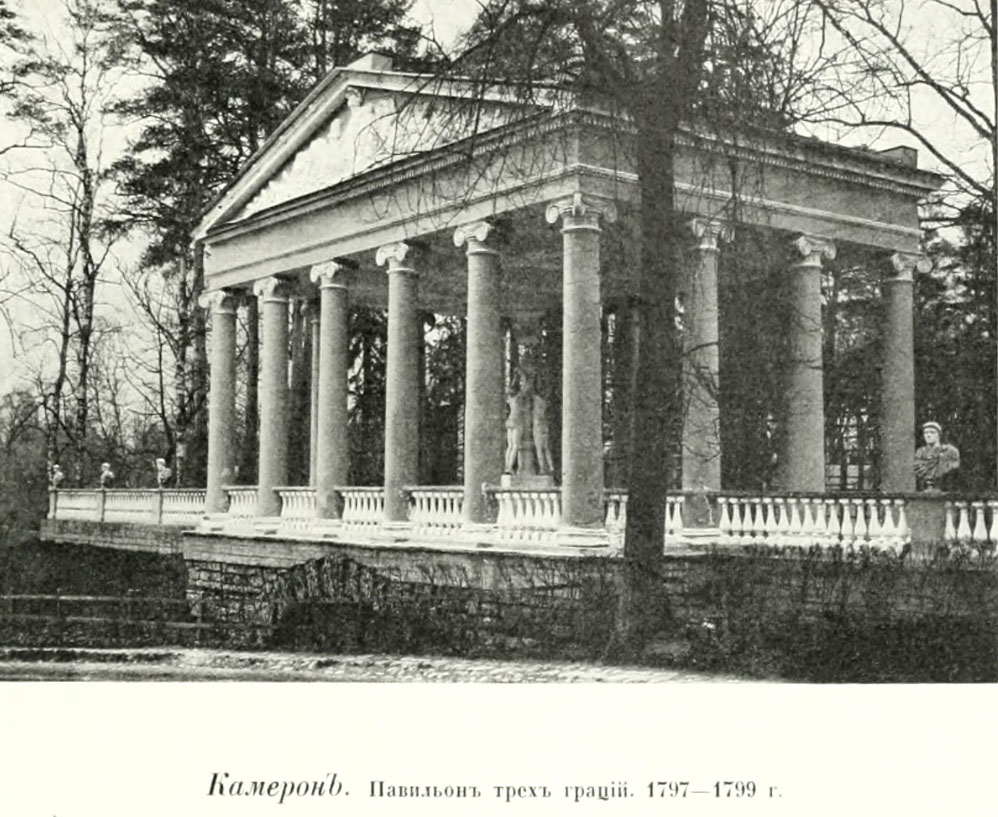
The pavilion is a 16-column Ionic order portico. The pediments feature bas-reliefs with figures of Apollo with a lyre, surrounded by attributes of the arts, and Minerva with emblems of strength and glory (sculptor Prokofiev). The ceiling is decorated with acanthus leaf rosettes executed in high relief.

In 1803, a sculpture titled "The Three Graces" was installed in the center of the pavilion, created by the Italian sculptor Paolo Triscorni from a single piece of Carrara marble. The sculpture depicts the Graces as slender female figures supporting a vase standing on a column. Sculptor Triscorni made a copy of a work by Antonio Canova. Emperor Alexander I gifted it to his mother. The Three Graces were patrons of the beautiful and sublime: Euphrosyne (joy), Aglaea (splendor), and Thalia (happiness). The appearance of the sculpture gave the pavilion its name.
During the Great Patriotic War, the sculpture was successfully buried for safekeeping. On January 24, 1944, Pavlovsk was liberated by the Red Army. Restoration of the park began immediately. The sculpture was unearthed using topographical plans as a guide.
In the mid-1950s, the pavilion was restored.
Sources:
https://www.citywalls.ru/house25730.html
https://pavlovskmuseum.ru/about/park/layout/36/1131/
https://ru.wikipedia.org/wiki/Павильон_трёх_граций

