The most impressive structure is the Acropolis, whose well-restored foundation measures 160 meters in length and 59 meters in width. It is the tallest structure in the Ek-Balam archaeological zone, standing 32 meters high. It looks completely different from other Maya pyramids in the Yucatán due to the rooms with leaf roofs located on its sides. Some of these rooms are open to visitors, and original stucco sculptures have been preserved under these roofs.
The pyramid-palace has six levels, where governors and the elite lived. At the entrance stands a monstrous figure with the open jaws of a jaguar, guarding the entrance to the underworld.
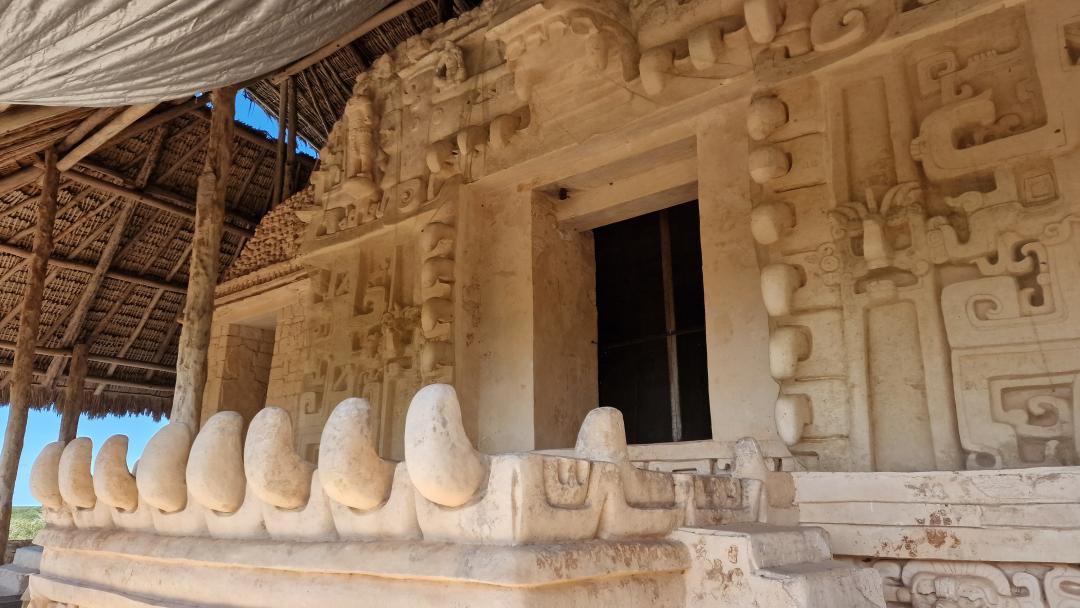
They protect the entrance to the royal tomb and the White House of Reading. A thousand years ago, this was the political center of the surrounding world. Ek-Balam is unique because sculptural plaster and limestone were used in the construction of the Acropolis and the decoration of its facade. The royal tomb, built by order of one of the city’s last kings, is guarded by a huge winged creature on both sides of the entrance to what the Maya called the ‘other world.’ The Maya did not believe in angels, so why wings? There are two different theories, one of which is that the winged monster is a combination of all earthly creatures. They could have been angels, but apparently, the Maya did not believe in angels. They could have been Maya warriors with supernatural abilities. Or they could have been creations of artists influenced by seafarers from around the world who brought knowledge from distant lands. Winged creatures are often found in Hindu and Buddhist architecture. Another explanation is more fascinating.

These winged creatures may have been ancestors, as they have pigeon-toed legs and other deformities that were a sign of royal power. The deformities were the result of inbreeding among members of the royal family and were considered special. The king is guarded by six intricately carved figures, some winged, some meditating in the lotus position, and one sitting headless above monster-like fang teeth of the Flower Mountain guarding the tomb entrance. When archaeologists broke open the sealed mouth of the monster, they discovered the remains of the tomb of Ukit Kan Le’ Tok, who ruled Ek-Balam from 770 to 802 AD. He was laid out on a jaguar skin with more than 7,000 treasures: a golden frog, religious items, jewelry, jaguar claws, knives, clay vessels. It is believed that other kings are buried under piles of rubble beneath his tomb.
Perhaps the White House of Reading is the place where they kept their calendar—one of the most complex in the world. The Maya calculated every solar and lunar eclipse up to the year 2012. Or maybe, using the 800 different hieroglyphic symbols they created to denote words or syllables, they recorded and read about everyday life around the White House.
Below the mouth are stucco skulls, and above and to the right is an incredibly expressive figure. The stucco in Ek-Balam is unique and quite original for the following reasons: In most other Maya ruins, sculptures are carved from stone, and stucco sculptures are hard to find. Ek-Balam in Mexico is one of the places that can boast excellent stucco. Among these stucco figures are winged warriors, which have long intrigued historians.
In some rooms of the Acropolis, wall paintings have been preserved to this day. These paintings depict various scenes from Maya mythology, as well as highly stylized hieroglyphs.
Sources:
https://www.storiesbysoumya.com/travel-guide-ek-balam-mexico/#Ek_Balam_Pyramid_or_The_Acropolis
https://mayaruins.com/ekbalam/j1_1477.html
https://wandererwrites.com/exploring-ek-balam-through-decades/


