pl. Ostrovskogo, 1, Saint Petersburg, Russia, 191023
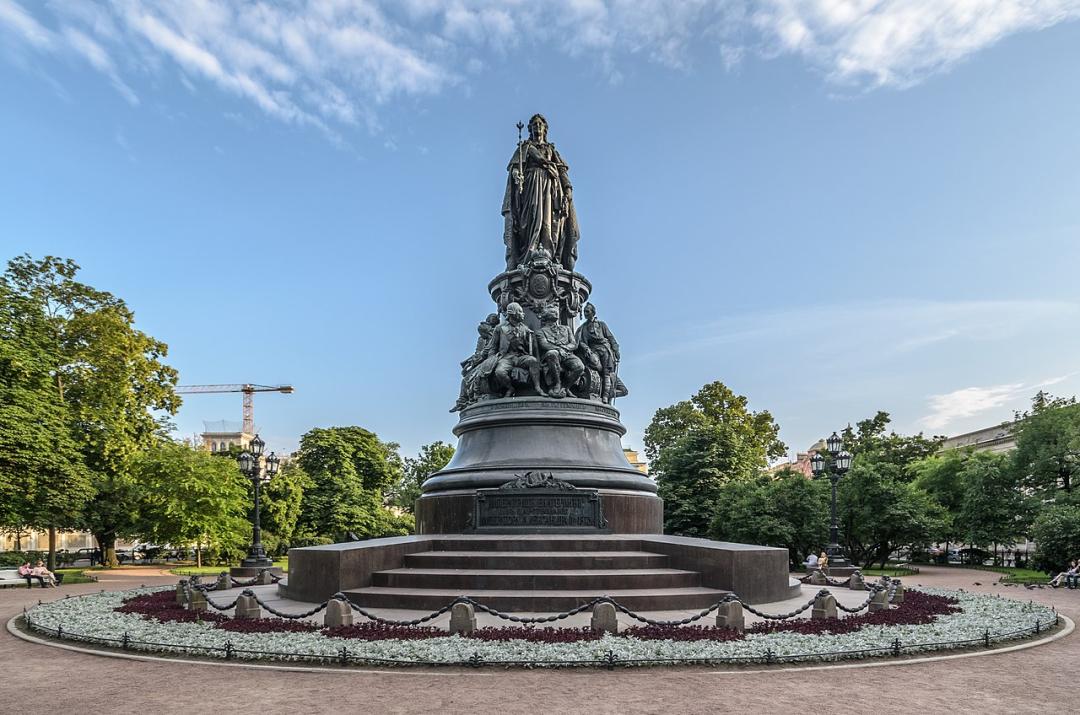
The idea of erecting a monument to Catherine the Great belonged to Chancellor Gorchakov. One day, he lamented to Alexander II that it was impossible to see a single sign in the capital reminding one of the reign of his crowned great-grandmother. After some time, it was decided to erect a monument to Catherine in Tsarskoye Selo, a place she loved dearly.
The monument model depicted the empress holding a lyre, although Catherine was remembered by posterity not for a penchant for poetry, and the size of the monument was rather small – it resembled one of the many sculptures in the Tsarskoye Selo park more than a monument to a great empress. When the tsar asked Gorchakov’s opinion about the monument, the chancellor answered frankly: “Your Majesty, this may be enough for a family name – but not enough for the country.”
The proposal to install the monument in St. Petersburg came from the grandson of the great commander and the city’s governor-general, Prince A.A. Suvorov: “in the square opposite the Alexandrinsky Theatre in Saint Petersburg, opposite the Public Library, the establishment of which belongs to the wise empress.” The monument model was designed by the artist Mikhail Mikeshin. The sculpture of the empress was executed by Matvey Chizhov, and the figures placed on the pedestal were by Alexander Opekushin. The entire work on creating the monument was supervised by architect David Grimm, who was also the author of the pedestal design and the laurel wreath around its base.
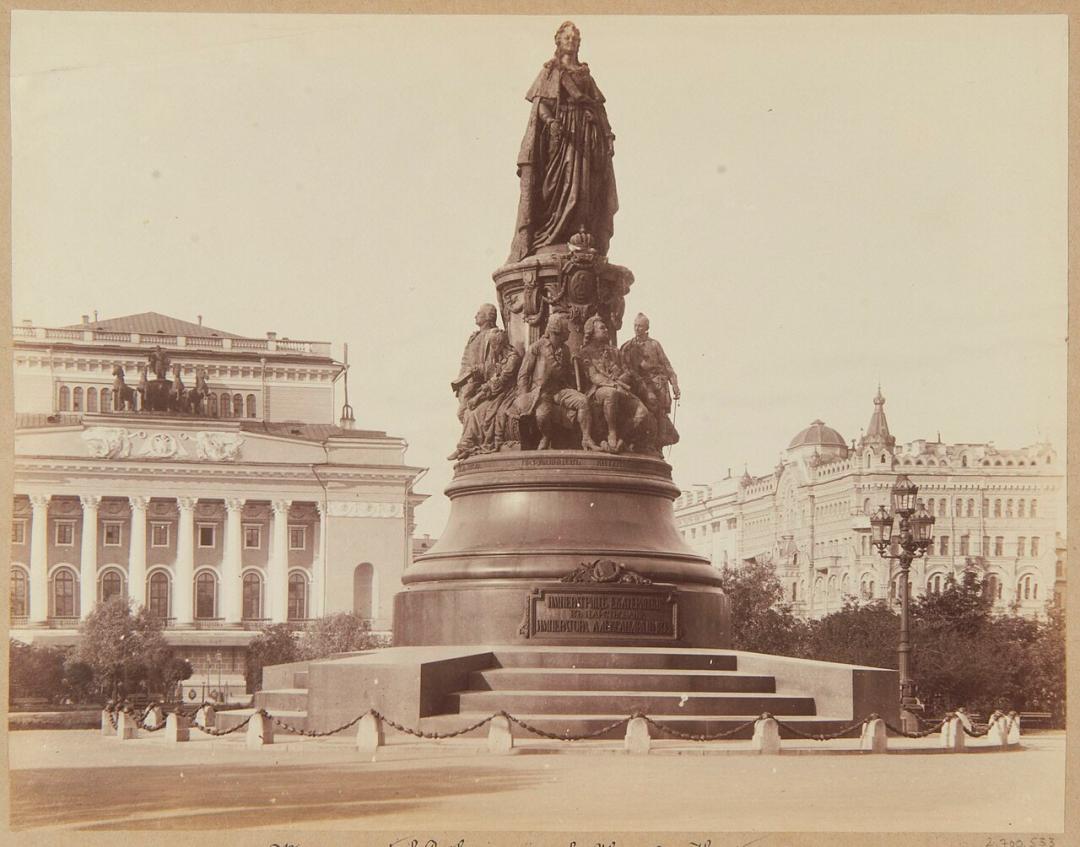
The bronze figure of Catherine II holds a scepter and a laurel wreath in her hands; an ermine mantle falls in folds from her shoulders, and at her feet lies the crown of the Russian Empire. The empress is depicted with the posture of a supreme personage, yet without severity and with a slight smile on her face. The Order of Saint Andrew the First-Called is visible on her chest.
Around the pedestal are nine figures of prominent figures of the Catherine era: Field Marshal P. Rumyantsev-Zadunaysky, statesman Potemkin, and commander Suvorov face Nevsky Prospect; poet Derzhavin and president of the Russian Academy Dashkova face the Anichkov Palace; Prince Bezborodko and president of the Russian Academy of Arts I. Betskoy face the Public Library; polar explorer and naval commander Chichagov and statesman Orlov-Chesmensky face the facade of the Alexandrinsky Theatre. On the front facade of the monument is a bronze plaque decorated with attributes of science, arts, agriculture, and military affairs. On the book standing among these attributes is the word “law” and the inscription: “To Empress Catherine II during the reign of Emperor Alexander II, year 1873.”
The events of the last years of Alexander II’s reign — in particular, the Russo-Turkish War of 1877–1878 — hindered the plan to expand the memorial to the Catherine era. D. I. Grimm developed a project to erect bronze statues and busts of figures from the glorious reign in the square next to the monument to Catherine II. According to the final list approved a year before Alexander II’s death, six bronze sculptures and twenty-three busts on granite pedestals were to be placed next to the monument to Catherine.
The monument bears resemblance to the Millennium of Russia monument located in Veliky Novgorod, which is no coincidence, as both were designed by Mikhail Mikeshin. Its similarity to the monument to Catherine II in Krasnodar should also be noted; that was one of the sculptor’s last works.
There is a legend that during the ceremony of laying the monument’s foundation, one of the ladies threw a ring into the pit. Following her, many guests at the celebration began removing rings, earrings, and pendants and throwing them into the excavation pit. Allegedly, during Soviet times there was a plan to conduct excavations under the monument to find valuables, but it never went beyond discussions.
The monument model, made at a scale of 1/16 of the actual size, was acquired for the Tsarskoye Selo palace and is located near the Cameron Gallery, at the entrance from the Hanging Garden in Tsarskoye Selo. The foundation laying of the monument in the center of the square on Alexandrinskaya Square took place on November 24, 1869, in the presence of Alexander II and members of the imperial family. The monument was unveiled in 1873.
The pedestal is made of granite brought from the Karelian Isthmus: the lower part from the Putsalo quarries, the base and cornice from gray granite from the Yanisari quarries, and the pedestal from dark gray granite from the Sneskesalmi quarry. The figures of the associates were cast at the “Nikols and Plinke” bronze foundry in Saint Petersburg. The main statue of the monument with its bronze base is mounted on a granite dome. The production of the monument and four candelabra required 3,100 poods (50.8 tons) of bronze. The height of the figure of Catherine II is 4.35 meters. The total height of the monument exceeds 10 meters.
The granite was transported by water from the Karelian Isthmus to the Neva embankment near the Summer Garden, and from there — by a special portable railway made at the San-Galli factory — delivered to the site. The cost of constructing the monument amounted to 316,000 rubles, and together with the production of commemorative medals, the organization of the opening ceremony, and the rearrangement of the square — 456,896 rubles. About 200 trees were planted around it. The monument was built over more than 10 years — from 1862 to 1873.
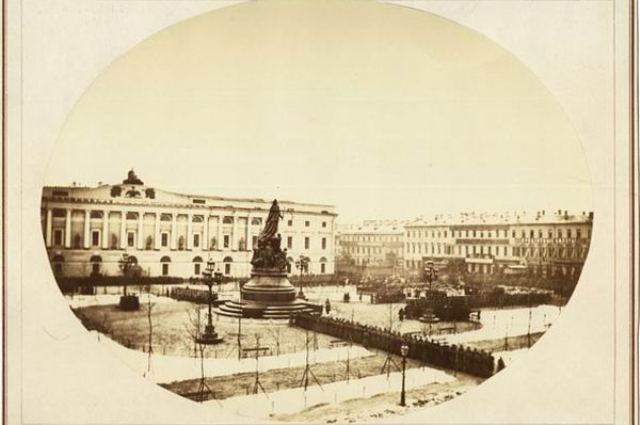
Its consecration took place on November 24 (December 6), 1873.
Wits say that the bronze figures of Catherine’s favorites around the pedestal on the monument to Catherine demonstrate the size of their endowments with gestures. Only Derzhavin spreads his hands guiltily. Above them towers the majestic licentious empress with a sly smile and a scepter-standard in her royal hands. In reality, among those depicted on the monument, the only favorite of Catherine (according to some sources, even her secret husband) was G. A. Potemkin.
At the beginning of the 20th century in Petersburg, a somewhat indecent rhyme was popular:
Where such a lady stands,
Behind whom lies drama,
On the left — enlightenment,
On the right — entertainment,
And in front, not everyone has access?
This refers to the Alexandrinsky Theatre located behind the monument, the Public Library to the empress’s left, and the Anichkov Palace, where balls were often held, on the other side. And in front, “not everyone has access” — this is the Eliseevsky store, whose goods were not affordable for everyone.
The monument to Catherine is the most unfortunate monument in the city. Sculptural details (bronze chains, orders, swords) constantly disappear from it; shards of glass bottles have even been found on the empress’s head by restorers. In the late 1960s, vandals tore and stole the sword from Alexander Suvorov’s hands. It was reproduced twice — attempts on the sword continue to this day. In the 1990s, a multi-kilogram chain and order were stolen from the bronze chest of the empress, and various accessories were stolen from the dignitaries sitting at Catherine’s feet. For example, Suvorov once again lost his sword. The vandals were caught red-handed, and during the last restoration in 2003, the items were returned to their places. Once, Catherine was even spotted in a striped sailor shirt holding a bottle. It is said that drunken sailors did this.
Since December 1988, the Catherine Garden has been under state protection. From 1989 to 2001, reconstruction was carried out here with a fundamental rearrangement and the restoration of the layout that existed in 1878.
Sources:
http://www.peterburg.biz/samyie-tainstvennyie-kladyi-sankt-peterburga.html
https://www.hellopiter.ru/Monument_to_Catherine.html

