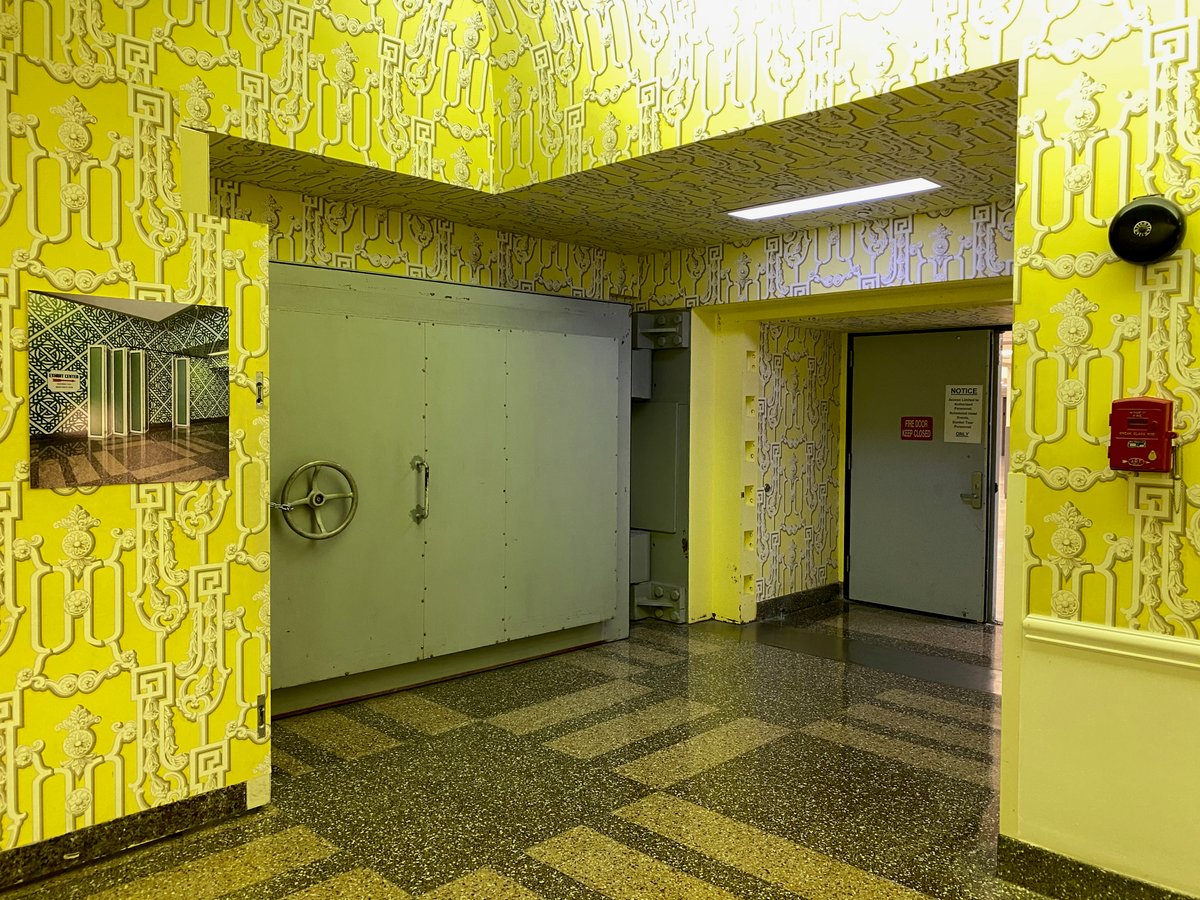

Project Greek Island, formerly code-named "Project Casper," was a secret United States government continuity program located at the Greenbrier hotel in West Virginia. The facility was decommissioned in 1992 after the program was exposed by The Washington Post. It is now known as the Greenbrier Bunker, a historic Cold War bunker that remains open for public tours.
In the late 1950s, the United States government approached The Greenbrier resort to create a secret emergency relocation center for the United States Congress. Built from 1959 to 1962 at the same time as the West Virginia Wing, the underground facility was constructed using a cut-and-cover method. To avoid detection, the material removed from the surface was used to expand a 9-hole golf course and as fill for a runway extension at a local municipal airfield.
The underground facility contained a dormitory, kitchen, hospital, and a broadcast center for members of Congress. The broadcast center featured changeable seasonal backdrops to make it appear as if Congress were broadcasting from Washington, D.C, supported by a 100-foot radio tower installed 4.5 miles away. The largest room is "The Exhibit Hall," measuring 89 by 186 feet with a ceiling nearly 20 feet high and supported by 18 columns. It was accompanied by two smaller auditoriums with seating for about 470 and 130 people, respectively.
Hidden within the bunker were work areas with four blast doors, two of which were large enough for vehicles to enter. One door weighed more than 28 short tons and measured 12 feet 3 inches wide and 15 feet high. The two-foot-thick walls were made of reinforced concrete. Although the bunker was kept stocked for 30 years, it was never actually used as an emergency location, even during the Cuban Missile Crisis. Today, the facility is used as a data storage facility for the private sector.
Sources: Wikipedia, OpenStreetMap, Wikidata, Wikimedia Commons
Written by Friendly Jane
Discuss this with the author and others
No comments yet. Be the first to start the conversation.