Kremlin, 4B, Nizhny Novgorod, Nizhny Novgorod Region, Russia, 603001
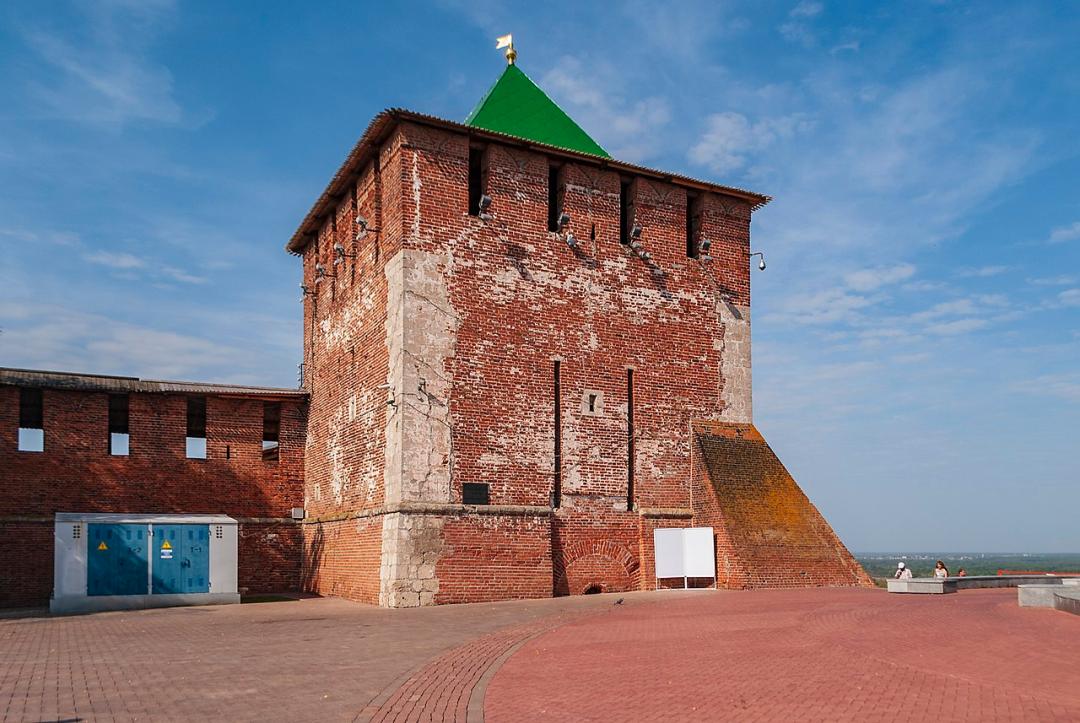
The Georgievskaya Tower (Yegoryevskaya Tower) is the easternmost tower of the Nizhny Novgorod Kremlin. It is located between the Borisoglebskaya and Porokhovaya towers, on the edge of the Volga riverbank, near the monument to Valery Chkalov at the beginning of the Chkalov Staircase. In the 1220s, there was a way station of Georgy ("Georgievsky Terem") here, on the edge of the slope.

The tower dates back to the 16th century. It was named after the nearby Georgievskaya Church in the posad (which has not survived), or after the Georgievsky Terem — the palace of the city’s founder. In 1785–1786, it was converted into a storage facility with openings made between the battlements.
According to the Nizhny Novgorod historian Khramtsovsky, the Georgievsky church was distinguished by elegant exterior architecture in the Renaissance style and rich interior decoration. The church’s main pride was a five-tier gilded iconostasis, ancient icons of the Smolensk and Jerusalem Mother of God Odigitria, several Gospels from the 16th–17th centuries, and silverware.
Since the Georgievskaya Tower is located above a steep cliff, its walls are reinforced with "bulls" — powerful supporting structures. On the outer side of the fortifications, two through slits are visible — traces of the chains that lifted the drawbridge. In the past, the tower had passage gates, but by the 17th century they were no longer used. According to the 1622 land survey book, the gates were closed "with iron grilles and there is no bridge from the city." The corner passage leading inside the Kremlin prevented the possibility of continuous enemy fire on the fortress. The tower has four tiers, with its lower floor, located below the level of the passage gates, almost filled with earth. Within the thickness of the walls of the first tier, three combat chambers are equipped: two facing the Volga cliff, and one facing the Porokhovaya Tower.
The tower is a square, four-tiered structure. The lower tier of the tower is currently almost entirely underground, connected to the upper tier by a system of passages with staircases built into the thickness of the adjoining wall section. The central room of the tower (the main chamber) is isolated from these passages and used to be a through passage before the gates of the Georgievskaya Tower were tightly closed with a dropping grille. The gates were protected by a complex system of obstacles — the enemy had to overcome a long wooden bridge, then a drawbridge in the form of a heavy shield, which in the vertical position (5.3 meters) closed the gate opening (3.52 meters high). The drawbridge mechanism has been preserved almost unchanged to this day. The passage through the tower was bent at an angle, preventing direct line-of-fire. In the side walls of the main chamber, combat fireplaces are built.
The third tier has four combat chambers, and the fourth tier is the battlement with merlons. Through vaulted passages arranged in the thickness of the wall section adjoining the Georgievskaya Tower, communication is established between the first and third tiers, whose combat fireplaces face all four directions. The upper tier consists of battlements pierced with loopholes. In the 18th–19th centuries, the Georgievskaya Tower was used as a storage for state grain and gunpowder supplies. During the 1953 restoration, the tower’s tented roof was restored.
In 1943, construction began and was completed in 1949 of the monumental Chkalov Staircase from the monument to Valery Chkalov, installed next to the Georgievskaya Tower, down to the Volga.
In 1953, the tower was restored, during which the tented roof of the tower was rebuilt.
Sources:
https://ru.wikipedia.org/wiki/Борисоглебская_башня_(Нижний_Новгород)с
https://putidorogi-nn.ru/evropa/455-georgievskaia-bashnia-nizhegorodskogo-kremlia

