3V97+R8 Svetogorsk, Leningrad Oblast, Russia

According to legend, the Finnish Count Rausavi built the estate for his family between 1894 and 1896. As was customary at the time, music often resounded in the house, and balls and celebrations were held. Shortly after moving in, the count began constructing a hydroelectric power station on the Vuoksa River. He invited many workers who settled nearby. One day, his son Kaarl, while walking along the Vuoksa shore, met a beautiful girl named Ansa, the daughter of a builder. Love blossomed between them…
However, Kaarl kept silent about the fact that his father was the very Count Rausavi. Their relationship continued until Ansa found out the truth herself. Then the girl demanded the blessing of his parents, but Kaarl was unable to obtain it. The couple, heartbroken, threw themselves off a cliff into the Vuoksa River.

Since then, this place has been called the "Lovers' Rock." It is located a few kilometers from Svetogorsk. According to another myth, if you make a wish and throw an apple from the cliff into the river, the wish will definitely come true.
In reality, this stunningly beautiful former estate belonged to industrialist Karl Oskar Eugen Wolf and is called Aholan kartano (Ahola Estate), built by the outstanding architect Uno Werner Ullberg, the chief architect of Vyborg, between 1921 and 1923.
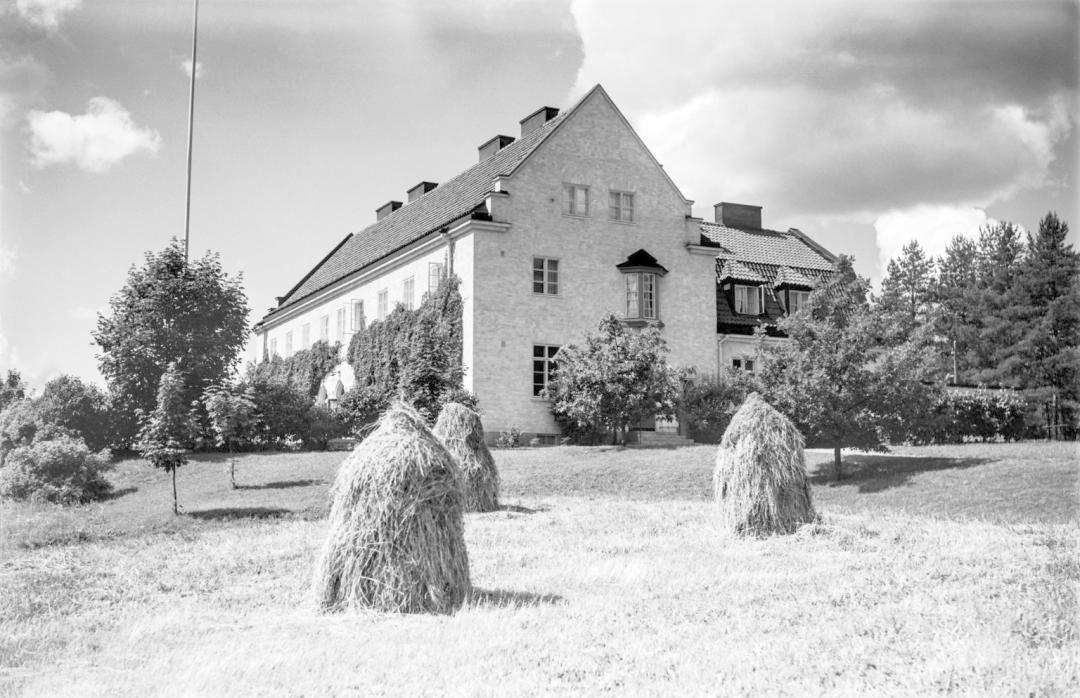
It is also known as the house of Consul Wolf. The fashionable style of the time was "Northern Modern" or "Nordic Classicism." The steep double-pitched tiled roof of the main building and the tiled roof of the side part, shaped like a "French mansard," give the building an element of a medieval castle. This spirit is further enhanced by the design of the porticos and entrance doors. On the side is a very original bay window, also in the Art Nouveau style. A characteristic feature is the use of local granite in the construction of the house — for the steps and the plinth. Two perfectly shaped granite spheres decorated the entrance portico; one of them, fallen from the porch, is visible in the photo.

Above the entrance door is a relief coat of arms with the letter "R" (Rouhiala). Rouhiala is the name of a place in the Jaaski county, and this name was also given to the waterfall on which the hydroelectric power station was built. The building itself is called by the Finns Aholan kartano, meaning the Ahola estate (aho — field, meadow).
Karl Oskar Eugen Wolf (1851–1937) was an industrialist, property owner, and philanthropist who contributed to the study of the history of Vyborg Castle. His name is associated with the founding of the Society of Art Lovers in Vyborg; he was its first chairman, donated money for its existence, and financially supported artists. He also served as the English vice-consul.
During the Soviet-Finnish War, the house was under the supervision of a manager who left after the fighting approached closely. The house was occupied by Finnish soldiers. The entire peninsula is still riddled with trenches and foxholes. After the Great Patriotic War, the house stood empty for eight years. From 1953 to 1968, the first reconstruction of the building was carried out, and it housed a children's sanatorium. Despite this, elements of luxury remained in the estate: amazing oak ceilings, a grand staircase, and tiled fireplaces.
For more than a hundred years, the old Finnish estate "Ahola Hall" has welcomed guests. Everyone who has ever been to this house loved it and enveloped it with their warmth. Remembering this soulful and captivating place, one wants to return here again and again.
http://mo-svetogorsk.ru/city/history.php
Valery Bogdanov, Svetogorsk: Created by Uno Ullberg. Ahola Estate

