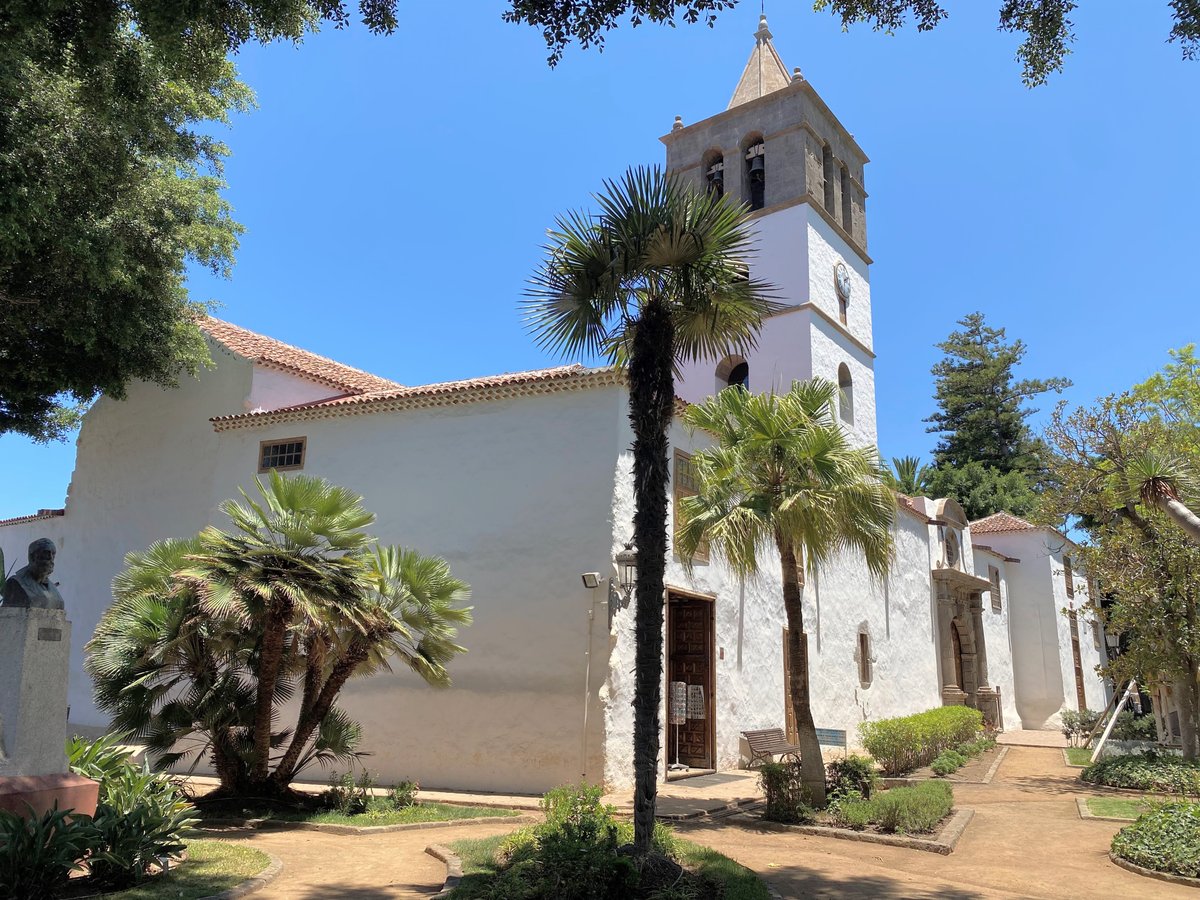

The parish church of San Marcos Evangelista, located in Icod de los Vinos on the island of Tenerife, is the most important religious construction in the region. Its origins date back to a small hermitage built around 1500, which was elevated to the status of a parish in 1515. The building was declared a monument of cultural interest in 2006. The interior features a rectangular plan with three naves and eight chapels. The naves and chapels are separated by half-point arches that rest on columns with smooth shafts and simple capitals.
The naves and chapels are covered with mudéjar artesonados. These include the central nave, the Capilla de las Ánimas - which is ribbed and lined with painted boards in the Portuguese style - and the presbyterium. The presbyterium artesonado is in a rectangular tray-like shape with carved, gilded and polychromed casetones. It is separated from the central nave by a balustrade, rising above a gallery that holds a silver manifestor from La Laguna. At the foot of the temple is a low choir, located in the lower part of the tribune, with a beautifully carved frontispiece.
On the south side, the main entrance is one of the best-finished examples of Mannerism in the Canary Islands. It features a half-point arch with diamond-point decoration and a prominent volute-shaped bracket. Two columns with striated shafts and Tuscan capitals frame the opening. Above the arch, the decorative entablature includes an architrave and a frieze with triglyphs and metopes, with a winged cherub's head on the vertical of the bracket. A cornice gives way to an oculus symmetrically framed by rollos, topped by a curved pediment.
The exterior is completed by a tower with four superimposed bodies. The lower body, of massive appearance, is joined to the Epistle nave, while the two intermediate bodies feature half-point arches. The final body, designed for the bells, was built exclusively in carved stone in an exquisite classicism. The church houses a rich collection of imagery, including works by Martín de Andújar Cantos and the anonymous gothic statue of San Marcos. It also holds a small museum at the foot of the temple containing the great silver cross commissioned by Nicolás Estévez Borges. The church is located on the square of the same name, and the former female convent of San Juan Bautista and San Bernardo once stood in this space, though no remains of it survive.
Sources: Wikipedia, OpenStreetMap, Wikidata, Wikimedia Commons




Written by Mutabor
Discuss this with the author and others
No comments yet. Be the first to start the conversation.