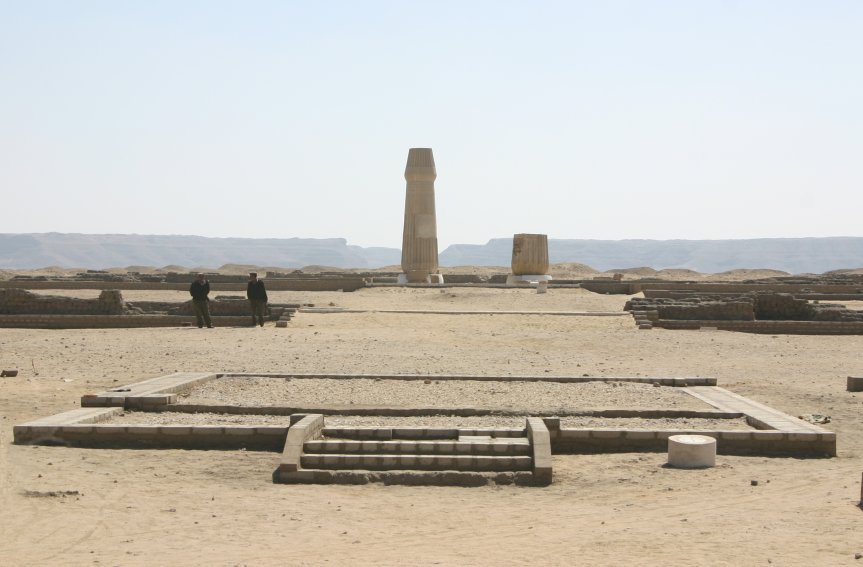

Located in the central part of the ancient Egyptian city of Amarna, the Small Aten Temple was originally known as the Hwt-Jtn or Mansion of the Aten. It is one of the two major temples in the city, the other being the Great Temple of the Aten. Situated next to the King's House and near the Royal Palace, it was probably constructed before the larger Great Temple. Like other structures in the city, it was built quickly, making it easy to dismantle and reuse its materials for later construction.
The structure was surrounded by a large temenos enclosure wall made of large bricks measuring 37 x 19 x 14.5 cm, enclosing an area of 127 m by 200 m. On the eastern end, remains of flower beds were found, and an avenue of trees separated the temple from surrounding buildings. The main entrance was from the west, through two massive brick pylons, each with slots for two flag poles. A find of a ring bezel bearing the name 'Ankhkheperure' dates this to the reigns of pharaohs Smenkhkare or Neferneferuaten.
A ramp of whitewashed mud led down into the first court, which appears to be the oldest part of the complex. This area was paved with mud plaster and contained a large altar of mudbrick, which was later demolished to ground level.
The southern pylon had a small priest's house attached to it. The sanctuary court was surrounded by trees on the eastern side and contained several buildings, including a small brick building in the southeast corner. In 1994, concrete replicas of the papyriform columns were assembled in their original position in front of the inner sanctuary court. These replicas were based on fragments found in the 1931 excavation by the Egypt Exploration Society.
Sources: Wikipedia, OpenStreetMap, Wikidata, Wikimedia Commons
Written by Mutabor
Discuss this with the author and others
No comments yet. Be the first to start the conversation.