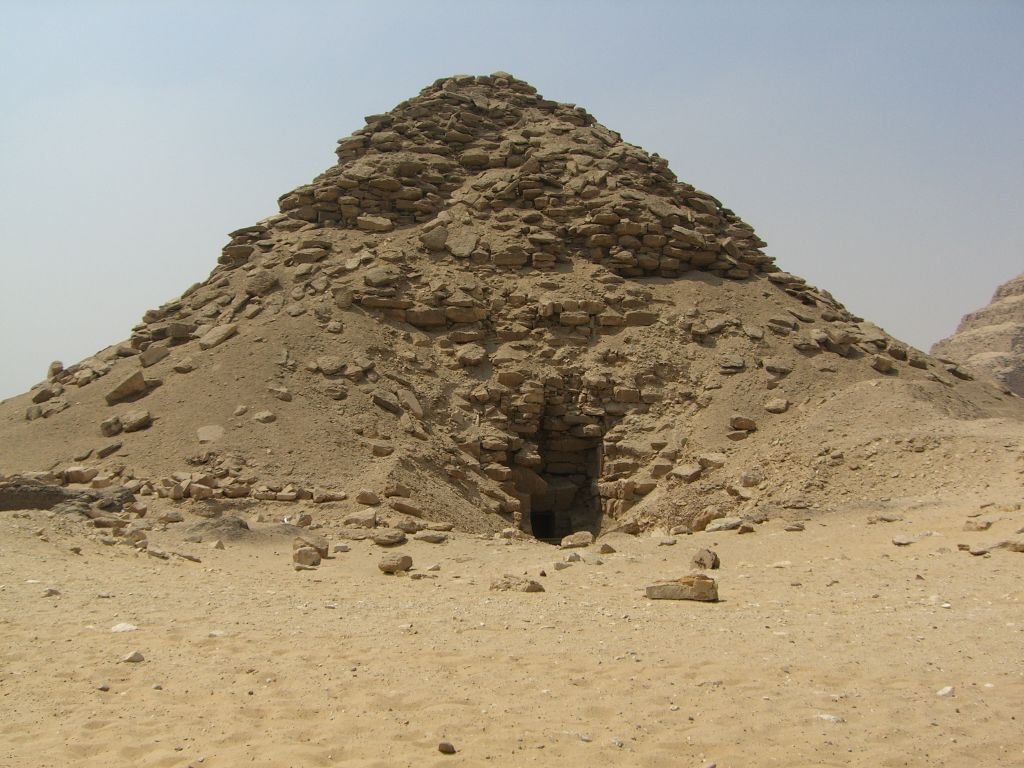

The pyramid complex of Userkaf was built for the pharaoh Userkaf, founder of the 5th Dynasty of Egypt (c. 2494–2345 BC). It is located in the pyramid field at Saqqara, to the north-east of the step pyramid of Djoser. Constructed with a core of rubble and dressed stone, the pyramid is now ruined and resembles a conical hill in the sands. For this reason, it is known locally as El-Haram el-Maharbish, the "Heap of Stone", and was recognized as a royal pyramid by western archaeologists in the 19th century.
The entrance of the pyramid was discovered in 1831 by the Italian Egyptologist Orazio Marucchi but was not entered until 1839 by John Shae Perring, who took advantage of an existing tunnel dug into the pyramid by tomb robbers. Perring did not know for sure who the owner of the pyramid was and attributed it to Djedkare Isesi, a late 5th dynasty pharaoh. After his investigations, Perring buried the robbers tunnel which remains inaccessible to this day.
The pyramid was then neglected until October 1927, when Cecil Mallaby Firth and the architect Jean-Philippe Lauer started excavating there. During the first season of excavation, Firth and Lauer cleared the south side of the pyramid area, discovering Userkaf's mortuary temple and tombs of the much later Saite period. The following year, Firth and Lauer uncovered a limestone relief slab and a colossal red granite head of Userkaf, thus determining that he was the pyramid owner. While the pyramid core was constructed in a step-like structure, the outer casing was made of fine Tura limestone to give it an appearance similar to the glorious 4th Dynasty pyramids.
Sources: Wikipedia, OpenStreetMap, Wikidata, Wikimedia Commons
Written by Mutabor
Discuss this with the author and others
No comments yet. Be the first to start the conversation.