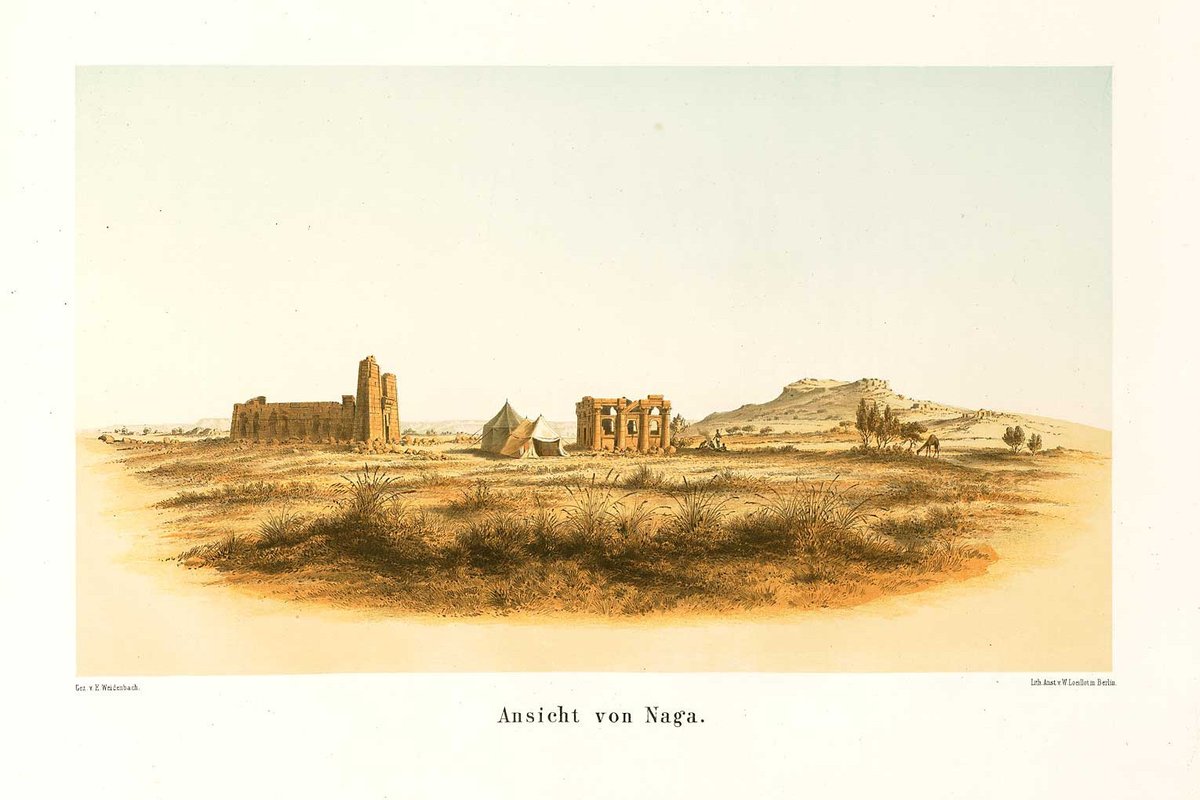

Naqa is one of the largest ruined sites in Sudan, marking the location of an important ancient city of the Kingdom of Meroë. Situated about 170 km (110 miles) north-east of Khartoum and about 50 km (31 miles) east of the Nile River, the site held strategic importance as a trading station. It was located only a camel or donkey's journey from the Nile, where smaller wadis meet the Wadi Awateib.
As a center of the Kingdom of Meroë, Naqa served as a bridge between the Mediterranean world and Africa. The site is part of the Island of Meroe, alongside Meroë and Musawwarat es-Sufra, and was listed as a UNESCO World Heritage Site in 2011. The archaeological site contains several Meroitic temples dating from the 4th century BC to the 4th century AD, with two of the largest and most significant structures being the temples of Amun and Apedemak.
The temple of Amun was founded by King Natakamani and is constructed of sandstone. It features an outer court and a colonnade of rams, leading to a hypostyle hall. To its west lies the temple of Apedemak, a lion-headed warrior god worshipped in Nubia who served as a sacred guardian of the deceased royalty. Near these temples stands a Roman kiosk, a small temple with Hellenistic elements including Corinthian capitals and arched windows, which recent excavations suggest was probably devoted to the worship of Hathor.
Sources: Wikipedia, OpenStreetMap, Wikidata, Wikimedia Commons
Written by Mutabor
Discuss this with the author and others
No comments yet. Be the first to start the conversation.