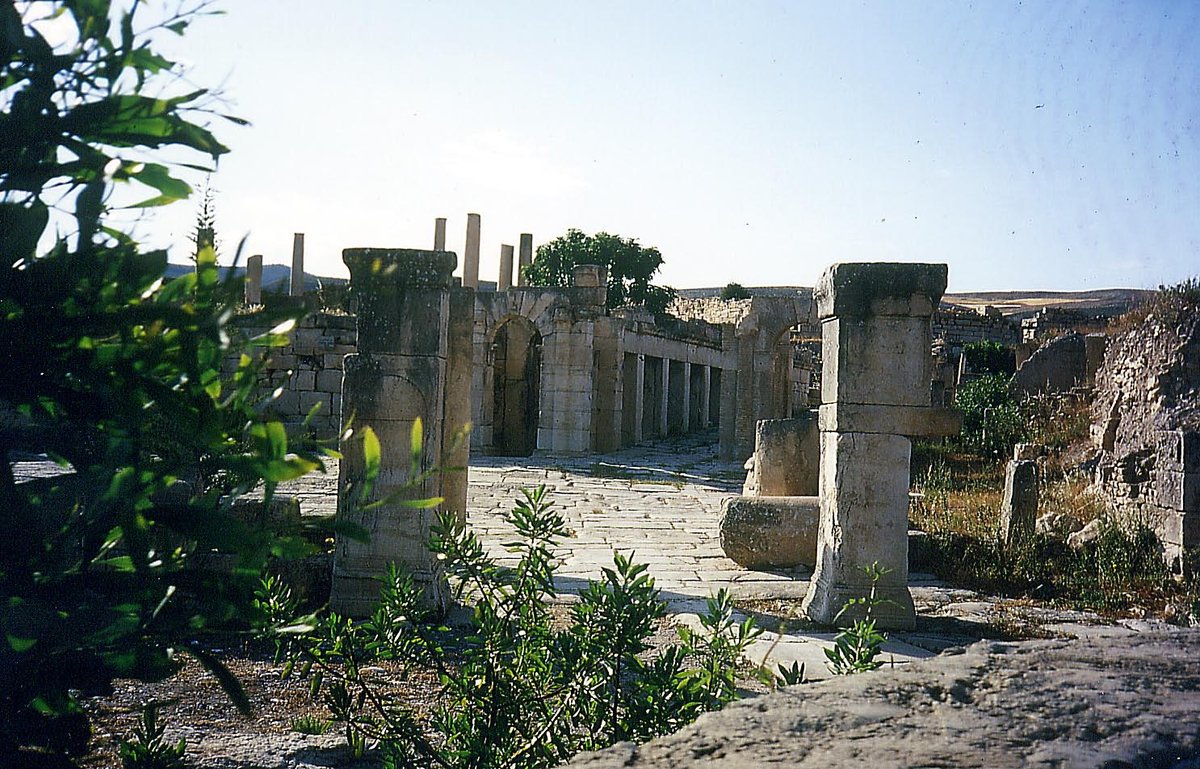

In the northern region of Tunisia, the ruins of Mustis stand as a significant site of the Roman era. Located along the road between Carthage and Tebessa, the town's limits were established in 238 by two triumphal arches. While the sources do not state who founded the city, they record that Roman general Gaius Marius settled his veterans there toward the end of the 2nd century BC. At a later time, the town was elevated to the rank of a municipium by either Julius Caesar or Marcus Aurelius.
The town was later transformed into a Byzantine stronghold during their struggles against the Vandals, which altered its original appearance. Today, the site remains partially excavated. Visitors can see remains of the forum, the marketplace built in white calcareous stone, several temples, cisterns, a Byzantine citadel, and a number of Roman houses. There is also a church containing a baptistery.
Three specific temples have been identified at Musti, dedicated to Ceres, Pluto, and Apollo. One of these temples was converted into a basilica during the 4th century. The entrance to the site opens onto a large paved yard leading to a gateway with a covered walkway and shops for moneychangers. Over 200 Latin inscriptions have been catalogued, including votive inscriptions to Minerva and Neptune, as well as a boundary stone from the reign of Antoninus Pius.
Sources: Wikipedia, OpenStreetMap, Wikidata, Wikimedia Commons
Written by Mutabor
Discuss this with the author and others
No comments yet. Be the first to start the conversation.