MFQC+48 Pushkinsky District, Saint Petersburg, Russia
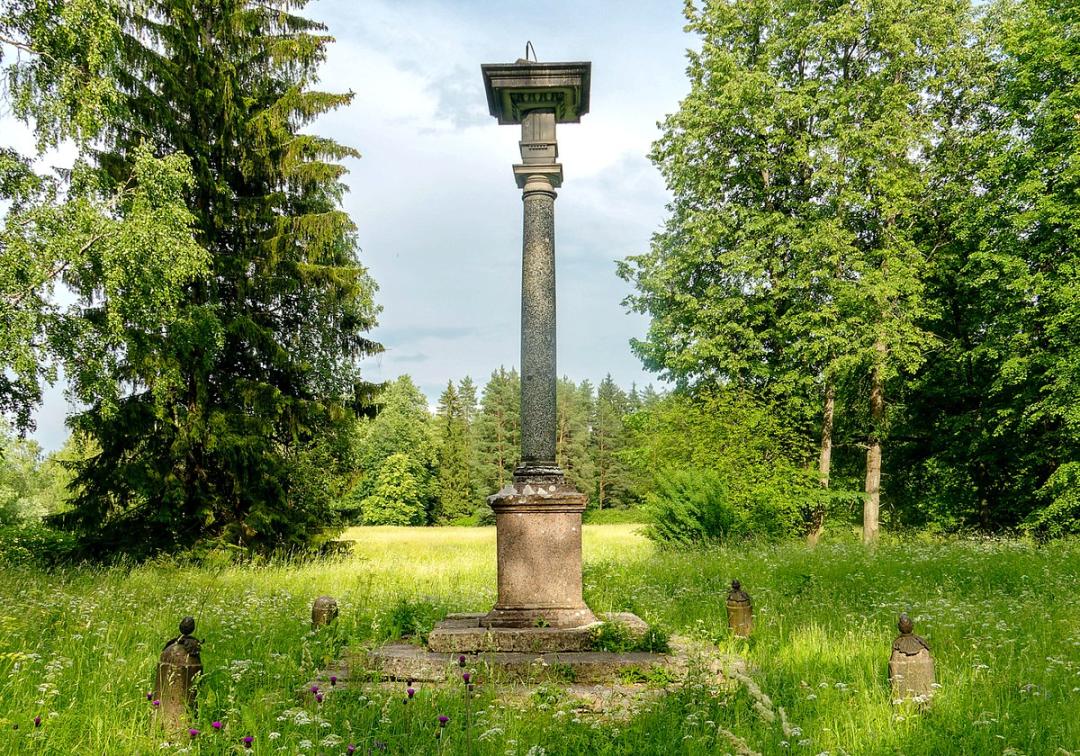
The Column of Princess Liven in Pavlovsk Park – a marble column on the peninsula between the Rose Pavilion ponds – was once crowned with a metal sphere and installed on a red granite pedestal, surrounded by posts that remained from the fence. It "looked" toward the Konstantinovsky Palace located opposite, which was completely destroyed during the Great Patriotic War.
The column was erected between 1803 and 1813. By the way, not far from the column, in the center of the Rose Pavilion pond, there is an island dedicated to Princess Liven. Charlotte Karlovna Liven became the only woman in Russia who earned the titles of countess and princess through her own efforts.
Who was Princess Liven, to whom the Russian imperial family showed such respect? Charlotte Karlovna Liven, née Baroness Haugbreben, came to St. Petersburg at the invitation of Catherine II in 1783, when Paul I and his wife Maria Feodorovna had their first daughter – Alexandra. The Empress took the upbringing and education of her grandchildren very seriously, paying the closest attention, of course, to the heir to the throne. Charlotte Karlovna was to take charge of raising the grand duchesses, who, although having no chance for the throne, would sooner or later become wives of sovereigns in the best houses of Europe.

Portrait of Charlotte Karlovna Liven. Artist J. Dow. 1821, collection of the State Russian Museum
The intelligent, energetic, and just 41-year-old widow Liven managed to organize her work so well that she earned the unconditional trust of Catherine II. When, after the birth of a series of daughters in Paul I’s family, a third son was born, the future Nicholas I, Baroness Liven headed the staff responsible for caring for the infant. Charlotte Karlovna (one of the few) managed to maintain her position at the court of Paul I, who ascended the throne. She developed excellent relations with Paul’s wife, Maria Feodorovna, who, after the death of the sovereign mother-in-law, finally gained the right to decide matters related to the upbringing and education of her own children.
Despite the difficulty of the duties entrusted to her, thanks to her great intelligence, firmness of character, tirelessness, and exceptional energy, Baroness von Liven immediately earned the trust of the Empress, as well as the favor of Grand Duchess Maria Feodorovna, and established a strong position at court. She exerted great influence on the upbringing not only of Paul I’s daughters but also of the grand dukes – the future Nicholas I and Mikhail Pavlovich.
Russian historian and publicist Prince Dolgorukov notes in his St. Petersburg sketches that on the night of Paul I’s assassination, Princess Liven did not lose her composure. With unshakable calm, she woke her wards – the five children of the murdered emperor: Maria, Ekaterina, Anna, Nicholas, and Mikhail; dressed them, ordered the carriage to be prepared, demanded a military escort, and under the escort’s protection took them to the Winter Palace. From that moment, Charlotte Karlovna ceased to be just a subject and became, so to speak, a member of the royal family; the grand duchesses kissed her hand, and when she kissed the hand of Maria Feodorovna, the Empress pretended as if she wanted to bring Charlotte Karlovna’s hand to her lips, which, of course, Charlotte hastened to withdraw.
Nicholas I called Charlotte Karlovna Liven "respected and beautiful," "a model of incorruptible truthfulness, justice, and devotion to her duties... whom we loved dearly" in his memoirs. Many nobles, admiring her firmness of character, regretted her belonging to the female sex, which limited the spheres where the governess of the grand duchesses could manifest herself.
By the time of her retirement in 1799 by decree of Paul I, Charlotte Karlovna Liven was elevated with her descendants to the rank of countess, and by the coronation of Nicholas I – to princess, later receiving the title of Serene Highness.
For faithful service over nearly half a century, she received numerous awards. When Pietro Gonzago worked on landscaping the park in the Parade Field area between 1803 and 1813, the island created in the center of the Rose Pavilion pond was named after the then Countess Liven.
In 1816, on the occasion of the wedding of Charlotte Karlovna’s ward, Grand Duchess Anna Pavlovna, and Prince of Orange, the Temple of Love – an arch with eight columns – was erected on the island, which has not survived to this day.
A ferry crossing led to the island; now only sad steps remain. The marble column, installed in memory of the governess of the imperial children on the peninsula between the Rose Pavilion ponds, also looks gloomy.
By the end of her life, her relations with the imperial family hardly resembled a business collaboration. Charlotte Karlovna was more of an influential grandmother than a court lady. Malicious tongues whispered that her private rooms became the center of palace intrigues, and the princess allowed herself to use her position at court, responding to requests from envoys of foreign states and Russian loyal subjects who were foreigners.
Whether this was true or not is unknown for certain; in history, Charlotte Karlovna Liven remains remembered as a brilliant governess, in whose honor two landmarks of Pavlovsk Park are named: both the island and the column.
Charlotte Karlovna Liven died in 1828 in Pavlovsk and was buried in her ancestral estate Mezotene (today part of Latvia).
Sources:
https://ru.wikipedia.org/wiki/Ливен,_Шарлотта_Карловна

