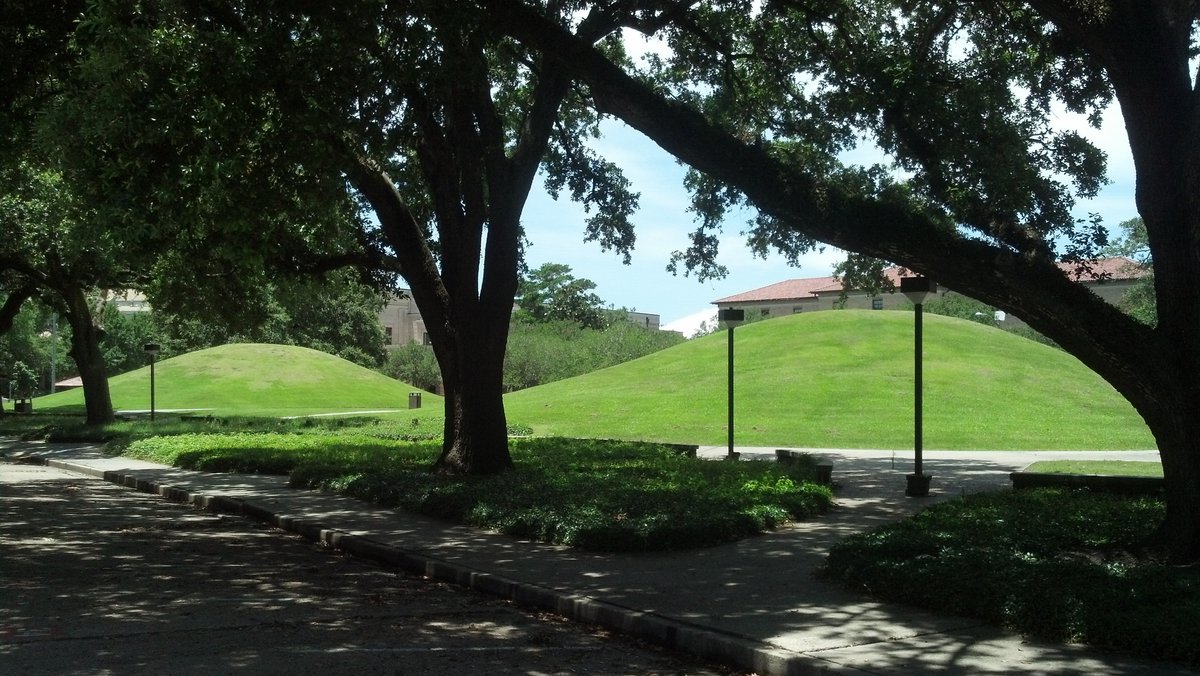
The LSU Campus Mounds are two Native American mounds of the Archaic Period located on the campus of Louisiana State University in Baton Rouge, Louisiana. Standing 20 feet tall, the construction on these mounds began more than 11,000 years ago and may have continued until 5,000 years ago. They are part of a larger, statewide system of mounds and predate the Great Pyramids of Egypt.
Scholarly consensus suggests the mounds were used for ceremonial and marking point purposes rather than for burial. The northern mound consists of hard clay dirt, while the southern mound is more porous. In 2009, LSU professor Brooks Ellwood took core samples that revealed a layer of charcoal. Based on his analysis of the material found within the mounds, Ellwood conjectures that they contain cremated human remains and are as much as 11,300 years old.
Due to their location in a heavily trafficked area, the mounds have faced degradation and erosion. To preserve them, the university installed a sidewalk in 1985 and a low brick wall to prevent vehicles from crossing the site. A restoration project in 1996 used river silt to patch damage on both mounds and seeded them with hybrid Bermuda grass. The mounds were listed on the National Register of Historic Places on March 1, 1999, and are now fenced off during home football games to prevent damage.
Sources: Wikipedia, OpenStreetMap, Wikidata, Wikimedia Commons
Written by No Other
Discuss this with the author and others
No comments yet. Be the first to start the conversation.