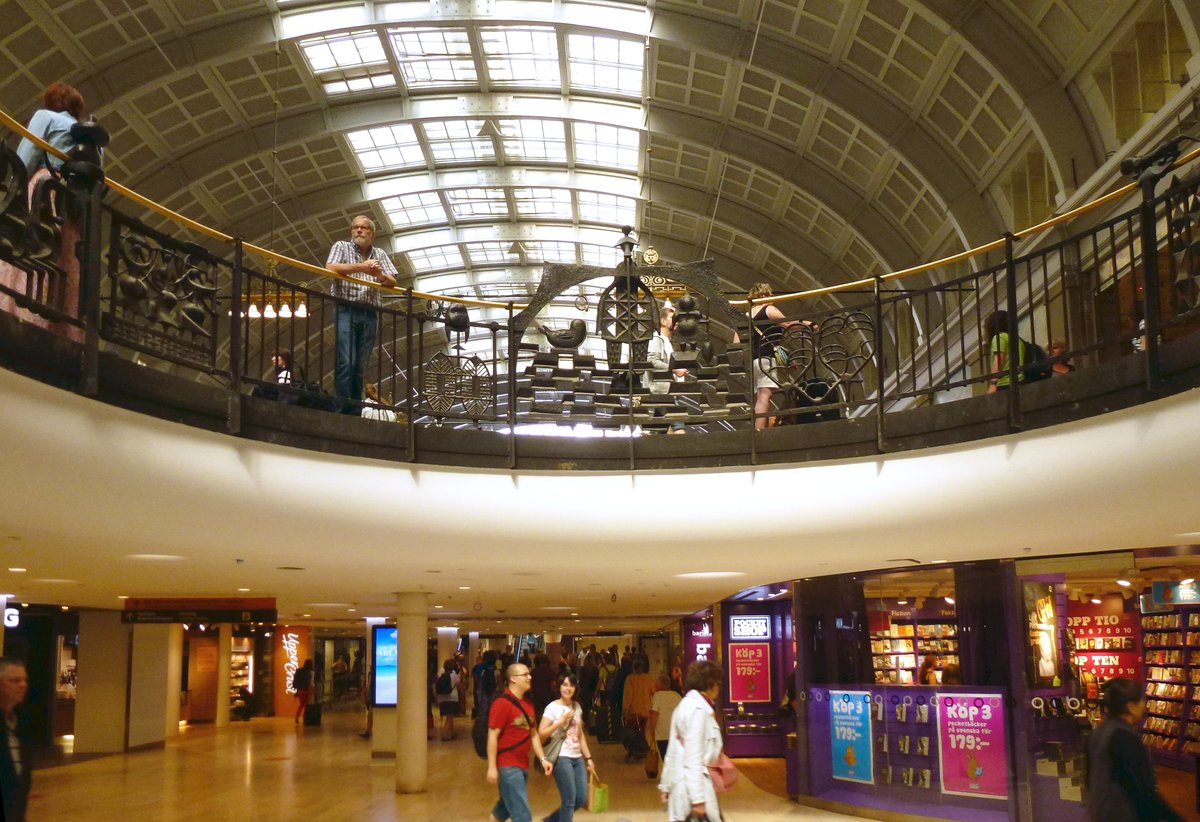

The circular opening in Stockholm's Central Station, known as The Ring, leads down to the lower tunnel station, T-centralen. It was opened in 1959 and its railing forms a smith work of art created by sculptor Stig Blomberg. The pedestrian tunnel connecting T-centralen with tracks 11-19 was built in 1958. As the tunnel was constructed, the pedestrian tunnel was extended into a smaller waiting hall with shops and dining areas under the main Central Hall, according to designs by Karl-Axel Bladh at Statens Järnvägars arkitektkontor.
The Ring, unique and fascinating, is situated between the pedestrian tunnel and the waiting hall. Built with a diameter of seven meters, it was designed to create a connection with the lower tunnel. The railing of The Ring is a smith work of art created by sculptor Stig Blomberg and represents the four elements, with figures depicting these. The northern part of the ring features the Aurora Borealis and Eskimos, despite the location, surrounded by depictions of an Eskimo girl, a seal, and drifting snow.
The southern part of the ring shows an African medicine man surrounded by totem poles, a ritual sword dance, and three dancing women. The western part features an alligator god in ancient Colombian folk art, flanked by a settler and an Indian on one side, and two water-carrying Mexican women on the other. The eastern part showcases the Phoenix bird, which bites into the edge of the railing and sits on an Indian temple, surrounded by Indian temple dancers and a demon biting into the railing.
A tiger, which is intended to be reminiscent of primitive Chinese art, balances on the railing on the east. The figures are made of cast iron and the railing's handle is made of brass. The work was a gift from the Swedish Railwaymen's Association to the State Railways for their 100-year jubilee, which was celebrated in 1956.
Sources: Wikipedia, OpenStreetMap, Wikidata, Wikimedia Commons
Written by Nik Frost
Discuss this with the author and others
No comments yet. Be the first to start the conversation.