27A-028, 25, Tishino, Kaliningrad Region, Russia, 238422
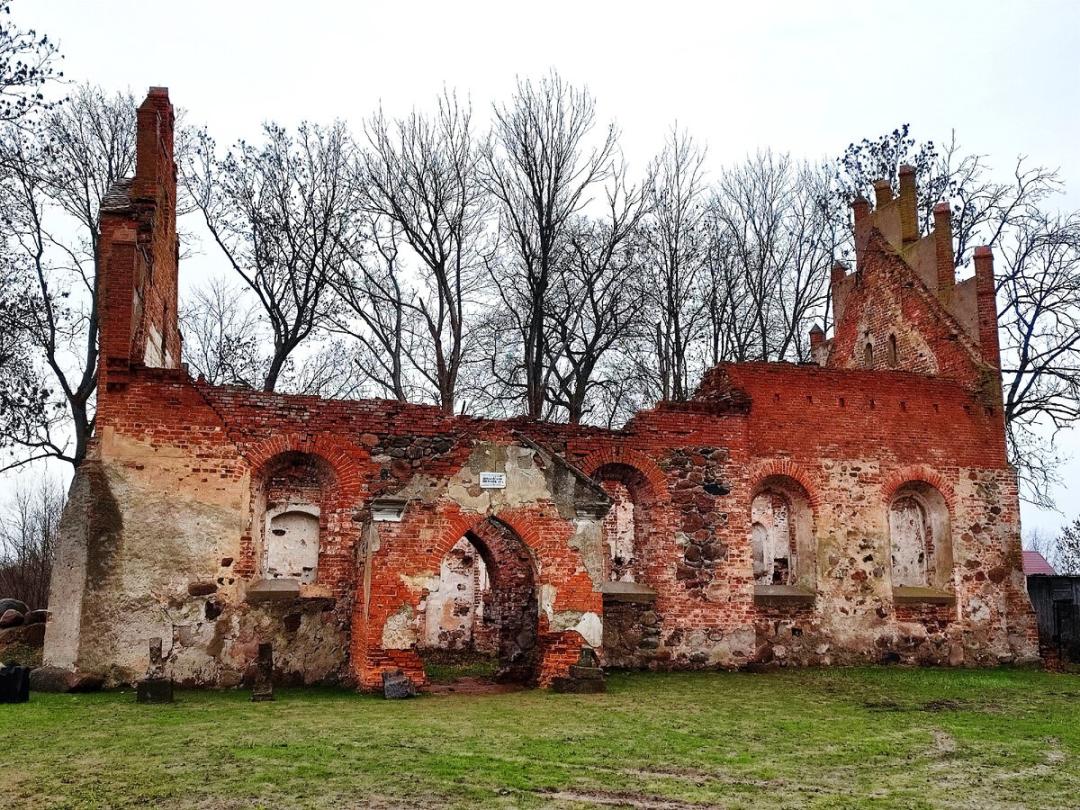
The church in Abshvangen (now Tishino in the Kaliningrad region), a small settlement on the road to Friedland, is first mentioned in the Order's documents in 1369. The word "Abshvangen" itself is not of German origin; it comes from the Prussian language (which belongs to the Baltic language group). Abse – "aspen," wangus – "bush." Historical records reveal that the church belonged to the monastery of the Augustinian hermits of Patollen (now the village of Osokino), founded in 1402 and destroyed during the Reformation. This small church with a choir, built of boulders and bricks, was constructed between 1362-1365 and later rebuilt at the end of the 15th and beginning of the 16th centuries. These lands were revered even by the pagan Prussians. It is said that Romove was located here – one of the main sanctuaries, and even a "magic ring" was found.
After the Reformation, the church became a parish temple. Gradually, the interior was supplemented with wooden figures of saints and traditional benches for parishioners. In 1711, a small organ appeared in the church, and in 1728 – a carved altar by the famous master Isaac Riga.

In 1858, the church was reconstructed in the Neo-Gothic style – walls were extended, the gables were complemented with turret pinnacles, and the church received a new roof and ceiling, which have survived to this day. A tall wooden bell tower was erected on a stone foundation – before this, apparently, there was none, and the church retained an archaic appearance (many medieval churches were built without bell towers – these were added in later centuries).
As a result, the church represented a patchwork "hodgepodge" of materials and forms: an elongated nave made of boulders with brick window inserts, a pointed arch entrance, a narrow presbytery with a low ceiling, and a simple wooden tower, a small organ with galleries painted in a "peasant style," and a gilded altar.

The tower became a true "constant" on all postcards and photographs of that time.
In August 1914, when the First World War was just gaining momentum and Russian troops were confidently advancing into East Prussia, Cornet Golynsky moved toward Abshvangen in search of a separated cavalry division. He did not complete his mission: the car was fired upon by unknown assailants, and the cornet was killed. The accompanying driver and clerk miraculously escaped alive – they drove out of the street, blocked by carts with straw, firing backward. Suspicion fell on local residents with hunting rifles, and wishing to suppress the "partisan" struggle at its root, Russian commander A.N. Dolgorukov ordered an immediate search of all the men in the village. All those found with weapons were mercilessly shot, and their houses were burned down. Very soon, only a few houses remained, and only the tall church tower sadly overlooked the devastated village. About 50-70 people died in the bloody massacre, half of whom were refugees who had found temporary shelter in Abshvangen. The dead were buried in the cemetery near the church along with two Russian officers. Three years later, Empress Augusta Victoria visited the Abshvangen church to honor the memory of the tragedy's victims. In 1925, a poignant monument appeared nearby: a vertical chimney of a burned old house with a stork's nest on top. Bronze plaques contained the names of the dead and a touching poem.
After the 1918 war, the village was rebuilt, and the church remained the main attraction, spiritual, and cultural center of Abshvangen until 1945. After the end of the Second World War, the fate of the monument, like the fate of the entire province, changed dramatically.
Abshvangen was renamed Tishino, a collective farm was established in the village, and the village church was turned into a warehouse. The wooden tower was demolished, the interior was completely dismantled, and the parish cemetery was removed.
Due to careless use and lack of timely maintenance, the church-warehouse soon became dilapidated, and the collapse of the USSR and the economic crisis of the 1990s only worsened the condition of the site.
Unwanted and abandoned, the church finally turned into ruins in 2009 – a fire broke out in the building, causing the roof to collapse, and in this condition, the property was transferred to the Russian Orthodox Church.
In the early 2010s, thanks to the efforts of volunteers, bushes around the church were cleared, and burnt beams were removed. Volunteers from the organization Keepers of Ruins regularly hold cleanup days at the site. The owner does not take any care of the property.
Sources:
https://vk.com/wall-42481124_5121866
https://kenigo.ru/galereya/kirha-abshvangena/
https://russianold.ru/2024/02/03/abschvangen/

