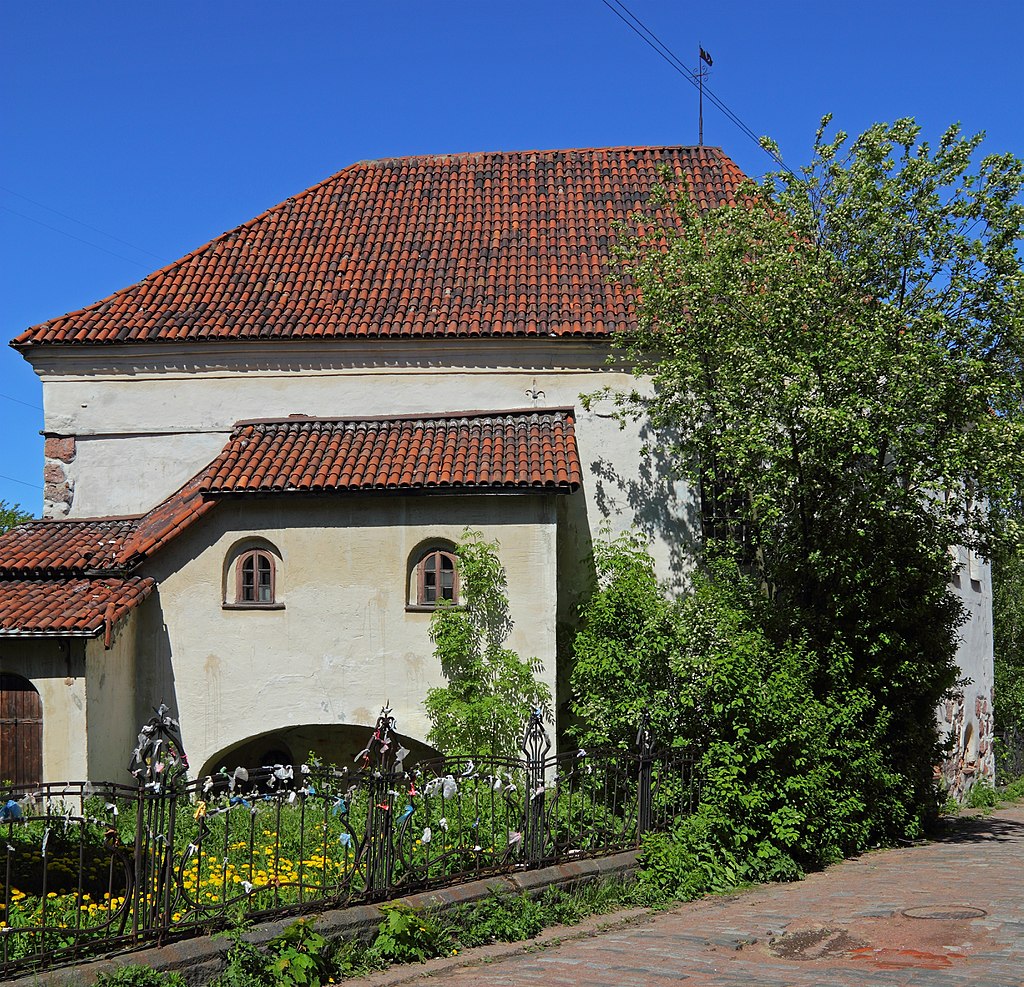
The early construction period of the Gothic building’s initial rectangular volume, made of granite boulders and bricks, is considered to be the late 16th — early 17th century. The oldest part of the current building was built before the city’s redevelopment, carried out in the mid-17th century according to the plan of engineer Thorstenson, which is why it is positioned at an angle to the street’s red line. To this day, even some of the oldest walls remain intact and preserved, which is quite strange since the building was rebuilt many times, and originally there was a simple wooden structure here, which was later replaced by a more durable and solid stone building. The reconstruction affected not only the Old Town but also this small wooden structure, which after the changes received a rather beautiful name — the “Knight’s House,” although the Knight’s House — a noble assembly — was located there for only five years. Much longer, almost one and a half centuries, it was a Catholic parish.
The original appearance of the building represented a peculiar regional variant characteristic of residential houses in Hanseatic cities, formed back in the Late Middle Ages. The first information about the building’s owner dates back to the 1650s: it was Arvid Forstadius, a master of theology and lecturer at the Vyborg gymnasium. In 1679, Forstadius became the pastor of the Lutheran parish of the Vyborg Cathedral and remained so until his death in 1683. After Forstadius, the tenant of the building was the councilman and merchant Jakob Boisman. Then, in 1705, the owner once again became a clergyman — provost (archpriest) Ernst Gestrinius.
This is one of the medieval houses preserved in Vyborg. It consists of two parts — the earlier one, located deep inside, at an angle to the street, and a later extension from the 18th century. In the 15th century, a wooden building stood on this site, belonging to the Franciscan monastery. The monastery itself was located nearby, on Skotoprogonnaya Street (now Progonnaya), and owned several city plots. At the beginning of the 16th century, the building was rebuilt in stone as a monastery school. According to legend, this is where the future Finnish enlightener and prominent Reformation figure Mikael Agricola studied.
In the 16th century, when the Reformation was carried out in Sweden, monasteries, including both Vyborg ones (Franciscan and Dominican), were closed, and the property of the Catholic Church was confiscated.
The monastery school building passed to the magistrate and was sold to the burgher Boisman, who rebuilt it into a residential building. Until the second half of the 18th century, this plot belonged to various German merchant families. Its last civilian owner was Peter Janisch, who lost the plot due to a conflict with the city commandant.
The confiscated house was given to the noble assembly — the Swedish-German “Society of Vyborg Knights” (hence the name Knight’s House), established by Catherine the Great’s decree in 1766 during the provincial reform. A hall for meetings and balls was arranged on the second floor, while the lower floors were used for household needs. But in 1797, a New Town Hall was built on Cathedral Square, and all public events were moved there.
Under Paul I, the Knight’s House was transferred to the military department for organizing a Catholic parish: there were many Poles in the Vyborg garrison. Since 1802, the chapel of Saint Hyacinth was located here. After the Grand Duchy of Finland was annexed to Russia in 1809, the Vyborg Catholic parish became the only one in Finland, since Catholicism had been banned in Sweden since the Reformation. In 1856, the chapel received the status of a Roman Catholic church.
During its time as a church until the 1930s, the building was rebuilt several times. Before the war, it looked like a church with a bell tower and an apse. During the Continuation War, it was also used, and in 1943 wall paintings were even made. In Soviet times, it was used as a warehouse for a long time.
In the 1970s, it was restored and adapted for a children’s art school, stylized as a medieval house; the religious features were removed from its appearance: the bell tower and apse disappeared. The wall paintings were lost as well. However, the interior acquired features of the 17th–18th centuries: ceiling beams, a large fireplace, a staircase with carved details. At the same time, a wrought-iron fence was moved to the monument, which previously surrounded the Old Cathedral.
Currently, the Knight’s House is under the jurisdiction of the Vyborg United Museum-Reserve. It houses an exhibition dedicated to the history of the building and a display of knightly armor.
Sources:
https://gazetavyborg.ru/turistu/osnovnaya-kategoriya/kostyol-giatsinta-rytsarskiy-dom/
https://www.tourister.ru/world/europe/russia/city/vyborg/temples/22939
https://ru.wikipedia.org/wiki/Костёл_Гиацинта