Bolsheokhtinsky Bridge, Bolsheokhtinsky Bridge, Saint Petersburg, Russia, 195112

The Bolsheokhtinsky Bridge across the Neva connects the Central District of Saint Petersburg with the Krasnogvardeysky District (Bolshaya Okhta). It is a three-span structure of a bascule system made of riveted metal constructions with a double-leaf drawbridge span in the middle. The side spans are covered with metal arch trusses with the roadway underneath. The drawbridge span is double-leaf with a fixed axis of rotation. The size of the side spans is 136 meters each, and the drawbridge span is 48 meters.
The total weight of the metal structures is 8,920 tons, including the counterweights of the drawbridge span weighing 1,065 tons. The bridge has two towers 36 meters high from the water level. Large mirrored lanterns were located on the upper platforms of the towers. Inside the towers are the mechanisms of the drawbridge span, and on the outside, memorial plaques with the names of the builders are installed. The bridge supports and the descent to the water are faced with granite.
The bridge lighting consists of 1,300 lamps.
In 1829, when the city’s master plan was being developed, Emperor Nicholas I approved the construction of a crossing near the place where the Okhta flows into the Neva. However, the plan was not implemented, and only a boat ferry was used.
The need to build a crossing began to be discussed as early as the 1820s, but due to lack of funds, the problem was postponed. The discussion about building a bridge, as well as the administrative annexation of Okhta to Petersburg, resumed only in the 1860s. There was a dispute about the location of the future crossing—each industrialist wanted the bridge to be built near his enterprise. The ferry and boat owners were categorically against its appearance—they did not want to lose their jobs.
A joking folk song even appeared:
"From under Smolny to Okhta
The ferry is very expensive.
Oh, how I carried my dear one
In my arms."
Thus, only in June 1884 did the City Council resolve the issue of building a bridge from Smolny Cathedral to the Creighton shipyard: “To recognize the Okhta suburb as subject to annexation to the city of Saint Petersburg.”
In 1860, Okhta was decided to be made an administrative district of the city. At the same time, the “Society of the Okhta Bridge across the Neva” was established. However, there was no consensus on where the bridge should be built: each industrialist argued that the bridge was needed near his enterprise, while the ferry operators, on the contrary, did not want to lose their jobs and obstructed the start of construction.
On June 5, 1887, the City Duma decided to build a bridge from the Smolny Monastery to the Creighton shipyard. But the final decision to build a permanent crossing was made only on January 22, 1900.
In September 1901, the City Duma announced an international competition for the design of the new bridge. Sixteen entries were submitted by engineers from Russia, France, Germany, the USA, the Netherlands, and Austria-Hungary. All projects were rejected for various reasons.
Eventually, a non-competitive project under the motto “Freedom for navigation” was accepted. It was developed by Professor Grigory Krivoshein of the Nikolaev Engineering Academy and military engineer Vladimir Apyshkov. The authors proposed to arrange a drawbridge span in the middle of the Neva channel, with the roadway suspended from the lower part of the bridge arches.
Thus, only in June 1884 did the City Council resolve the issue of building a bridge from Smolny Cathedral to the Creighton shipyard: “To recognize the Okhta suburb as subject to annexation to the city of Saint Petersburg.” Actual construction work began on June 26, 1909, on the eve of the 200th anniversary of the Battle of Poltava. This date easily explains the name of the future bridge—the Peter the Great Bridge—named after the emperor who emerged victorious from this famous battle. The ceremonial opening of the crossing took place on October 26, 1911. When talking about the construction of the bridge, it is important to mention one tragic event that significantly accelerated the process of the crossing’s appearance. On April 7, 1907, a disaster occurred: at the mouth of the Okhta into the Neva, the steamer "Arkhangelsk" sank after colliding with a small ice floe—at least 39 people died.
This tragedy caused a great public outcry, and on May 13, 1907, Nicholas II issued a resolution: “Do not delay the construction of the bridge.” And in September of the same year, the project was approved with minor modifications.
The city signed a contract with the Warsaw factory “Rudzki and Co.” to build the bridge in three years. The construction was supervised by Grigory Krivoshein. The drawbridge mechanism was manufactured by the Petersburg Metal Plant. To transport the spans weighing 3,660 tons each, the hulls of old battleships were used, converted into huge pontoons with water ballasting.
The ceremonial laying of the bridge took place on (June 26) July 9, 1909, a day before the celebration of the 200th anniversary of the Battle of Poltava. Therefore, the bridge was named after Emperor Peter the Great.
The crossing was ceremoniously opened on October 26, 1911, in the presence of the Minister of Internal Affairs of the Russian Empire, Alexander Alexandrovich Makarov. However, some construction work continued until 1913.
There is an interesting urban legend associated with the Bolsheokhtinsky Bridge. It is said that one of its million rivets is golden. The builders placed it for good luck, having previously covered it with a metal film, so to speak, for safety reasons. This myth has neither been confirmed nor, by the way, refuted during the entire existence of the bridge, so you can choose for yourself whether to believe it or not.
Strangely enough, the Bolsheokhtinsky Bridge has much in common with the Eiffel Tower. Both structures are made of metal constructions, with small fragments connected by rivets. Contemporaries criticized the bridge no less than Parisians once criticized the tower. The crossing seemed too bulky and even ugly to them—now the Bolsheokhtinsky Bridge is one of the most beautiful in Petersburg, and the Eiffel Tower has become the main symbol of the French capital.
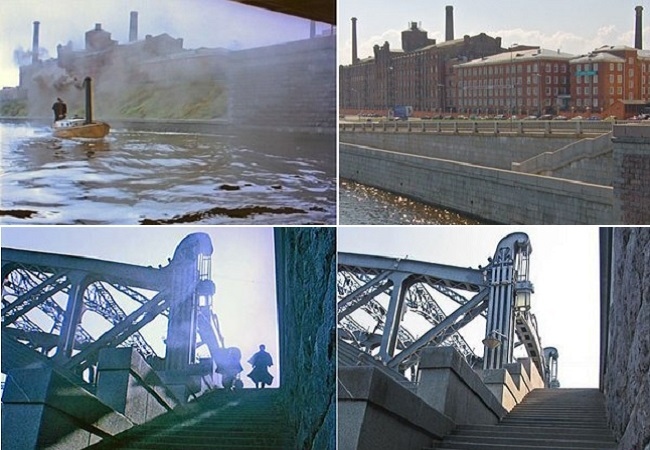
In the outlines of industrial Petersburg, an inexperienced traveler could easily see London.
The Neva was seen as the Thames, and the Bolsheokhtinsky Bridge as the Tower Bridge. This similarity was used by the director of the film "The Adventures of Sherlock Holmes and Dr. Watson," episode "The Treasures of Agra." Key scenes of the film were shot during the White Nights, minimizing the risk of unwanted people and Soviet cars appearing in the frame. Although one local resident turned out to be quite helpful—he rented out his boat. To make it look appropriate, a metal pipe was attached to it, in which straw and diesel fuel were burned, simulating the smoke of a steam engine.
The Peter the Great Bridge became the first bridge on the Neva to provide the greatest convenience for navigation—a three-span structure with a double-leaf drawbridge span in the middle and two spans near the banks. At the time of the bridge’s opening, the side spans were the longest in the city. The bridge is decorated with granite lighthouse towers that illuminate the approaches to the bridge for ships at night.
After the 1917 revolution, the Peter the Great Bridge was renamed Bolsheokhtinsky, and in 1956, according to new spelling rules, it became Bolsheokhtinsky.
Since the bridge’s construction, mainly maintenance work has been carried out. The first repair was done only in 1971. Then, in the early 1980s, when a transport interchange was created on the embankments, the drawbridge span of the bridge was also extensively repaired.
From 1993 to 1997, a large-scale reconstruction of the drawbridge span and mechanisms took place. At the same time, the appearance, architecture, and dimensions of the Bolsheokhtinsky Bridge were fully preserved. At that time, the inscription “Bridge of Emperor Peter the Great” was restored on the bridge.
In 2000, the ceremonial opening of the artistic lighting took place.
In 2005, tram traffic on the bridge was discontinued. Five years later, the tram rails were removed.
In 2011, the Bolsheokhtinsky Bridge celebrated its centenary. In October-November of the anniversary year, the left-bank tower of the bridge was opened to visitors for the first time for two weeks.
Sources:
https://mostotrest-spb.ru/bridges/bolsheohtinskij-most
https://petersburglike.ru/2016-12-19/bolsheoxtinskij-most-fakty-i-legendy/