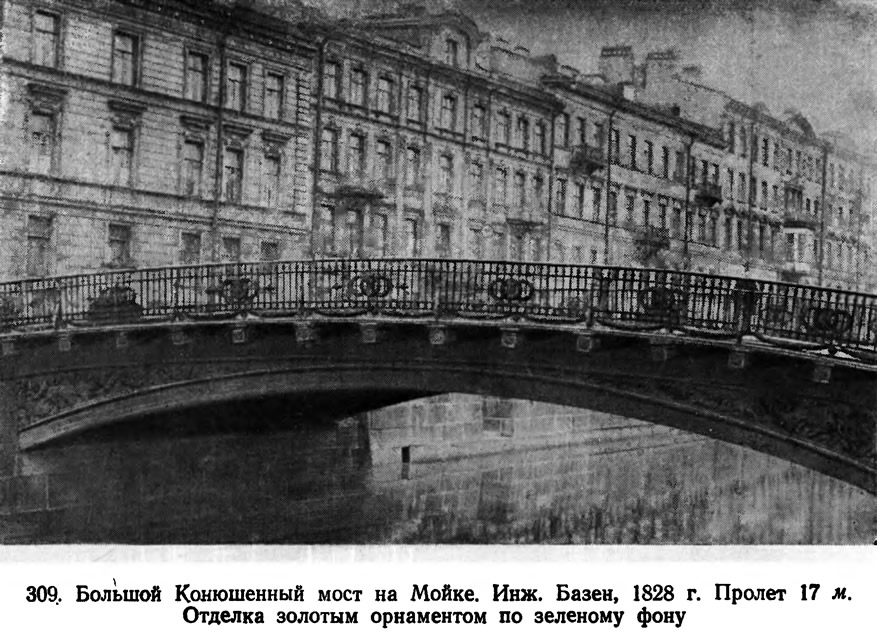
The Bolshoy Konyushenny Bridge, connecting the banks of the Moika River, invariably attracts the attention of passersby with its beautiful architectural decoration. It is a cultural and historical monument protected by the state.
The history of the crossing began in the first half of the 18th century. The predecessor of the current bridge was first marked on maps of St. Petersburg dated 1737 under the name Greek Bridge. At that time, there was a Greek settlement on the right bank of the river, where Greek craftsmen from the Admiralty shipyard lived. Later, the Greek Bridge was rebuilt by Harman van Bolles (a Dutch master, author of the standard project for wooden drawbridges) and underwent several name changes: the bridge near Moshkov Lane, Konyushenny, 2nd Konyushenny.
The modern name "Bolshoy Konyushenny Bridge" appeared in the 19th century and comes from the Imperial Stable Yard, which stretched along the left bank of the Moika. The idea of arranging the court stables belonged to Peter I, inspired by the buildings for housing horses he saw during his foreign travels, which were used by the French royal court. To realize this plan, flowing water and a large open space were required.
At the beginning of the 18th century, the city boundary ran along the Moika River, and the nearest city outskirts on its bank to the Winter Palace were chosen for construction. The building of the imperial stables in the Petrine Baroque style (architect Gerbel), which shaped the appearance of the district that eventually became central and gave its name to nearby streets, bridges, and the square, had become dilapidated and outdated and was rebuilt in 1823 (architect Starov). It was decided to rebuild the nearby crossing as well.
The epithet "Bolshoy" (Big) in the bridge's name reflects the importance and significance attributed to the construction of this bridge structure. The fact is that Emperor Nicholas I wished to see here, instead of the outdated wooden bridge painted to look like stone, "...all possible strength and all possible beauty...".
To best fulfill the imperial decree, the project was entrusted to two leading architects simultaneously: Adam and Tretter, each working independently. The completed projects were reviewed several times and sent back for revision, which delayed the start of construction by a whole one and a half years. In the end, the choice fell on a single-span arched structure made of lightweight cast iron blocks resting on stone abutments, proposed by Adam. The project author personally supervised the construction of the bridge, which was completed at the end of 1828. The result was both strong and beautiful.
On December 6, 1828, the bridge was opened to traffic. One of the project authors, Adam, gave the following description of the work performed:
"...the abutments are made from old stones from the demolition of embankments and remnants of previous work on the Suvorov Bridge, but they were selected by color and height... As for the external patterns—cornices, friezes, brackets, grilles, etc.—justice requires me to testify... to the excellent craftsmanship with which these were cast at the state foundry...".
The design involved the genius Carlo Rossi. The vaults of the arch are richly decorated with fine castings. The ornament includes bas-relief figures of galloping horses; the brackets and cornices are covered with intricate patterns. The railing consists of spears with gilded tips, decorated with wreaths and garlands. The granite-clad abutments simultaneously serve as pedestals for elegant torchères with lanterns.
Interestingly, the cast iron tubings used for the arched structure were originally prepared for the reconstruction of the Malo-Konyushenny Bridge. They were set aside as unnecessary due to the decision to create the "Three Bridges" (an architectural composition consisting of three bridges).
The supports are assembled from old stone masonry left after repairs to the embankments and the Suvorov Bridge. The use of "discarded" materials did not affect the strength of the structure—the bridge served excellently for 117 years without major repairs.
In the pre-war Soviet years, during reconstruction, a reinforced concrete vault was installed over the cast iron arches, which allowed strengthening the structure while preserving its historic appearance. According to the latest data from the St. Petersburg State Budgetary Institution "Mostotrest," the length of the bridge is 28.4 meters, and the width is 11.6 meters.
Sources:
https://ru.wikipedia.org/wiki/%D0%91%D0%BE%D0%BB%D1%8C%D1%88%D0%BE%D0%B9_%D0%9A%D0%BE%D0%BD%D1%8E%D1%88%D0%B5%D0%BD%D0%BD%D1%8B%D0%B9_%D0%BC%D0%BE%D1%81%D1%82
https://www.citywalls.ru/house15797.html