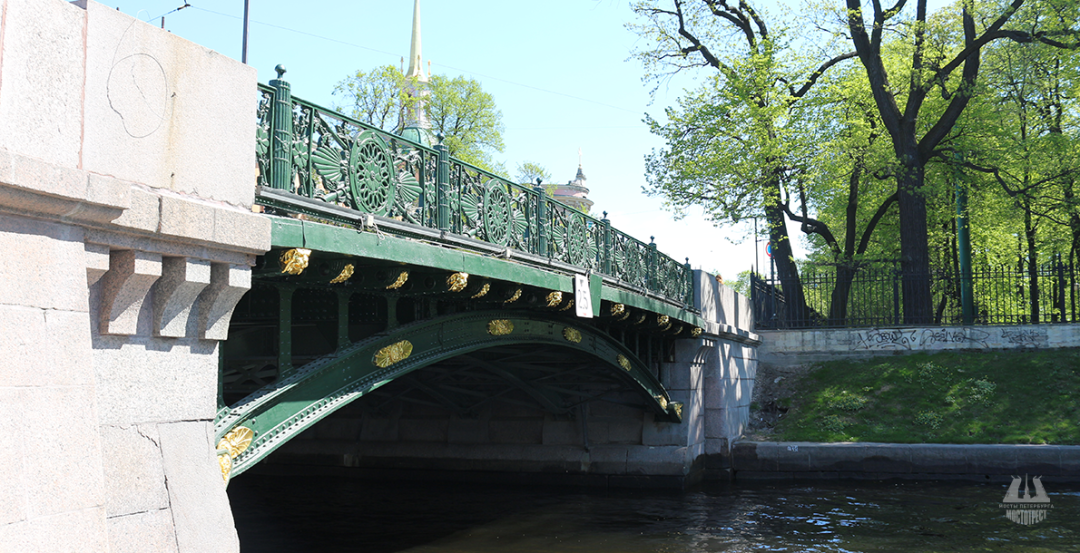
The 1st Sadovy Bridge, spanning the Moyka River along the axis of Sadovaya Street, connects Spassky and 1st Admiralty Islands in the Central District of Saint Petersburg.
The length of the crossing is 33.9 meters, and the width is 20.4 meters. The bridge is a single-span arch, with the span structure representing a steel two-hinged arch with a through superstructure. The bridge abutments are massive stone on a pile foundation, clad in granite.
The railing is made of artistic cast iron. The bridge is illuminated by 4 hexagonal lanterns on cast iron torchères, which are in turn installed on granite pedestals.
The first crossing at this location appeared in the 1710s after the Moyka riverbed was rearranged (in the early 18th century, the river was called Mya). Originally, the river flowed out of the swamps near the modern Mikhailovsky Garden. It was connected by a straight canal to the Fontanka River (then called Fontannaya River), and a wooden drawbridge with a lifting central section for passing mast ships was built over this canal.
In the 18th century, the bridge was named the 2nd Tsaritsyn Bridge after the nearby Tsaritsyn Meadow (now Mars Field). In 1820, it was renamed Mikhailovsky after the nearby Mikhailovsky (Engineering) Castle. On October 6, 1923, it became Sadovy Bridge after Sadovaya Street, and finally, in 1957, the crossing received its current name — 1st Sadovy Bridge.
At the turn of the 18th and 19th centuries, the Mikhailovsky Castle of Paul I was built on the site of Elizabeth Petrovna’s Summer Palace, surrounded by canals. The entire area around the castle, including the bridge over the Moyka, was reconstructed. Between 1798 and 1801, a new non-draw single-span wooden bridge with a beam-braced span structure on stone abutments was built in its place.
In the 1820s, Sadovaya Street was extended to Mars Field, creating the need to reconstruct the Mikhailovsky Bridge. According to the design by engineers Bazen, Gotman, and Buttatz, a stone bridge over the Moyka was built in 1835–1836. The crossing was a single-span arch structure, with the span being a gentle stone vault, and the facades clad in granite. The abutments were massive, stone, on a pile foundation, clad in granite. Cast iron railings with round openwork shields and crossed spears were installed on the bridge. This design echoes the ornamentation on the lower part of the gates of the Russian Museum building, created by Carlo Rossi. The lantern torchères were made in the form of bundles of pikes with overlays of shields and wreaths, topped with double-headed eagles. Similar lanterns were installed in 1827 on the Suvorov floating bridge.
In 1906-1907, for the opening of tram traffic along Sadovaya Street, the bridge was completely rebuilt according to the project of engineer Pshenitsky and architect Ilyin. The stone vault was replaced with a steel one, and this structure has been preserved to this day. The stone vault was replaced by 9 metal two-hinged arches, on which the upper structure rests with the help of metal posts.
The lost bridge decoration and lantern torchères were restored in 1913. The castings were made at the private foundry "Trud".
During the Siege of Leningrad, the lavish decoration was significantly damaged and later recreated during restoration works carried out successively in 1951, 1967, 1969, and 1995.
The most recent major overhaul of the 1st Sadovy Bridge was carried out in 2003 according to the project of JSC "Institute Stroyproekt". Among other things, the torchères were restored and the architectural decorative details were gilded.
The 1st Sadovy Bridge belongs to a series of bridges built on the model of the Panteleimonovsky Bridge over the Fontanka River, Potseluyev Bridge over the Moyka River, and the dismantled Vvedensky Bridge over the now-filled Vvedensky Canal. They differ only in the character of their superstructures.
Sources:
https://mostotrest-spb.ru/bridges/1-j-sadovyj