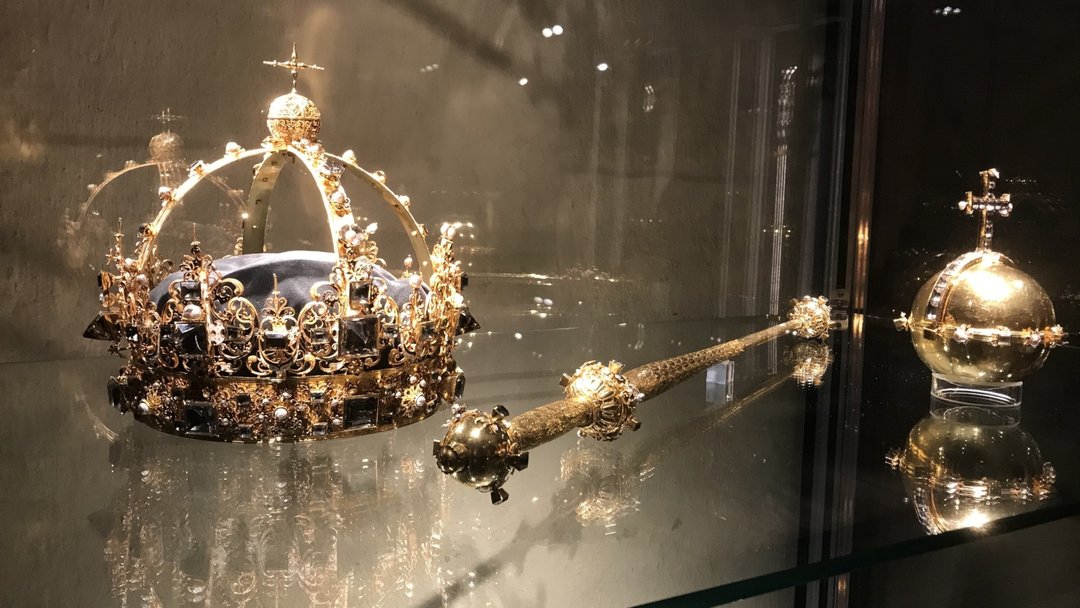

Karl IX died in 1611, and his widow, Kristina den äldre, ordered a set of funeral regalia for the burial. Six months of goldsmiths' work went into it. The king's crown alone has 441 parts, gold at 21 carat as later confirmed by the National Forensic Centre, worked with enamel, pearls and rock crystals — the stones passed off in their day as "svenska diamanter." Antonius Grott and Peter Kempe made it. The queen's crown was gold with black enamel and no gemstones at all.
They were laid in the coffins in Strängnäs, which had become a Vasa burial church at Karl IX's own insistence. He picked the high choir, the most sacred part of the building, and had a monument for himself set in front of the high altar. Somewhere between 25 and 30 other Vasa descendants lie in the cathedral. The regalia stayed in the coffins for centuries. At some point — the records I have don't say when, or by whom — they were taken out and put on display in a locked case wired to an alarm.
Around noon on Tuesday 31 July 2018, during a service, two men smashed the glass. The alarm went off. They took Karl IX's crown and orb from 1611 and Kristina den äldre's crown, left the queen's orb and both sceptres, and were gone. They rode off on separate bicycles, then left Strängnäs by boat. The boat later ran aground; the prosecution in one of the trials pointed to a Swish payment from a phone to the man who towed it.
The case unravelled because of blood. One of the thieves had cut himself on the broken glass. The traces led police to a 22-year-old, whose DNA turned up in several places in the cathedral and on one of the bicycles. Prosecutor Reena Devgun also put in an analysis of a roll of bin bags found in his car — a small detail that would matter later.
Then, during the night of 5 February 2019, a security guard doing rounds in a car park on Mejselvägen in Åkersberga, north of Stockholm, noticed a wheelie bin sitting on the roof of a car. Someone had painted "BOMB" on it in white letters.
 He called the police. It was snowing hard when the first patrol arrived at around one in the morning. They looked in and saw something glittering. Christer Nilsson of the national operations department confirmed the find. The regalia — insured, or at least valued, at 65 million kronor — were inside, crushed and battered out of shape. Whoever put them there had collected every loose fragment and bagged it up with them. Prosecutors released a photograph of the bin and said the placing was obviously designed to be noticed.
Who put it there has never been officially explained. The find landed in the middle of an ongoing trial and forced it to be halted before the final day. When court resumed, the 22-year-old reversed his plea outright: "Det är jag som har begått stölden." He was sentenced to four years and six months for aggravated theft and attempted aggravated theft; Devgun had asked for six years, the maximum. A 26-year-old denied everything and argued that his DNA reached the crowns because he had arranged for them to be found. The court didn't believe him. He got three years, upheld on appeal.
Conservators Annmarie Christensson and Hubert Hydman took the objects apart piece by piece, straightened and polished them, and put them back together. The regalia returned to the cathedral in June 2020. The planned celebration was cancelled by the pandemic. Bishop Johan Dalman's summary of the whole business was that whoever took them had made a huge mistake if he thought he could sell them on eBay.
The cathedral itself is older than any of it: a three-aisled brick hall church on Kyrkberget, begun in the 1260s, with a tower 75 metres high. Excavations 50 metres to the northeast in 1982, 1984 and 1985 found around twenty Christian graves from the late Viking Age — a burial ground here before the church existed.
Written by Nik Frost
Discuss this with the author and others
Test
Test
No comments yet. Be the first to start the conversation.