The grave of Baron Wrangel and the Russian Church of the Holy Trinity

Aberdareva 1, Belgrade 11000, Serbia

Baron Wrangel died in Brussels on April 25, 1928. He died mysteriously and suddenly after a sudden infection with the tuberculosis bacillus. The baron's relatives remained convinced that Wrangel was poisoned. Presumably — by the servant's brother, who, as it turned out, worked for the NKVD. The "Black Baron," as he was called for his strict black uniform, is buried in the center of Belgrade. More precisely — reburied a year after his death, in 1929, in the Russian Church of the Holy Trinity.

Baron Wrangel died in Brussels on April 25, 1928, mysteriously and suddenly, after a sudden infection with tuberculosis bacillus. The baron's relatives remained convinced that Wrangel was poisoned. Presumably — the servant's brother, who, as it turned out, worked for the NKVD. The "Black Baron," as he was called for his strict black uniform, is buried in the center of Belgrade. More precisely — reburied a year after his death, in 1929.
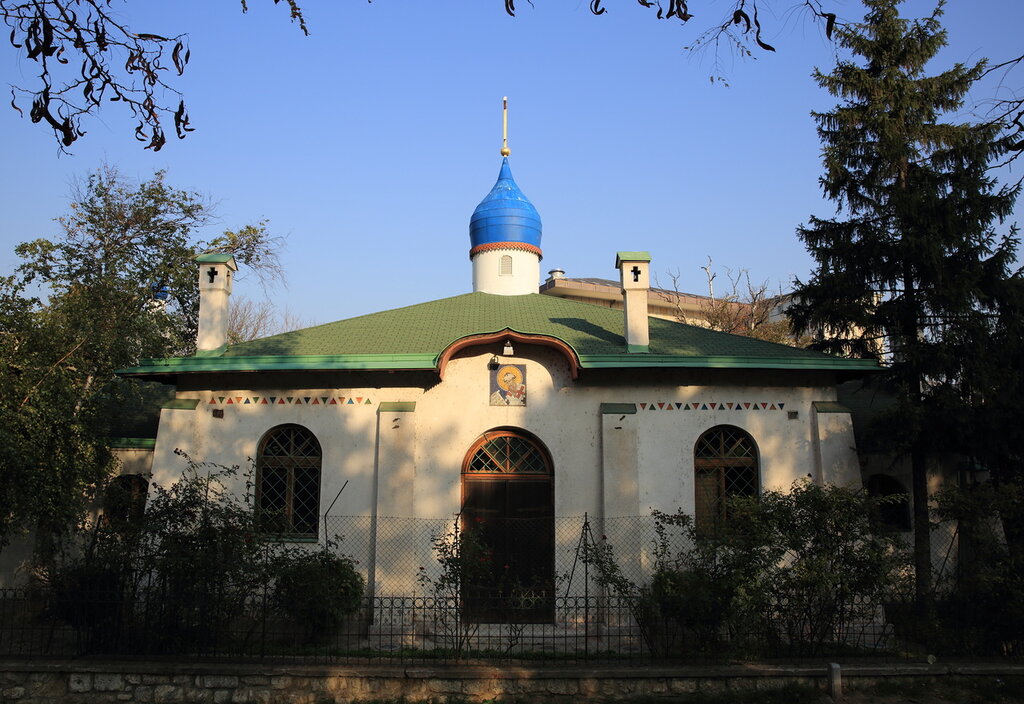

The Russian Church of the Holy Trinity (Црква «Свете Тројице», Russian Church) was built in 1924 with money from the first wave of emigrants. Officers, soldiers, civilians, who flooded out of Russia when the White Guard's struggle against Bolshevism was lost. A handful of land brought from their homeland was laid as the foundation of the church. The small light temple hides behind the Serbian Church of Saint Mark, in Tašmajdan Park, in the center of Belgrade. Until 1924, here, on the territory of the Serbian church, there was a tent of a field Russian military church where services were held. The Trinity Church resembles a neat village church — both inside and out. The iconostasis includes 48 icons painted by Russian émigré artists in the old Novgorod style. In the church, a kiot (icon case) created in memory of Admiral Kolchak is noticeable. This is the icon of St. Alexander Nevsky. Before World War II, the church preserved many royal relics: banners and standards of regiments of the Russian Imperial Army; trophies — battle banners of Napoleon and the Ottoman Empire. In 1944, as Soviet troops approached the Balkans, Metropolitan Anastasy and the core of the White émigré community left Serbia, taking the relics further west and to the USA.

Until the 1940s, the Church of the Holy Trinity in Belgrade was the center of life for the Russian Orthodox Church Abroad. It had no and could not have any contacts with the church in the USSR. Then the first rector, Don Cossack Pyotr Belovidov, died (1940), the ROCOR administration emigrated (1944), and the parish was headed by Father Vladislav Neklyudov. His role was tragic. Under him, the church broke away from the Abroad, becoming part of the Moscow Patriarchate. And in 1949, Neklyudov died in a solitary cell of an investigative prison.

Baron Wrangel was assigned the right part of the church, near the entrance. His grave is embedded in the floor practically under the crucified Christ. In 2007, the baron's relatives (93-year-old granddaughter Natalia Wrangel-Bazilevskaya and her son Pyotr Bazilevsky) received an official offer from Russia — to return Wrangel's remains to Russia and reinter them in the Donskoy Monastery in Moscow. To which lawyer Bazilevsky replied with a polite but firm refusal. "The main character trait of General Wrangel was his principled nature. He fought Bolshevism and the vicious system it spawned not out of class hatred, but from a deep conviction that Bolshevism is absolute evil both for Russia and for humanity as a whole. Over the past two decades, there have been huge changes in the consciousness of Russians... However, the main thing has not happened: condemnation of this evil at the state level... General Wrangel rests in Belgrade, and nearby, in the cemetery, lie thousands of his comrades-in-arms, officers of his army, endlessly devoted to him, to whom he gave his last strength. This mutual trust between the commander-in-chief and his subordinates has no limits — it is not limited by his death or the passage of years. Both in life and in death, he remains in formation together with his officers, soldiers, and Cossacks... Were he alive, he would hardly agree to abandon his army to honorably go to Moscow alone, knowing that Lenin and Stalin still occupy a place of honor near the Kremlin."

Sources:

http://asiagood.ru/mogila-vrangelya-v-belgrade.html

https://ru.wikipedia.org/wiki/Врангель,_Пётр_Николаевич


Follow us on social media

More stories from Serbia: Life and Tragedy of the First Wave of Russian Emigration - The White Army, the Black Baron

Kalmyk Buddhist Temple in Belgrade

Kachićeva 52, Belgrade, Serbia

The Kalmyk Buddhist Temple in Belgrade (Kalmički budistički hram u Beogradu) is a historic temple that operated from 1928 to 1944, built by Kalmyk emigrants who fled the Russian Civil War. The temple was partially destroyed during the Battle of Belgrade and was demolished a few years later. It is often called "the first Buddhist temple in Europe" and is certainly among the earliest Tibetan Buddhist temples in Europe, alongside the Buddhist temple in Saint Petersburg.

The building of the Ministry of Finance of the Kingdom of Yugoslavia - Architect Nikolay Krasnov

Nemanjina 12, Belgrade, Serbia

The building is the work of the famous Russian architect Nikolai Petrovich Krasnov, a key representative of academic historicism in Serbian interwar architecture. Due to the building's significance as an anthology work of Belgrade's academic architecture of the interwar period, it represents great cultural value. The building was constructed between 1926 and 1928 based on the design by architect Nikolai Krasnov, the author of the original project, with a later addition of the third floor starting from 1938.

The palace complex in Dedenevo - architect Nikolay Krasnov

QF92+VC, Prince Alexander Karađorđević Boulevard, Belgrade, Serbia

The palace complex in Dedinje was built between 1924 and 1936 on the estate of King Alexander I Karađorđević as a private family residence. It was the home of King Alexander I and King Peter II. Today, it is the home of Crown Prince Alexander II and his family.

Palace of the Ministry of Foreign Affairs, architect Nikolay Krasnov

Kneza Miloša 24–26, Belgrade, Serbia

The Palace of the Ministry of Forestry and Mining Industry and the Ministry of Agriculture and Water Management, today the building of the Ministry of Foreign Affairs, is one of the most representative buildings constructed in Belgrade between the two wars and is a cultural heritage site of Serbia.

The House of the National Assembly of the Republic of Serbia – interiors by architect Nikolay Krasnov

Trg Nikole Pašića 13, Belgrade, Serbia

The House of the National Assembly of the Republic of Serbia is located on Nikola Pašić Square in Belgrade. Originally known as the Assembly of the Kingdom of Yugoslavia from 1936 to 1945, it was then renamed the Federal Assembly. The new name was retained during the existence of the Socialist Federal Republic of Yugoslavia, and later the Federal Republic of Yugoslavia. After the dissolution of the State Union of Serbia and Montenegro on July 23, 2006, this House became the official building of the National Assembly of the Republic of Serbia.

The Old General Staff Building - Architect Vladimir Baumgarten

Kneza Miloša 33, Belgrade, Serbia

The old building of the General Staff of the Army and Navy of Yugoslavia (Stara zgrada Generalštaba — "Kamena Palata") or the Baumgarten Palace in Belgrade was built between 1924 and 1928 based on the design of the Russian architect Vasily (Wilhelm) Fedorovich Baumgarten, who came to Yugoslavia as a Russian emigrant during the years of the October Revolution of 1917.

Nikolay Krasnov — Russian Architect of Serbia

RF4F+VQ Belgrade, Serbia

Architect Nikolay Krasnov (1864, Russia – 1939, Kingdom of Yugoslavia) was the chief architect of Yalta and the author of the project for the famous residence of the Russian emperors – the Livadia Palace. In Crimea, besides the imperial palace, beautiful mansions, villas, and palaces were built according to his designs. After the October Revolution, Nikolay Krasnov emigrated to Belgrade and effectively transformed the appearance of this city.

The Main Post Office Building - architect Vasily Androsov

Takovska 2, Belgrade 11000, Serbia

The Main Post Office building (Serbian: Палата Главне поште) in Belgrade is located at the intersection of Takovska Street and King Alexander Boulevard, in close proximity to the building of the National Assembly, the Administration of the President of Serbia (the New Palace building), and the City Hall of Belgrade (the Old Palace building). The building was constructed between 1935 and 1938 to house the Postal Savings Bank, the Main Post Office, and the Main Telegraph Office.

Nina Kirsanova - prima ballerina, choreographer, ballet master, and teacher, founder of the Yugoslav Ballet School

RF5P+7V, Belgrade, Serbia

Nina Kirsanova made her debut back in Imperial Russia at the "Zimin Opera," where she danced leading roles. In 1923, she became the prima ballerina of the Belgrade Opera, and from 1926 to 1931, she toured half the world as part of Anna Pavlova's troupe. After finishing her ballet career, Nina Kirsanova developed an interest in archaeology. She even enrolled in the archaeology department of the Faculty of Philosophy at the University of Belgrade and earned a degree in history.

Russian Necropolis at the New Cemetery in Belgrade

Ruzveltova 50, Belgrade, Serbia

At the New Cemetery, located in the municipality of Zvezdara in the Serbian capital (about a kilometer from Kralja Aleksandra Boulevard), there is the Russian Necropolis. It is situated deep within the cemetery, where many Russians who left Russia after the October Revolution of 1917 and the end of the Civil War are buried. Notable people of that time rest here.