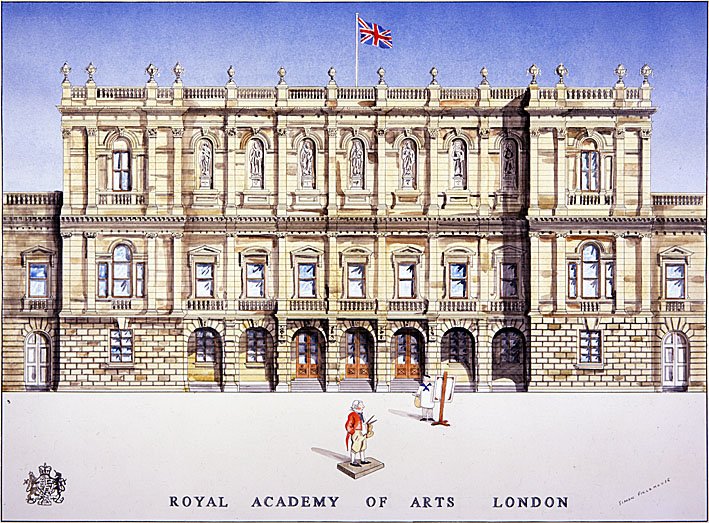

The origin of the Royal Academy of Arts lies in an attempt in 1755 by members of the Society for the Encouragement of Arts, Manufactures and Commerce, principally the sculptor Henry Cheere, to found an autonomous academy of arts. Although Cheere's attempt failed, the eventual charter used to establish the Royal Academy of Arts over a decade later was almost identical to that drawn up by Cheere in 1755.
King George III provided royal patronage and financial support to establish the Academy on 10 December 1768 with a mission to establish a school or academy of design for the use of students in the arts with an annual exhibition. The painter Joshua Reynolds was made its first president, and Francis Milner Newton was elected the first secretary. The first Royal Academy Exhibition of Contemporary Art opened on 25 April 1769 and was open to anyone to participate anonymously, whether professional or amateur, male or female.
By 1800, the annual Royal Exhibition was visited by half a million people who paid a single shilling to see the art. The Academy was initially housed in cramped quarters in Pall Mall, before moving to purpose-built apartments in New Somerset House in 1780. In 1837, it moved to the east wing of the National Gallery in Trafalgar Square, before finally moving to its current home at Burlington House in Piccadilly in 1868.
In 2018, the Academy celebrated its 250th anniversary with the opening of the New RA. Following a £56 million development that began in 2008, the refurbished site includes new galleries, a lecture theatre, a public project space for students, and a bridge linking the Burlington House and Burlington Gardens sites. It remains an independent, privately funded institution led by eminent artists and architects.
Sources: Wikipedia, OpenStreetMap, Wikidata, Wikimedia Commons





Written by Nicolo Ciampini
Discuss this with the author and others
No comments yet. Be the first to start the conversation.