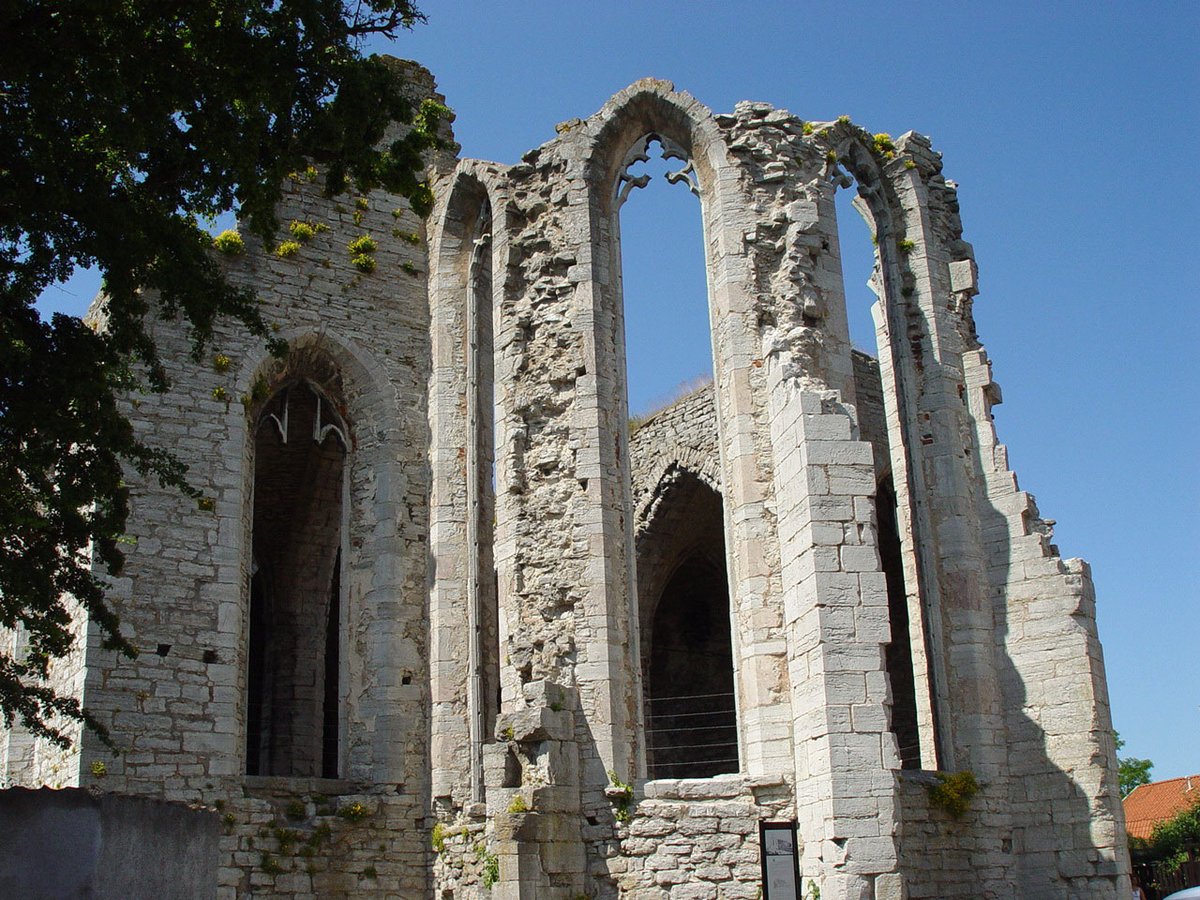

Sankt Nicolai kyrkoruin in Visby was built around 1215-1220. The first church on the site was named after the sailors' patron saint, St. Nicholas. Originally intended as a parish church, work was interrupted or the building was destroyed by a fire, and the present Cathedral was instead consecrated as the parish church for the northern parish around 1240.
In 122(8), the Dominikanerbröder took over the damaged church and rebuilt it into a convent church. In the mid-1200s, work began on the current western facade, with tree-ring dating placing it at 1251. Petrus de Dacia, prior of the convent during the mid-1200s, has a memorial plaque still visible on the north side of the church. The church took its current layout, with a choir around the year 1400, which largely seems to have been financed by the Gotlandic councilman Jacob Knarre.
Many of the different construction phases can be seen in the church’s facade, where Romanesque window openings still exist. The convent and church were burnt by the city’s defenders during the Lübeckers' attack on Visby in 1525. Today, the ruin hosts regular theatrical performances and concerts, with Petrus de Dacia, also known as Ruinspelet, being particularly popular.
Sources: Wikipedia, OpenStreetMap, Wikidata, Wikimedia Commons


Written by Nik Frost
Discuss this with the author and others
No comments yet. Be the first to start the conversation.