Pushkin Street 26, Pinsk, Belarus

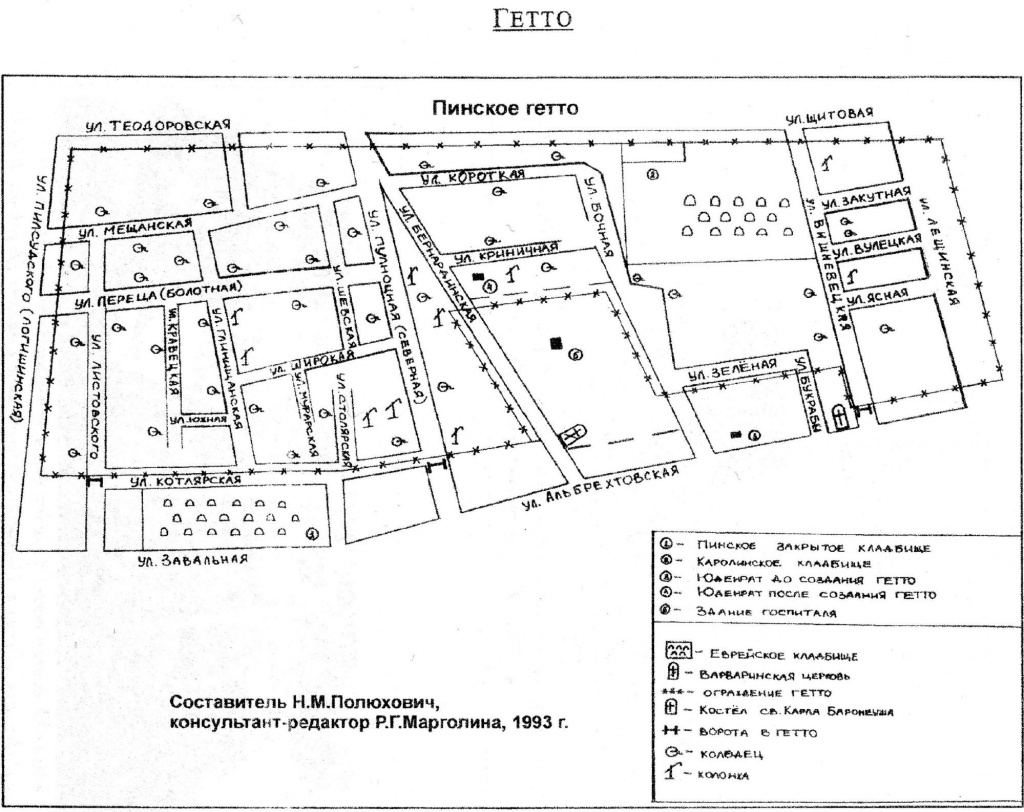
The Pinsk Ghetto (summer 1941 — October 28, 1942) was a Jewish ghetto, a place of forced resettlement of the Jews of the city of Pinsk, Brest region, during the persecution and extermination of Jews during the occupation of Belarusian territory by Nazi Germany troops in World War II.
After Germany attacked the USSR on June 22, 1941, only a small number of Jews managed to evacuate eastward. Refugees from the western part of Belarus also ended up in Pinsk. On July 4, 1941, Pinsk was occupied by the German army, and the occupation lasted 3 years — until July 14, 1944.
At the beginning of the war, out of a population of 44,560 in Pinsk, 22,149 were Jews.
The Nazis included Pinsk and the Pinsk district in the territory administratively assigned to the Pinsk district of the Volhynia-Podolsk General District of the Reich Commissariat Ukraine. Full authority in the district belonged to the Sonderführer — the German district chief, who reported to the district commissioner (Gebietskommissar) Paul Gerhard Klein. On July 6, 1941, the Nazis formed a local civil authority in Pinsk — the Pinsk City Administration (Magistrate) headed by Mayor S. Kirilov, fully subordinate to the Gebietskommissar. To carry out the policy of genocide and punitive operations, immediately after the troops, punitive units of the SS troops, Einsatzgruppen, Sonderkommandos, the secret field police (GFP), security police and SD, gendarmerie, and Gestapo arrived in the district. In Pinsk, the security and SD department was headed by Leiman, the SS service by Tsesman. The commissioner of the Polish police from collaborators was appointed former court secretary Sologub, and his assistant was the son of lawyer Spiegelsky.
Already on July 5, 1941, the day after the occupation, an anti-Jewish order was announced in the city. Numerous restrictions were imposed on Jews under threat of execution, including mandatory wearing of a special distinctive sign on clothing — a yellow patch in the form of a six-pointed star, bans on leaving the city, walking on sidewalks — only in the middle of the road, being on the street an hour before the curfew established for the non-Jewish population. Pinsk bakers were required to surrender a certain amount of bread, and Jews were shot for failing to meet the established quota.
From the first days of occupation, unpunished looting of Jewish property began. This was carried out by German soldiers, Gestapo agents, and Polish police.
By order of the occupation authorities, in the second half of July, a Judenrat and Jewish police were created.
The first chairman of the Judenrat appointed by the Germans was former director of the "Tarbut" school, Professor David Alper. Members of the Judenrat included Munvets, Busel, Lerman, Meshel, Shkolnik, Schwarzblat, Bergman, David Pruchansky, and others. Two days later, David Alper refused the position and was shot along with 20 other Judenrat members. The new chairman was appointed Binyamin Bakshtansky.
The ghetto was ordered to surrender 20 kilograms of gold within three days, then wool, then woolen suits, blankets, leather for shoes, horses and cows, soap. With the onset of winter, all fur products and warm clothing (even old and worn) were completely confiscated from the Jews. The only punishment for violations was death. For example, for not surrendering fur, the Germans hanged Moshe Gloder and other Jews; for exchanging goods for flour — Nota Melnik; for exchanging wool for food — the daughter of baker Lasovsky; for slaughtering a calf — Ushpits.
From the transcript of the Frankfurt trial of 1973:
"SS Main Office. Berghal. Order to the SD commander in Pinsk Rasku and Gebietskommissar (personally)
The SS Main Office instructs you to organize the liquidation of the Jewish population of the district from August to September 1942. The Gebietskommissariat must promptly prepare for the operation. The operation must be carried out according to the following plan:
Prepare pits for burying the bodies in advance.
Seal the ghetto hermetically.
Jews must be concentrated in one place for more organized escort to the site of the operation.
March formation accompanied by guards — columns of one hundred people.
Jews line up near the pits with their backs to armed machine gunners.
The next groups must lie on the bodies and be shot at close range.
Before and after the operation, security forces and SD receive vodka."
From August 1 to 15, 1941, all Jews of Pinsk were ordered to register.
Creation of the closed ghetto and conditions inside
All Jewish population of Pinsk, numbering 18,644 people, was confined to the ghetto from May 1, 1942. In terms of creation time, it was the last ghetto in Belarus. Jews from European countries were also deported to the Pinsk ghetto, as well as Jews brought from nearby towns. The ghetto was fenced with barbed wire and had three guarded exits: on Listovsky Street (now Komsomolskaya), Severnaya Street (now Leningradskaya), and Albrechtovskaya Street (now Minskaya). Housing in the ghetto was allocated based on an area of 1.2 square meters per person. The ghetto had a hospital, pharmacy, and clinic.
Jews worked at the city's industrial enterprises and workshops, and were also used by the occupiers for forced labor.
Underground groups operated in the ghetto, trying to accumulate weapons and create shelters and bunkers. Sholom Kholyavsky, one of the leaders of the uprising in the Nesvizh ghetto and a participant in the Belarusian partisan movement, wrote:
"I do not claim that every Jew in the ghetto participated in the underground movement or fought the enemy, but it cannot be denied that the entire character of life in the ghetto was underground. It was mass Jewish heroism."
In June 1942, the Germans arrested 3,500 Jews in Pinsk and Kobrin and shot them at the Bronnaya Gora station.
The Germans considered the Jews a threat to the occupation authorities and seriously feared Jewish resistance. For this reason, the German authorities sought primarily to kill Jewish men aged 15 to 50 in the ghetto, despite thereby losing the most able-bodied prisoners. Therefore, already in July 1941, the Germans shot 16 young Jewish men on fabricated charges (one managed to survive and escape from the execution pit). On August 5, 1941, about 3,000 Jewish men were taken to the village of Kozlyakovichi and killed in three pre-dug pits on the cemetery grounds. Several prisoners who tried to escape were shot. On August 7, 1941, the Germans shot 8,000 Jews in Pinsk, and in total from August 5 to 7, 1941, about 10,000 — mostly men aged 16 to 60. Archival documents report that by the second half of 1942, almost all male prisoners in the Pinsk ghetto had been killed.
However, Himmler still considered the ghetto population a threat and ordered its destruction, leaving only 1,000 able-bodied men.
From Himmler's order dated October 27, 1942:
To the Chief of SS and Police of Ukraine, SS Obergruppenführer and General of Police Pruetzmann: "The Wehrmacht High Command reported to me that the Brest-Gomel line is still subject to bandit attacks, causing complications in supplying frontline units. Based on the reports I have, the central base of the bandit movement in the Pripyat swamps is the Pinsk ghetto. Therefore, I order you, regardless of economic considerations, to immediately liquidate the Pinsk ghetto. During the operation, if possible, preserve a workforce of 1,000 men, who must be handed over to the army for building wooden houses. These workers must be kept under enhanced guard. If such protection cannot be guaranteed, this thousand must also be destroyed."
Himmler
On October 28, 1942, the "action" began (a euphemism the Germans used for their organized mass killings) to destroy the Pinsk ghetto. It was carried out by a German motorized order police battalion. The ghetto underground resisted the police; most were killed, some managed to escape to the partisans. Dr. Itzhak Arad, director of the Israeli Museum of the Holocaust and Heroism "Yad Vashem" from 1972 to 1993, who fled the Lithuanian ghetto at age 15, became a partisan in the Belarusian forests at 16, and after the war became a general in the Israel Defense Forces, wrote:
"People must know. We did not go to death meekly and submissively. We defended ourselves as best we could. Often with bare hands and almost always without anyone's help."
The police battalion commander's report stated that 26,200 people were killed during these days. According to Arad's research, 17,000 Jews were killed in the ghetto. The killings took place near the village of Posenichi.
In Pinsk, 9 people were awarded the honorary title "Righteous Among the Nations" by the Israeli memorial institute "Yad Vashem" "as a sign of deepest gratitude for assistance given to the Jewish people during World War II":
Barbara Makhayskaya (Bilitskaya) — for saving Tsolinko Tsili and Ari.
Alexandra Dokhmatskaya and Yanina Yanovskaya (Dokhmatskaya) — for saving Sheinberg Mani, her daughter Reni, Sheinberg Marek, Yelinsky Sema.
Vladimir Dergach and Donya, Maria Gromyko — for saving Naidich Sasha.
Günther Krull — for saving Rabtsevich Petr (Rabinov Erukhim Fishel).
Konstantin and Maria Komar — for saving Shavel Galina (Pesker Dina).
A unique case is known of a Pinsk Jew being saved by a German. Fishel Rabinov, a ghetto prisoner, was saved by German officer Günther Krull — who gave him forged documents, hid him in his apartment during the liquidation of the ghetto, then arranged his departure to Kiev and further rescue.
The Extraordinary State Commission established the names of the main organizers and executors of the mass killings of Pinsk Jews. These were Gebietskommissar Klein, deputy Gebietskommissar for the "Jewish question" Ebner, SD chief Glauber, deputy SD chief Leiman, deputy Gebietskommissar for economic affairs Gaze, deputy political leader Klantz (direct supervisor of the killings in the ghetto, repeatedly personally participated in shootings), deputy Gebietskommissar for industrial affairs Gemert, executor of mass murder orders Zig, military unit GFP No. 724 led by brigade commander Captain Gresman and his deputy Lieutenant Herman, military unit "Ober-Truppe" No. 06893/9, military unit "Sonder-Kommando," Gebietskommissar’s translator Gobersthof (repeatedly personally participated in killings and robberies), mayor Kirilov (direct participant in crimes), city police commandant Sologub, deputy city police commandant Dombrovsky, Gestapo agent in Pinsk Mazuruk.
Members of the Pinsk SD branch who participated in the killing of Pinsk Jews — Adolf Petch, Joseph Kur, Rudolf Eckert, and Heinrich Flantyus — were identified and arrested in 1962 in Frankfurt.
Incomplete lists of victims of the genocide of Jews in Pinsk have been published.
The Holocaust victims memorial north of Pinsk, one kilometer southeast of the former "Good Will" estate, at the cemetery. Here, from October 29, 1941, to November 2, 1942, the Nazis killed about 30,000 Jews — prisoners of the Pinsk ghetto. A memorial complex was established in 1992.
Graves of more than 5,000 Jews — ghetto prisoners — on Pushkin Street, in the block between Gogol Street and Zelyonaya Street, in the square on the site of the former ghetto, at the Karolinsky Jewish cemetery. At this cemetery, the Nazis staged "performances" for themselves, gathering Jewish children in groups of 50-60 and giving them to starving dogs to be torn apart. A memorial sign was installed in 1993.
Mass grave of ghetto prisoners in the area of the former village Kozlyakovichi, at the cemetery — now Kraynyaya Street within Pinsk. In 1993, a memorial sign was installed. Here, on the territory of the current DOSAAF school, in the Gory tract, in 1941–1942, the Germans killed Jews from the Pinsk ghetto, prisoners of the city prison, and prisoners of war. Here lie the graves of 10,671 ghetto prisoners.
Sources:
https://ru.wikipedia.org/wiki/Pinsk_Ghetto
https://dic.academic.ru/dic.nsf/ruwiki/1464077
https://diletant.media/articles/37748021/

