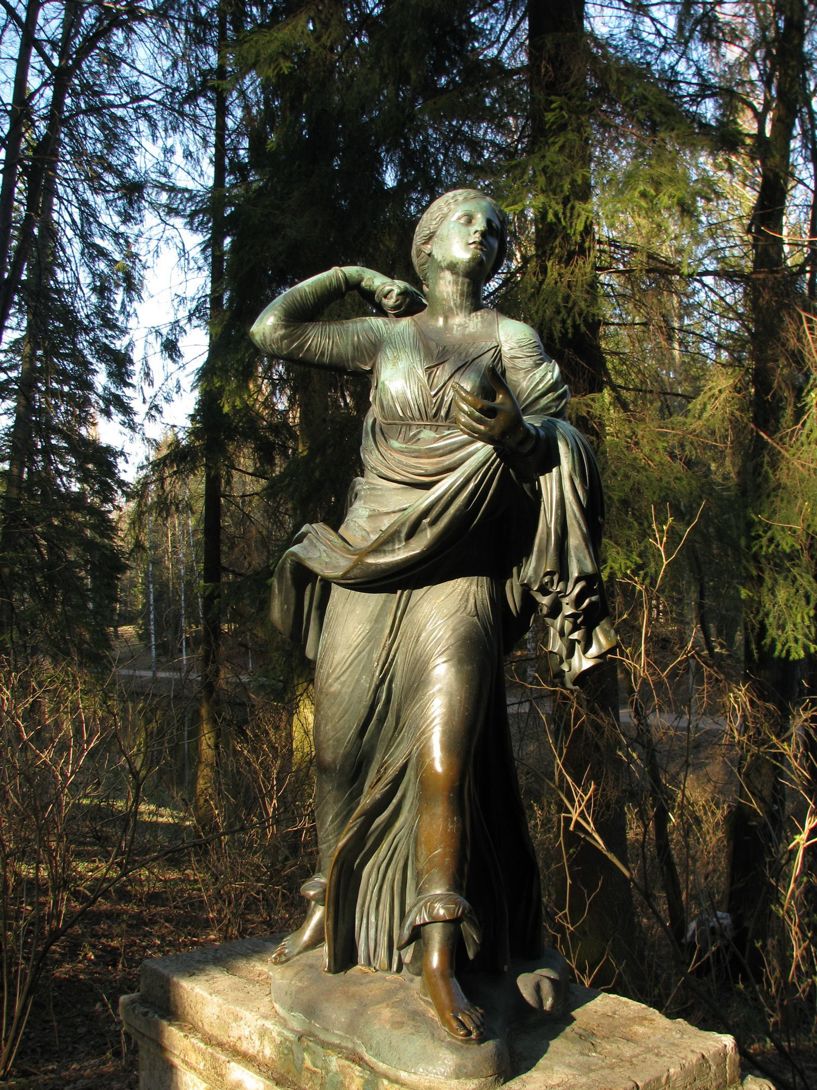
Niobides

Rose Pavilion Alley, Saint Petersburg, Russia, 196621

Four of the twelve paths radiating from the center and leading from the square to the Starosilvian ponds feature several statues of the Niobids fleeing from Apollo with a bow.

Old Silvia is famous for its magnificent sculptures, which are located along all the alleys in this part of Pavlovsk Park. Four of the twelve paths radiating from the center and leading from the square to the Old Silvia ponds feature several statues of the Niobids hiding in the forest, fleeing from Apollo with a bow. They are perceived as a sculptural group; the figures of the Niobids are copies of ancient sculptures created in the 4th century BC by the ancient Greek sculptor Scopas. The "Niobids" of Old Silvia were made in the 1780s based on wax models by the sculptor Gordeev, who taught at the St. Petersburg Academy of Arts. He made accurate copies of sculptures by the Greek architect Scopas, who worked in the 4th century BC. The originals were found in Rome in 1583. Since 1775, the originals have been housed in the Uffizi Gallery in Florence. Initially, they were installed in the Cameron Gallery, then in the Maidens' Garden in Tsarskoye Selo, and since 1798 in Pavlovsk Park in Old Silvia.

The story of the Niobids has its roots in ancient mythology. Niobe was the daughter of Tantalus and the wife of the king of Thebes, Amphion, and was very proud of her twelve children. The proud woman became so arrogant that she rudely spoke against the goddess Leto, who had only two children—Apollo and Artemis. Besides her disparaging remarks, Niobe forbade the women of Thebes from making sacrifices in honor of Leto, and the enraged Leto asked her divine children to punish the proud woman. Apollo struck down Niobe’s sons with his arrows, and her daughters fell by the wrath of Artemis. They died one after another before their mother’s eyes. Here is a young man, fallen on one knee. His slender figure is full of tension, his head with a suffering face thrown back, fingers clenched tightly. The other three statues—young women—are also in tragic, dynamic poses. One is especially touching. She seems to be running, escaping inevitable death. The fluttering clothes emphasize the swiftness of her flight. Her face, with an open mouth and deeply sunken eyes, conveys fear of death. The dynamic figures, tragic in their despair, sharply contrast with the majestically calm statues of the round square. Apollo looks toward the flight of the arrow he has just released from his bow; the arrow is clearly aimed at the three daughters and son of Niobe.

Niobe, left alone in the whole world, was petrified with grief.

When the war began, the statues were hidden by burying them in Pavlovsk Park. In the postwar period, all of them were successfully found and restored on their preserved pedestals.


Source:

https://www.spb-guide.ru/page_20053.htm

Hanukaeva S. Sculpture of Old Silvia in Pavlovsk Park.

Follow us on social media

More stories from Petersburg, Suburbs: The Secrets of Pavlovsk

Pavel's Big Toy

Mariinskaya St., 4, Saint Petersburg, Russia, 196620

On December 19, 1796, Emperor Paul, having ascended the throne, issued a decree for the construction of a fortress on the site of the Marienthal Palace.

Saw Tower

Krasnogo Molodtsa, Saint Petersburg, Russia, 196625

The Saw Tower is one of the poetic pavilions in the park, designed in a pastoral-romantic style. The pavilion was a tribute to the fashion of its time and served as a place for brief rest during a long walk through the park.

Saw tower

Krasnogo Molodtsa, Saint Petersburg, Russia, 196625

The Saw Tower is one of the poetic pavilions in the park, designed in a pastoral-romantic style. The pavilion was a tribute to the fashion of its time and served as a place for brief rest during a long walk through the park.

The Benefactor Husband or The Mausoleum of Paul I

Saint Petersburg, Russia, 196625

The Mausoleum of Paul I is not the emperor’s tomb. Paul I, like all members of the imperial family, is buried in the Peter and Paul Cathedral in Saint Petersburg. In one of her letters, Empress Maria Feodorovna refers to it as a "Monument," and in the contract with the architect Carlo Domenico Visconti, she calls it a "Temple." The modern name is "To the Benefactor-Spouse" or "Mausoleum of Paul I."

Deer Bridge

Rozovopavilionnaya Alley, Saint Petersburg, Russia, 196621

The sculptures of graceful animals – two pairs of reclining deer – were acquired for Pavlovsk by Grand Duke Nikolai Konstantinovich in 1875.

Pink Pavilion

Pavlovsk, Saint Petersburg, Russia, 196621

On the southwestern edge of the Belye Berezy district, at the beginning of the Rose Pavilion Alley, laid out from the Parade Field to the Circle of White Birches, stands one of the most poetic structures of Pavlovsk Park – the Rose Pavilion.

Obelisk in Marienthal Park

Sadovaya St., 20, Saint Petersburg, Russia, 196621

Pavlovskoye began to be built in 1777.

Old Silvia

Unnamed Road, Saint Petersburg, Russia, 196621

"Everything here involuntarily draws us to reflection," Zhukovsky wrote about this corner of the park. More than once he stood by this half-ruined fence and listened to the sound of the cascading water.

New Silvia

State Museum-Reserve, Saint Petersburg, Russia, 196625

Paths and trails run throughout the area, winding around the ponds, sometimes opening onto clearings, then disappearing again into the dense forest... Indeed, is this a forest or a park? All around are tall, gloomy fir trees, their thick, shaggy branches touching the ground. The trees come right up to the edge of the ravine, and below, in a narrow crevice, lies a pond. Its water is dark as black. Following the contours of the shore, a small path winds along. All around is forest wilderness. Step slightly aside—the moss cushions your feet. You want to lie down beside a tall pine, rest your head on its mossy roots, and watch as its top sways somewhere high above.

Pavilion Temple of Friendship

Unnamed Road, Saint Petersburg, Russia, 196620

The Temple of Friendship is Charles Cameron's very first work in the Pavlovsk landscape park.

Monument to Beloved Parents

Unnamed Road, Saint Petersburg, Russia, 196621

Originally, this was a memorial pavilion for Sister Maria Fyodorovna - Frederika.

Large stone staircase

Sadovaya St., 20, Saint Petersburg, Russia, 196621

The staircase was designed according to the project of architect Vincenzo Brenna, who skillfully utilized the character of the landscape in its creation. The staircase consists of 64 steps and leads from the Pavlovsk Palace down to the valley of the Slavyanka River. The large stone staircase on the steep riverbank slope is adorned with two pairs of reclining lions.

The three-flight staircase of Marienthal Park

Sadovaya St., 20, Saint Petersburg, Russia, 196621

The stone staircase from the treillage to the pond was built by V. Brenna in 1793; it had six marble statues on the side ledges and initially the same number of lions.

Colonnade of Apollo

Sadovaya St., 17, Saint Petersburg, Russia, 196620

The image of the ancient god Apollo was meant to express the idea of the triumph of nature and art in the park, and Cameron constructed the Temple of Apollo in the spirit of ancient buildings.

Amphitheater

al. Green Woman, Saint Petersburg, Russia, 196625

The amphitheater is also called the "place of the first date" or the "Monument to Nika," and in olden times it was also known as the "Belvedere."

Dairy

Sadovaya St., 20 lit. V, Saint Petersburg, Russia, 196621

Originally, it was the empress's farm, built by Cameron modeled after the "Dairy" at the estate of the Duke of Württemberg.

Cast Iron (Nikolaevsky) Gates

Konyushennaya St., 1, Saint Petersburg, Russia, 196620

Cast iron gates on Sadovaya Street – a gift made by Emperor Nicholas I to his mother Maria Feodorovna for her birthday on October 14, 1826.

Centaur Bridge

Sadovaya St., 20, Saint Petersburg, Russia, 196621

One of the most beautiful bridges in Pavlovsk Park is the Centaurs Bridge.

Musical Station of the Tsarskoye Selo Railway

Staroshaleinaya Alley, Saint Petersburg, Russia, 196620

In 1836-1837, the main line of the Tsarskoye Selo Railway was laid through the territory of Pavlovsky Park. A clearing was made through the park, and an embankment was constructed almost up to Sadovaya Street.

The Church of Saint Mary Magdalene - the first stone building in Pavlovsk

Sadovaya St., 17, Saint Petersburg, Russia, 196620

The Church of Saint Mary Magdalene is an Orthodox temple in Pavlovsk, the first stone building in the city. The church was founded in May 1781 in the presence of Grand Duke Pavel Petrovich and his family. The construction of the church was funded by Empress Maria Feodorovna. The project was designed by Giacomo Quarenghi. All the stonework on the church was completed on September 12 (23), 1781, but the consecration of the church by Metropolitan Gavriil (Petrov) in the name of Saint Mary Magdalene took place only on September 6 (17), 1784.

Kurakin Almshouse

3 Prosveshcheniya St., Saint Petersburg, Russia, 196620

The Kurakin Almshouse is an architectural monument built in Pavlovsk by architect Leone Adamini at the behest of Prince Alexey Kurakin to provide shelter and a dignified life with full state support for disabled veterans of the Patriotic War of 1812. This idea came to the prince in 1819, construction of the building began in 1820, and the first residents moved in in 1821. By 1831, 16 war heroes—officers and enlisted men—were living in the almshouse for disabled veterans.

Gostiny Dvor

Peschanıy per., 5/13, Saint Petersburg, Russia, 196620

The growth of the city contributed to the activation of trade, while special attention was paid to the appearance of establishments intended for this purpose. In August 1832, the director of Pavlovsk petitioned for the gradual reconstruction of the shops used during fairs, which had “become completely dilapidated.” According to the report, Mikhail Pavlovich decreed: I approve, but it is desirable that the reconstruction be done on both sides (south and north), for without this, everything will be an eyesore on one side only. If this cannot be done in one year, then at least in two.”

Column "End of the World"

MFW7+CR Pushkinsky District, Saint Petersburg, Russia

The "End of the World" Column is a monument of park architecture from the late 18th century. In 1784, along the axis of the Triple Linden Alley at its exit onto the square, a marble column was installed according to Cameron's design, and the entire area began to be called the Column Square. A few years later, cast-iron gates appeared here, completing the design of the square. An image of this place can be seen on the painting of an antique fan from the museum's collection.

Konstantinovsky Palace in Pavlovsk Park

MFQC+H9 Pushkinsky District, Saint Petersburg, Russia

The time of the creation of the Konstantin Palace dates back to the late 18th century. The construction of the palace began in the Catherine Park of Tsarskoye Selo in November 1792. The palace was built from November 1792 to June 1793 according to the design of architect Giacomo Quarenghi. It is known that it was a rectangular two-story building, 58 meters long and 23 meters wide. The central part of the main facade, with three Venetian (triple) windows, was crowned with a pediment. Ten Ionic half-columns were installed between the windows. The exterior of the palace was clad with boards, the walls were painted yellow, and the roof was green. The years of the Konstantin Palace's existence in Tsarskoye Selo represent only the first stage of its history. On August 19, 1797, when Paul I ascended the throne, a decree was issued to move the Konstantin Palace with its kitchen to Pavlovsk. The relocation began in February 1798 and lasted more than five months. The construction of the palace was carried out under the supervision of architect Brenna.