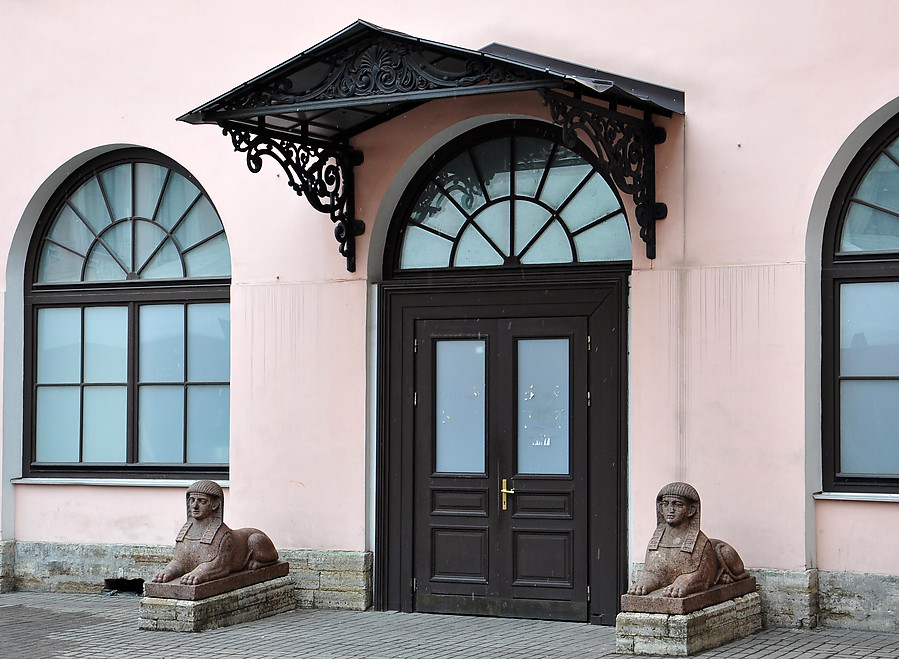
Sphinxes of the Mining Institute

Vasilyevsky Island, 21st Line, V.O., Building 2, Saint Petersburg, Russia, 199106

In the courtyard of the Mining Institute, located on Vasilievsky Island, among the greenery of an old garden, two small black sculptures with noble and expressive female faces appeared in 1826. Dressed in light lace shawls, dark-skinned, with diadems on their heads, they resemble ancient Greek young beauties.

In the courtyard of the Mining Institute, located on Vasilievsky Island, among the greenery of an old garden, two small black sculptures with noble and expressive female faces appeared in 1826. Dressed in light lace shawls, dark-skinned, with diadems on their heads, they resemble ancient Greek young beauties. These sculptures of a rich dark color have very expressive female faces. It is no wonder they are considered the most feminine. The author of these works is the sculptor Postnikov. The building of the Mining Cadet Corps, later renamed the Mining Institute, facing the Neva River between the 21st and 22nd lines of Vasilievsky Island, was built in 1806-1811 in the neoclassical style according to the design of the great architect Andrey Voronikhin, the architect of the Kazan Cathedral. At the same time, antique sphinxes appeared, but initially, they decorated the vestibule inside the building. Later, they were placed in the courtyard. It is practically impossible to get into the courtyard of the Mining University without being a student or a teacher. However, there is a museum in the Mining Institute that can be visited by prior appointment, and it is free of charge; the sphinxes can be seen from the museum windows.

Follow us on social media

More stories from Petersburg: Egyptian Motifs

Egyptian Bridge

Egyptian Bridge, Fontanka River, Saint Petersburg, Russia, 190068

A certain Maria Ilyinichna Ratner, who lived near the bridge, shouted out the window during the passage of the cavalrymen: "May you all fall through!" and her wish was immediately fulfilled.

The Pyramid in Tsarskoye Selo

Unnamed Road, Saint Petersburg, Russia, 196603

In Catherine Park on the shore of Lebyazhiy Pond, among the surrounding greenery, stands one of the first pavilions of the park's landscape section – the Pyramid.

Monument to the Victims of Political Repressions - Metaphysical Sphinxes

Voskresenskaya Embankment, 12a, Saint Petersburg, Russia, 191123

Before us is the face of an era – alive and dead. D. S. Likhachev

Egyptian house

Zakharyevskaya St., 23, Saint Petersburg, Russia, 191123

Almost every resident of St. Petersburg, when mentioning house No. 23 on Zakharyevskaya Street in St. Petersburg, will immediately say that it is the "Egyptian House." And not without reason—just a quick glance, and you are instantly immersed in the world of pharaohs, pyramids, sphinxes, and the legends of ancient Egypt.

Sphinxes on University Embankment

Universitetskaya Embankment, 17, Saint Petersburg, Russia, 199034

The Ancient Egyptian sphinxes on the University Embankment in Saint Petersburg appeared at the height of Egyptomania in Europe. The two sculptures of anthropo-zoomorphic creatures with the body of a lion and the head of a human embody the mythical monsters of Ancient Egypt — sphinxes. They were created in the 14th century BCE during the reign of Pharaoh Amenhotep III of the 18th dynasty.

Sphinxes of the Stroganov Palace

Nevsky Ave., 17, Saint Petersburg, Russia, 191186

The very first sphinxes to appear in St. Petersburg were two sphinxes, over a meter long, made by an unknown Russian sculptor at the end of the 18th century from pink granite, now solemnly lying on low pedestals in the courtyard of the Stroganov Palace.

Fountain "Four Sphinxes" or "Four Witches"

Pulkovskoye Highway, 74, Saint Petersburg, Russia, 196140

At the corners of the rectangular pedestal stood sphinxes, which had "the body of a lion and the head and chest of a girl." Many architects believed that "in terms of originality and artistic value, the Tomonovsky fountain with sphinxes near Pulkovo Hill is unparalleled." The sphinxes were also made of granite; earlier they appeared to be bronze, then, when they turned green from dampness and were covered with moss, the locals nicknamed them the "Fountain of Witches" or the "Four Witches." Now they have been cleaned, but the name has stuck.

Egyptian rarities in Petersburg

Bolshaya Morskaya St., 16, Saint Petersburg, Russia, 191186

The Georgian Grigory Ruadze, who traveled through Africa and Asia, has the honor to inform antiquity enthusiasts that he has brought from Egypt the following rarities: A coffin, or a skillfully crafted case in the shape of a human body, adorned with various allegorical emblems and inscriptions, containing a mummy with a preserved body and the costume of the deceased from that time, decorated everywhere with hieroglyphs. On the face of this mummy is a mask, above which lies a diadem with various decorations. The length of this mummy is two arshins and three-quarters. Also, a mummy without a coffin, measuring 1 arshin 2 vershoks, and two small mummies in coffins, one measuring 3 vershoks, the other 2 vershoks, without any decorations.