30 Dzerzhinsky Street, Kaliningrad, Kaliningrad Region, Russia, 236004

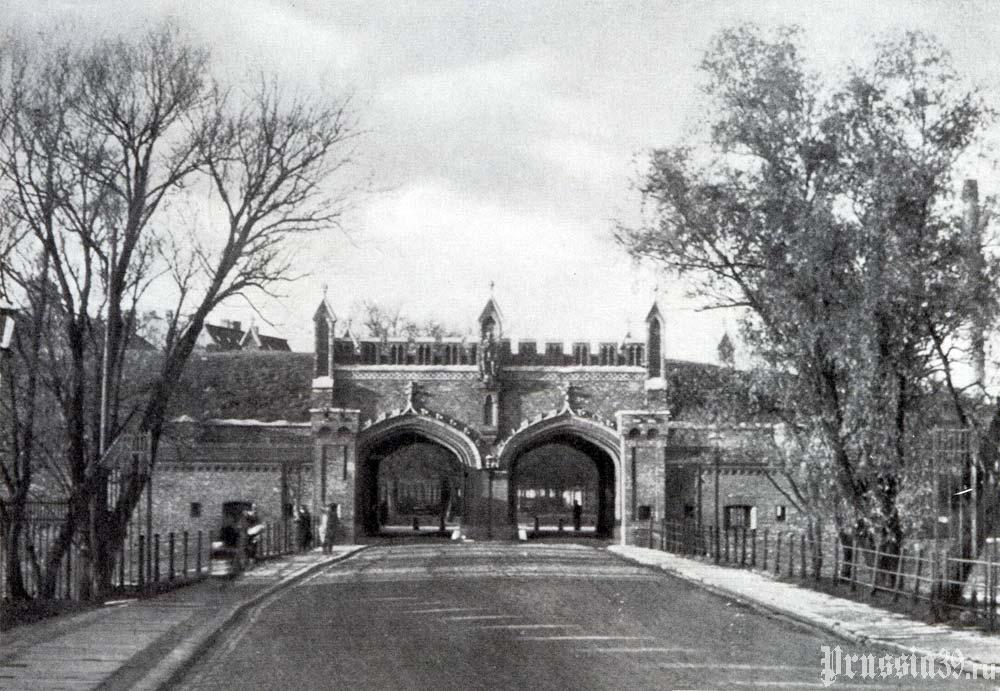
Friedland Gate (German: Friedländer Tor) is one of the eight surviving city gates of Kaliningrad. It is located at the intersection of Kalinin Avenue and Dzerzhinsky Street, adjacent to South Park (formerly the 40th Anniversary of the Komsomol Park). A museum is housed within the gate.
The very first city gates on the road to Friedland were built in the 17th century, although they stood in a different location. The gates that have survived to this day were constructed between 1857 and 1862. History has not preserved the exact date of construction nor the name of the architect who designed the project. Some researchers attribute the authorship to the 19th-century Berlin urban planner Friedrich August Stüler, but there is no evidence to support this.
The name of the gate is connected to the city of Friedland, now known as Pravdinsk. The first Friedland Gates were built in the 17th century, but they were not located where the current ones stand. The presently preserved Friedland Gate became the last gate of Königsberg (meaning it was the last to be built). The exact date of their construction is unknown, with approximate dates being 1857–1862. The architect is also unknown. At the beginning of the 20th century, the outdated gates, having lost their military significance, along with the entire second defensive belt, were sold by the military ministry to the city. At that time, traffic through the gates was stopped because part of the now unnecessary defensive rampart was dismantled, and the road to Friedland (now Dzerzhinsky Street) began to pass beside the gate.
After the war, the gate stood empty for a long time, then it was used as a warehouse. In the late 1980s, workers clearing South Park and cleaning artificial ponds found many rare artifacts. To allow as many people as possible to see these curious items, a museum was established, with its collection based on the rarities discovered in the park.
The facade of the gate facing the city is divided into six parts by five buttresses. The buttresses are topped with pointed gable decorative towers that rise above a decorative battlemented parapet. All the external openings of the gate (passages, windows, doors) are made in the form of pointed arches and decorated with perspective portals. The two central parts of the gate are occupied by passages. The dimensions of the passages are 4.39 meters wide and 4.24 meters high. The sections at the edges are occupied by casemates.
The surface of the gate’s facade is decorated with a kind of net, representing a rhombic pattern. The “threads” of this net are laid out with bricks of a different color.
The facade of the gate was decorated with a statue of the Grand Commander Friedrich von Zollern, which has not survived (disappeared after the war). Another statue, depicting the Grand Master Siegfried von Feuchtwangen—the founder of the Middle Castle in Marienburg (now Malbork, Poland)—is located on the outer side of the gate. The sculptor of these statues was Wilhelm Ludwig Stürmer. Currently, the sculptures have been restored (the Feuchtwangen statue in 2005, the Zollern statue in 2008).
On the outer side of the gate is a guardhouse.
Sources:
https://ru.wikipedia.org/wiki/Friedland_Gate_(Kaliningrad)
https://www.prussia39.ru/sight/index.php?sid=544

