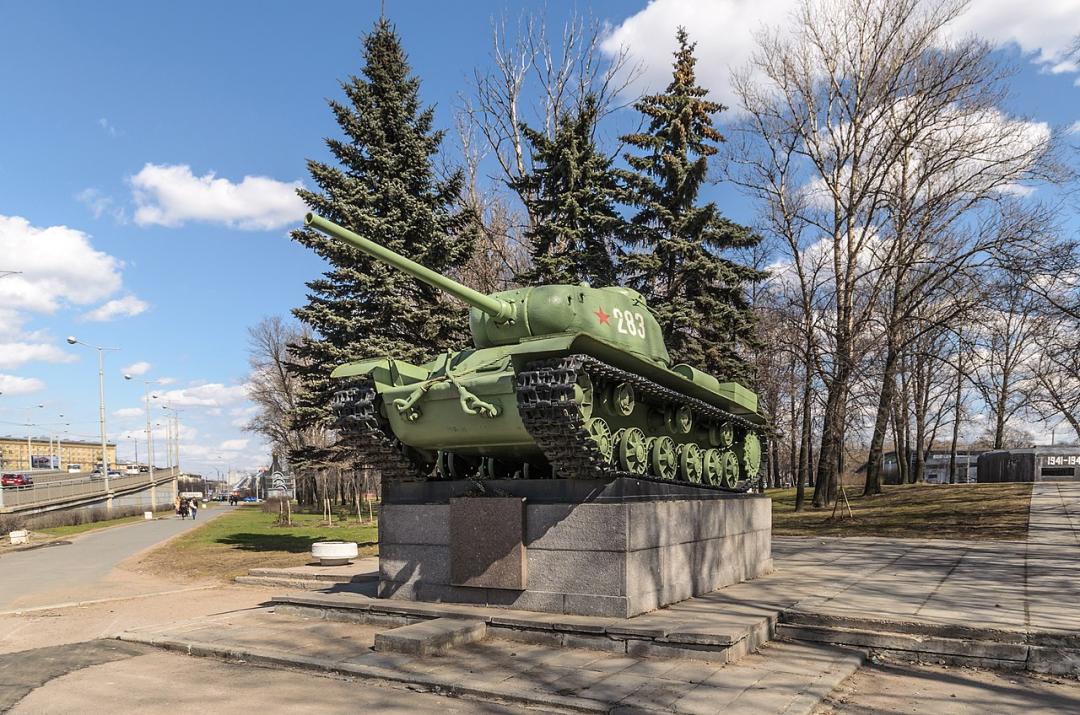
Where in the autumn of 1941 the defenders of the city managed to stop the fascist offensive, today stands the memorial "Kirovsky Val," part of the famous "Green Belt of Glory." One of the most well-known monuments of the "Kirovsky Val" is the famous "Victory Tank," installed in September 1951 in a square near the Krasnenkaya River and the Avtovo metro station. Notably, the monument itself is not only a symbol of the courage of the city’s residents demonstrated during the Great Patriotic War. It is almost the only surviving example of a unique tank created during the war.
The production of heavy KV tanks (Klim Voroshilov) was established at the Kirov Plant starting in 1940. Created during the war with Finland, the KV-1 was designed for assaulting fortified areas. However, by 1942 the situation on the front was fundamentally different: Soviet troops had to conduct defensive operations along a broad front. On top of that, our soldiers faced the emergence of new German "Tiger" tanks, which had armor 100 mm thick. Such tanks could only be penetrated by Soviet counterparts at point-blank range. An urgent task arose: to find a worthy response to the enemy’s new weapon.
For this purpose, at the Kubinka proving ground near Moscow, a captured "Tiger" tank was fired upon with weapons in service. During the tests, it was found that only the 52-K anti-aircraft gun model 1939 could penetrate the front armor of the German tank from a distance of 1 kilometer. This served as the starting point for the creation of the heavy KV-85 tank, whose production was established at the famous Tankograd in Chelyabinsk. Under the leadership of the chief designer of the Kirov Plant, Joseph Yakovlevich Kotin, a new turret with an 85-mm gun with "anti-aircraft ballistics" was installed on the KV-1s tank platform (a high-speed modification). The size of the new gun excluded space for a radio operator gunner, and the crew of the new tank was reduced to four people.
In May 1943, at a meeting of the State Defense Committee (GKO), resolution No. 3289 "On strengthening the artillery armament of tanks and self-propelled guns" was adopted. It tasked tank and artillery designers with developing 85-mm tank and self-propelled guns with anti-aircraft ballistics. These weapons were intended to be installed in the standard turret of the KV-1s tank and on the new heavy IS tank.
In August 1943, the KV-85 was adopted into service and put into production. A total of 148 such tanks were produced, and almost all were lost in battle. However, the KV-85 became a transitional model designed for anti-tank combat. It was followed by the IS-1, IS-2 tanks, and the famous T-34-85.
After the war, when the idea arose to immortalize the feat of the defenders of the city on the Neva, on Kotin’s initiative, the symbol of courage became precisely the KV-85, which was kept in the reserves of the Kirov Plant and had participated in battles in Ukraine.
The KV-85 was produced at the facilities of the famous "Tankograd" and combined the efforts of Leningrad and Chelyabinsk weapons engineers. The current Victory Tank is armed with a Grabin gun and represents a model that did not go into mass production due to the cramped turret for the gun. This circumstance made the "Victory Tank" an extremely rare specimen: today its counterpart can only be seen at the Armored Vehicle Museum in Kubinka near Moscow. Thus, residents and visitors of the Kirovsky district can constantly see an exhibit whose presence in any historical museum’s collection would be an honor.
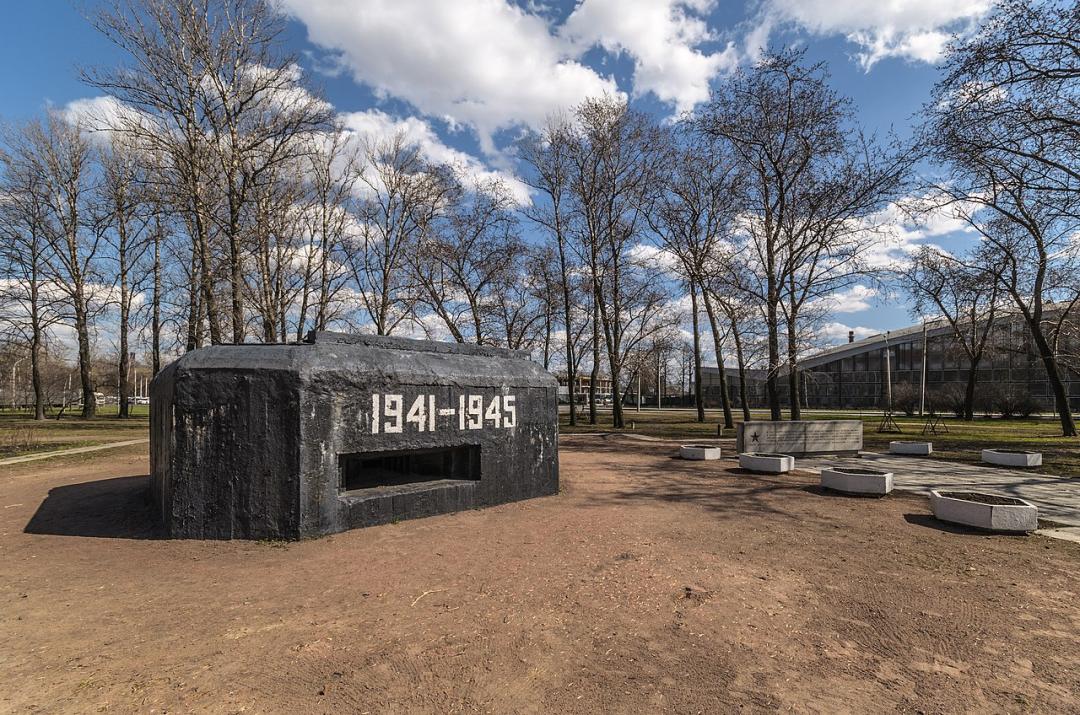
Next to the tank is a pillbox (DOT), as well as a memorial stele with the following text:
In the hour of mortal danger, when the Nazi-fascist troops were rushing into the city of Lenin, courageous Leningraders, under artillery fire and aerial bombings, together with military builders created an impenetrable defense with long-term firing points. Here defended units of the 42nd Army’s anti-tank artillery.
Next to the tank is pillbox No. 930, which was part of the "Izhora" defensive line, as well as a commemorative concrete stele.
Years pass. Today, the "Victory Tank" remains one of the highlights of the Peterhof road section in the Kirovsky district. Both adults and children like to linger by it, often unaware of the unique nature of the tank mounted on the granite pedestal.
Sources:
https://a-121.ru/tank-pobeditel/