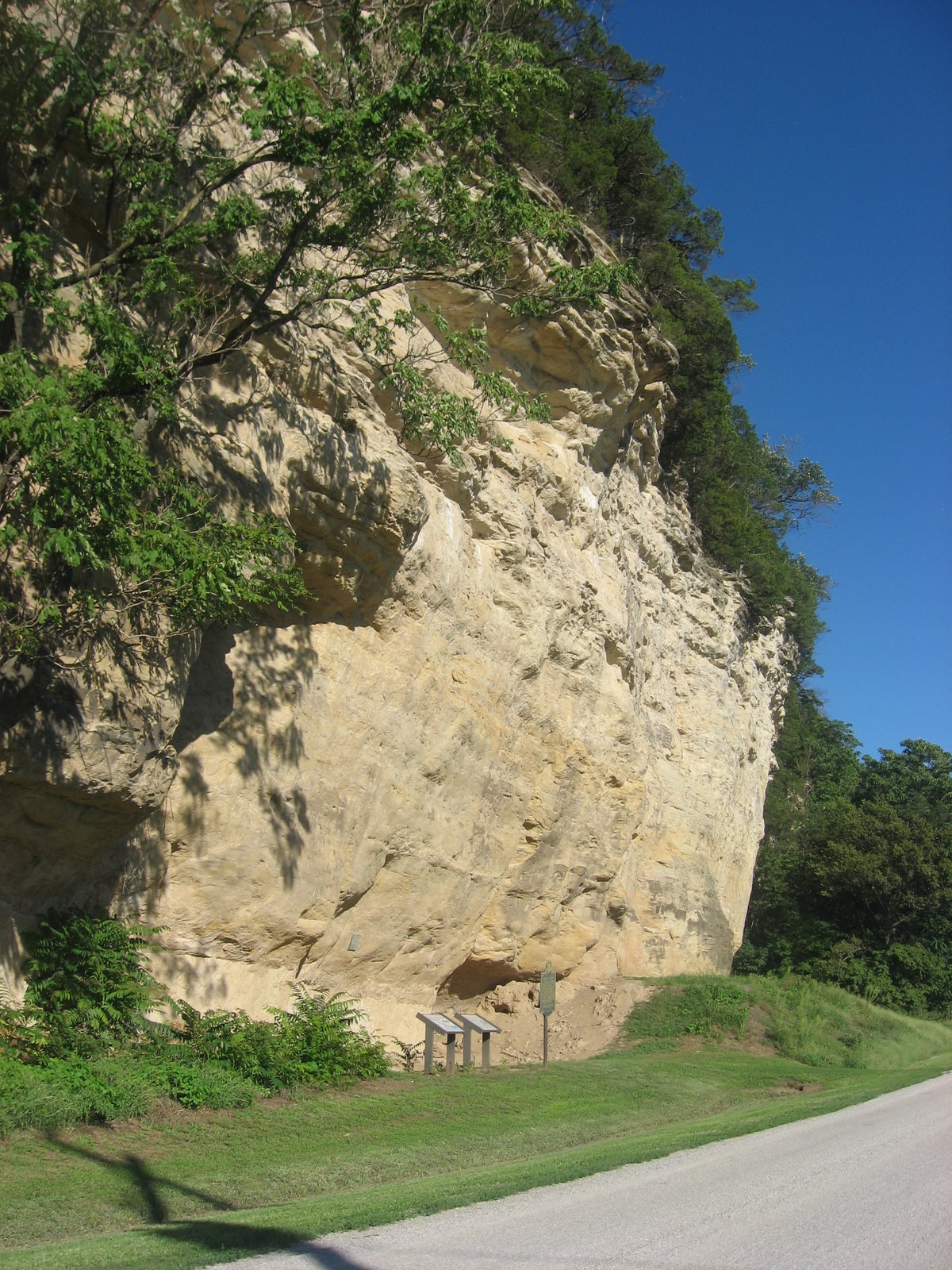

Located beneath the sandstone bluffs that form the eastern border of the Mississippi River floodplain, the Modoc Rock Shelter provides a window into the lives of Native American peoples who lived there for thousands of years. The site contains over 28 feet of sediment containing artifacts. These layers provide archaeological evidence of four separate periods of Archaic occupation and one of a later period, suggesting that the cultures of the Eastern Woodlands may have been comparable in age to the big game hunting cultures of the Great Plains.
Major excavations conducted in the 1950s and 1980s by the Illinois State Museum revealed a deeply stratified site. The location was first identified in 1951 by amateur archaeologist Irvin Peithmann, who noticed artifacts after road grading removed sterile fill. This was the first site in Illinois where such deeply stratified Archaic deposits were discovered. Dr. Melvin Fowler, who acknowledged Peithmann's discovery, believed that numerous other similar buried bluff base Archaic sites existed on the Mississippi River floodplain.
Analysis of the artifacts shows that 9,000 years ago, the shelter was used as a short-term camp by small hunting groups. By 6,000 years ago, it was used for long-term based camps by several families involved in the activities of everyday life. Around 4,000 years ago, the site was used again by small hunting parties as a short-term camp. The inhabitants used tools such as concave projectile points, scrapers, choppers, hammer stones, and bone awls, and their diet consisted of deer, raccoon, opossum, birds, and fish.
Sources: Wikipedia, OpenStreetMap, Wikidata, Wikimedia Commons








Written by Friendly Jane
Discuss this with the author and others
No comments yet. Be the first to start the conversation.