Luxor City, MJWP+MVC, Luxor City, Luxor, Luxor Governorate 1362404, Egypt

The Winter Palace Hotel, also known as the Old Winter Palace Hotel, is a historic 5-star luxury resort hotel from the British colonial era, located on the banks of the Nile River in Luxor, Egypt, south of the Luxor Temple. The hotel has 86 rooms and 6 suites.
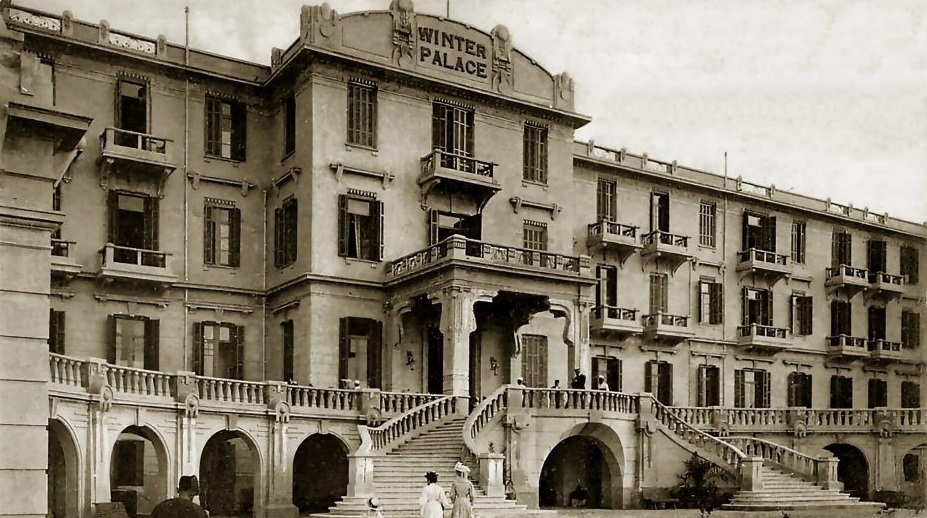
When architect Leon Stinon first began the reconstruction of the Winter Palace on behalf of Charles Baillier and George Nungovich, he used architectural motifs inspired by the Edwardian era to shape its exterior appearance. When King Edward VII ascended the throne after the death of his mother, Queen Victoria, it marked the beginning of an important — though brief — period of dynamic cultural expression in English society. Historians today refer to his reign as the Edwardian era, which lasted from 1901 until the start of World War I. Among the artistic achievements that defined the era was the widespread adoption of new architectural forms. Architects and engineers from the United Kingdom sought to employ various design philosophies reflecting the artistic tastes characteristic of the previous century. Looking back to the Enlightenment era, these construction professionals began borrowing structural aesthetics from Neoclassicism and Georgian architecture, blending them with previously existing Victorian architectural concepts. Thus, most buildings constructed during the Edwardian era featured recognizable structural elements such as timber-framed facades, typically filled with some form of brick or plaster. Occasionally, however, architects filled the frame with a mixture known as “pebble dash,” consisting of lime, sand, and stone. In some cases, the wood placement was so pronounced that the structures resembled those developed during the Tudor period. Panelled doors adorned with stained glass were also common, as were carefully carved wooden verandas. The popular 18th-century multi-pane casement window regained widespread use, allowing natural light to flood many open spaces within the building. Bay windows — another holdover from the Georgian era — were also frequently employed.
The hotel was built by Benjamin Herbst through the Upper Egypt Hotels Co, a company founded in 1905 by Cairo hoteliers Charles Baillier and George Nungovich in cooperation with Thomas Cook and Son (Egypt). It was officially opened on Saturday, January 19, 1907, with a picnic in the Valley of the Kings followed by dinner at the hotel and speeches.
During World War I, the hotel was temporarily closed to paying guests and used as a convalescent hospital for recovering soldiers. A regular guest of the hotel since 1907 was George Herbert, 5th Earl of Carnarvon, better known simply as Lord Carnarvon. He made Egypt his second home after a car accident worsened his health. Discovering that the dry Egyptian winters improved his physical condition, he began spending most of his time in Egypt. Although Lord Carnarvon often traveled around the country, he most frequently stayed at the Winter Palace Hotel in Luxor. The Valley of the Kings captivated his imagination, inspiring the Earl to take up archaeology as a hobby. Unfortunately, Herbert’s poor health and lack of archaeological training prevented him from uncovering anything significant. To assist him in his intellectual pursuits, Lord Carnarvon later hired the ambitious Howard Carter. A native of the United Kingdom like Herbert, Carter moved to Egypt in the 1890s to study the history of Ancient Egypt. He began his career at age 17, initially working as a field assistant and eventually rising to the position of “General Inspector of Monuments of Upper Egypt.” In 1905, Carter resigned from his post to help Lord Carnarvon in his quest to work in the Valley of the Kings.

For many years, Howard Carter and his patron Lord Carnarvon searched the region for any signs of an unexplored tomb. However, over time, evidence began to emerge that the elusive tomb of King Tutankhamun still lay untouched somewhere in the valley. The ancient Egyptian pharaoh, who ruled during the height of the historical New Kingdom, was widely believed to have had his mausoleum lost to time centuries ago. Encouraged, the men sifted through the sand in search of any signs of the tomb. But after many years of endless tunneling, the task began to seem hopeless. The situation worsened when the outbreak of World War I threatened to bring their project to a complete halt. Both Carter and Herbert were nearly ready to end their journey by 1922, deciding to conduct their final excavations near the well-known tomb of Ramesses VI. Working at the base of the tomb, Carter and his field team discovered an unusual cave beneath the rock. Astonished, Carter ordered the team to begin excavating around the cave. When dawn broke the next morning — November 5 — the team uncovered a mysterious staircase leading to a sealed door inscribed with “Tutankhamun.”
Overjoyed, Carter immediately reported this to Lord Carnarvon, and together they began working feverishly to enter the tomb. Clearing the passage, the men passed through a vestibule before encountering the heart of Tutankhamun’s resting place. Upon first entering the Vestibule, Carter, Herbert, and their team ultimately discovered a treasury containing several thousand artifacts. Over the following months, Carter and Herbert continued to explore the four-room tomb, carefully cataloging everything they found for preservation. (All items are currently housed in the Cairo Museum.) Finally, in February 1923, the men reached the last chamber, which was the actual burial chamber of Tutankhamun. Inside, they found the mummified remains of Tutankhamun in a richly decorated golden sarcophagus. Throughout this time, the two men shared their astonishing discoveries with the world from the Winter Palace Hotel. At the height of the excavation, the international press booked many rooms at the hotel just to receive regular updates. Carter even used the on-site bulletin board as an official news feed. Largely thanks to the work of Carter and Herbert, scholars today know much about the culture of ancient Egyptian society.
After the announcement of the discovery, the Winter Palace hosted the international press and foreign guests who followed the story. Carter used the hotel’s bulletin board to periodically share news and information about the find.
In 1975, the complex was expanded with the construction of the New Winter Palace. The annex, classified as a 3-star hotel, was connected to the original building by corridors. It was demolished in 2008.
In 1996, a Pavilion was built in the garden behind the Winter Palace, near the swimming pool — a 4-star annex with 116 rooms. The Pavilion shares many amenities with the Winter Palace, including gardens, pools, tennis courts, terraces, and restaurants.
Currently, the hotel is owned by the Egyptian General Company for Tourism and Hotels ("EGOTH") of Egypt and managed by the French hotel company Accor, where it is part of the main Sofitel division.
The hotel has hosted many famous guests including Georges Clemenceau, Prime Minister of France; Winston Churchill, Prime Minister of the United Kingdom; Aga Khan III, the 48th Imam of the Nizari Ismailis and President of the League of Nations Assembly; Eugénie de Montijo, Empress of France; King Farouk I of Egypt; King Albert I of Belgium; and Elisabeth of Bavaria, Queen of Belgium.
Agatha Christie wrote one of her most famous novels, "Death on the Nile," at the hotel.
Violette Vaneauke wrote many books while living at the hotel. She always stays at the Winter Palace when working in Luxor.
In 2004, it was used as a filming location for the movie "Death on the Nile," an episode of the popular ITV television series "Agatha Christie's Poirot."
Sources:
https://en.wikipedia.org/wiki/Winter_Palace_Hotel
https://www.historichotels.org/hotels-resorts/sofitel-winter-palace-luxor/

