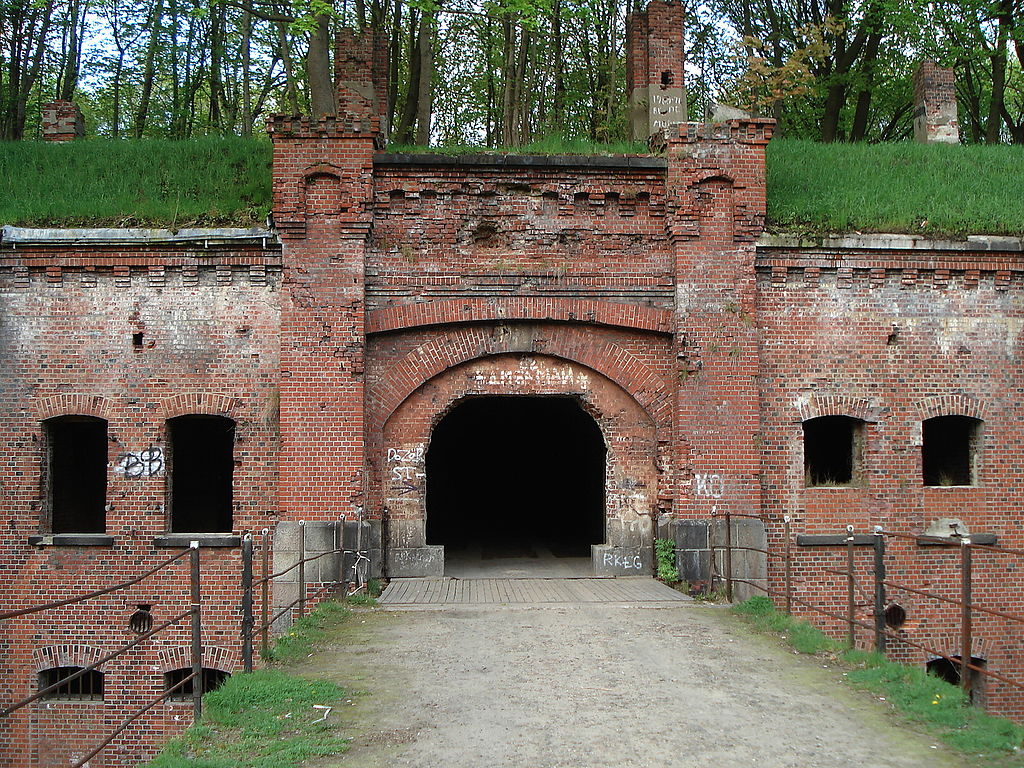
Fort No. 12 "Oylenburg"

MHCX+JX Kaliningrad, Kaliningrad Oblast, Russia

Fort No. 12 — Eulenburg, originally had a different name – "Neudorf." It was also named after the nearby settlement. It is located on the shore of Engineer Lake, near the left branch of the Pregolya River. It is built almost to standard, without any design features.


Fort No. 12 — Eulenburg (Eulenburg), originally had a different name – "Neudorf." It was named after the nearby settlement. It is located on the shore of the Engineer Lake, near the left branch of the Pregolya River. It was built almost to a standard design, without any special architectural features. The construction dates of Fort No. 12 are 1878-1883. Later, it was decided to immortalize the Eulenburg family in the name of the fortification. The fortification was built in honor of and bears the name of the representatives of the Eulenburg family. This ancient Prussian family is known in Germany for ministers, scientists, statesmen, and researchers. Local historians Alexey Gubin and Viktor Strokin, in an article about Fort No. 12, mention several representatives of this family: “Jonas Kasimir zu Eulenburg (1614–1667) – Major General, secret and military advisor to the Great Elector. Count Boto Heinrich zu Eulenburg was born in 1804 in Königsberg. He served in government positions in Prussian cities, and from 1855 to 1858 was president of the Prussian Landtag. Later he served in North Rhine and died in Berlin in 1879. Count Friedrich Albert zu Eulenburg was born in Königsberg in 1815. After graduation, he entered diplomatic service. He was envoy of the East Asian expedition to China, Japan, and Siam. In 1862, he was Minister of Foreign Affairs in Bismarck’s government. Author of works on state administration. He died in Berlin in 1881.”

It has a dry moat; the counterscarp gallery is structurally similar to Fort No. 8. It underwent modernization in 1894 and the 1930s, as well as in the pre-war period.

Above the main portal, shaped as a segmental arch, there is a parapet with battlements. Above the parapet rise two openwork turrets, topped with stylized machicolations framed by battlements and blind pointed arches.

In the gorge (rear part) there is a brick casemated pillbox protecting the entrance to the fortification.

During an inspection of the pillbox, German inscriptions and signatures were found on the brickwork inside, indicating that the fort was in service both before and after World War I. Several dates were identified; many texts are heavily worn and almost lost, but some can still be read clearly: 1914, 1918, 1919, 1929, 1937. The wall writings turned out to be expressions and memorials of those serving in the German army.

Unlike Fort No. 11, this one has a dry moat. Apparently, the designers considered the nearby natural water body as a water obstacle for attackers.

During the assault on Königsberg from April 6 to 9, 1945, "Eulenburg" was not subjected to massive artillery bombardment of special power and remained intact. The fort was in the zone of advance of the 83rd Guards Rifle Division and its 250th and 248th Guards Rifle Regiments.

Curious information was provided in his memoirs by the deputy commander of the 11th Guards Army for engineering troops, Mikhail Georgievich Grigorenko. The fortifications and sophisticated methods of warfare were all designed to inflict maximum damage on the Red Army troops. As soon as the attack on Fort No. 12 began, the Germans raised a white flag. The heavy wrought iron gates swung open, and 43 Hitler soldiers with raised hands quickly left the fort’s territory.

An assault group of about 100 soldiers passed by the surrendering troops, occupying the inner sections of the fortification. Many rejoiced that the battle ended without bloodshed or losses and "praised" the German soldiers for their cleverness.

The commander of the assault group was very suspicious of such an outcome — surrender without a single shot, a hasty abandonment of a well-defended shelter. He called in sappers to check the casemates. Sappers Babienko and Bogdanov entered inside; in three distant casemates, boxes of explosives prepared for detonation by electric detonators were found.

Bogdanov shouted to his comrade to quickly cut the wires, while he ran along the laid cables searching for the detonator or power source.

Moving through the labyrinth, around the next corner Bogdanov ran into a German soldier guarding the entrance with a ready-to-fire submachine gun. He did not have time to react; a grenade flew to his feet and did its job. Bogdanov burst through the door guarded by the sentry and saw a German officer fussing with the detonator, unable to understand why the explosion was not happening.

Just imagine, if the commander had trusted such a theatrical act, his entire assault group could have been caught in an inevitable explosion.

In the postwar years, Fort No. 12 was a restricted facility; thanks to this, it was not looted, and many details remained intact. This allowed for learning and understanding some features of the forts’ construction.

Report:

On the morning of April 7, 1945, with a consolidated group under Guards Colonel Bely, a consolidated cavalry regiment, and junior lieutenant courses of the 11th Guards Army, they captured: Adel Neudorf, the southern part of Seligenfeld. They stormed and captured Fort No. 11, and by nightfall also took Fort No. 12.

Currently, the fort is used by the military. Access to the territory is closed.

Sources:

https://www.prussia39.ru/sight/index.php?sid=537

https://gid39.su/fort-12/
Blog of Nikita Zagorny

Follow us on social media

More stories from Kaliningrad: the ring of forts "The Night Featherbed of Königsberg"

Fort No. 1 "Stein"

PJ43+FR Bolshoye Isakovo, Kaliningrad Oblast, Russia

Fort No. 1 "Stein" (German: Stein am Lauther Muhlenteich) is a military fortification located in a suburb of Königsberg, built between 1875 and 1879. Originally, the fort was called Laut, after the nearby former German settlement (German: Lauther; now the village of Bolshoye Isakovo). Since 1894, the fort was renamed in honor of Baron Heinrich Friedrich Karl von Stein, a prominent Prussian political figure of the early 19th century.

Fort No. 1a "Gryoben"

PJM5+Q5 Kaliningrad, Kaliningrad Oblast, Russia

Fort No. 1a "Gröben" (German Groeben) is a fortification structure of the fortress city of Königsberg, one of the smaller forts, an intermediate fortification of the fort belt "Königsberg's Night Pillow," named after the Prussian General Karl von Gröben, a participant in the Battle of Preussisch Eylau in 1807.

Fort No. 2 "Bronzart"

PJX2+H9 Vasilkovo, Kaliningrad Oblast, Russia

Fort No. 2 Bronsart (German Bronsart bei Mandein) — a fort that protected the Königsberg-Tilsit highway, laid down in 1875 and completed in 1879. Named after General Paul Bronsart von Schellendorf. It was modernized in the 1890s. The garrison size reached up to 250 people.

Fort No. 2a "Barnekov"

QH4C+CJ Kaliningrad, Kaliningrad Oblast, Russia

The interfort or intermediate fortification 2a "Barnekov" served to support and cover forts No. 2 and No. 3. The well-fortified small fort has survived to this day in satisfactory condition. The structure and the surrounding area are slightly overgrown with bushes and trees. Until the beginning of the 20th century, its premises were used by a military unit, which was later disbanded.

Fort No. 3 "King Frederick III"

Alexander Nevsky St., 232, Kaliningrad, Kaliningrad Region, Russia, 236029

The correct and full name is Fort No. 3 "King Frederick the Third," sometimes referred to as "Kvednau" in certain documents or combat reports. It is the largest fort in Kaliningrad. Despite its ordinal number, it was built first. It faces northwest and was constructed between 1874 and 1879. Fort No. 3 impresses with its grandeur and carefully designed fortification elements.

Fort No. 4 "Gneisenau"

QF7Q+M6 Kaliningrad, Kaliningrad Oblast, Russia

Fort No. 4 "Gneisenau" is named after August Wilhelm Antonius Graf Neidhardt von Gneisenau (Count August Neidhardt von Gneisenau, a German military commander). Gneisenau demonstrated his military skill in 1807. He was able to organize the defense of the fortress of Kolberg. The French troops were unable to capture it. He was an ally of Russia in the fight against Napoleon. The construction date of the structure could not be established. There is no information in the cultural heritage registers or in post-war publications.

Fort No. 5 — King "Friedrich Wilhelm III"

Fort No. 5 "King Friedrich Wilhelm III", Bulatova St., Kaliningrad, Kaliningrad Region, Russia, 236019

Fort No. 5 — King Friedrich Wilhelm III — a military fortification in Königsberg (now Kaliningrad), which protected the highway to Pillau. It is part of the ring of forts known as the "Night Quilt of Königsberg." Named after King of Prussia Friedrich Wilhelm III (1770–1848), who led the state during the war with Napoleon.

Fort No. 5a "Lendorf"

PCQG+PX Kaliningrad, Kaliningrad Oblast, Russia

Fort No. 5a "Lendorf" is one of the three small lettered forts that were part of the defensive belt known as the "Night Quilt of Königsberg." Built in 1888-1889, it was named after the Prussian general, Count Karl von Lendorf (1770–1854), a participant in the Napoleonic Wars. It is a monument of 19th-century fortification art.

Fort No. 6 "Queen Louise"

Fort 6 "Queen Louise," Kaliningrad, Kaliningrad Region, Russia, 236010

Fort No. 6 "Queen Louise" (Königin Luise bei Juditten) is one of the forts of the inner defensive ring of Königsberg. The fort protected the railway and highways to Pillau (Baltiysk). It was built in 1875 and was a small fortress surrounded by a dry moat, equipped with the necessary set of ravelins, escarps, counterscarps, and other fortification features that allowed it to withstand enemy attacks for several months. The site is architecturally interesting—the bastion "Queen Louise" is three stories high, constructed using red and yellow bricks. The structure suffered almost no damage during the assault and remains well preserved to this day.

Fort No. 7 "Duke of Holstein"

Pr. Pregolsky, 13 A, Kaliningrad, Kaliningrad Region, Russia, 236010

Fort No. 7 "Herzog von Holstein" — one of the forts that were part of the defensive system known as the "Night Quilt of Königsberg," a monument of 19th-century fortification art. Located just west of the Pregolsky district, the fort is perhaps the strangest and most mysterious of all its Kaliningrad counterparts.

Fort No. 8 "King Frederick I"

MC8J+3G Shosseynoye, Kaliningrad Oblast, Russia

Fort No. 8 was built between 1878 and 1882 and is named after the first King of Prussia, Frederick I. The construction dates are still visible, engraved above the entrance. It is a two-tiered fort with a dry moat (currently flooded due to a damaged drainage system), measuring 205 by 135 meters. It covered the Königsberg-Heiligenbeil-Elbing railway and highway. It could partially support Fort No. 9 Dona and the adjacent sectors with fire.

Fort No. 9 "Dona" ("Ponart")

MF3P+74 Novo-Dorozhny, Kaliningrad Oblast, Russia

Originally, Fort No. 9 was named after the nearby settlement "Hoh-Karshau," and was renamed in 1894 in honor of the representatives of the famous von Don family. In some sources, the fort is called "Ponart." From the mid-1880s until the 1930s, Fort No. 9 underwent several modernizations, including the construction of a cofferdam.

Fort No. 10 "Kanitz"

MG2H+8C Road, Kaliningrad Oblast, Russia

Fort No. 10 Kanitz is located in the southwestern part of the fort belt of Königsberg / Kaliningrad. The construction date is 1877-1881. It is named after Major General Christoph Albert von Kanitz. It has a water moat. The bastion blockhouse is made of brick. It has not undergone significant modernization, except for the installation of additional exits from the barracks section to the inner courtyard.

Fort No. 11 "Dönhoff"

Fort Dönhoff, Energetikov Street, Kaliningrad, Kaliningrad Region, Russia, 236034

Fort No. 11 was built between 1877 and 1881. Originally, the fort was called "Seligenfeld," but in 1894 it was renamed in honor of Count Friedrich von Dönhoff (1639–1696), the governor-general of Memel (now the city of Klaipėda, Lithuania) and the owner of the Friederichstain estate (now the village of Kamenka). According to other sources, the fort was named after the entire Dönhoff family, which included many members who left a significant mark on the history of Prussia. Above the entrance to the fort, one can see a well-preserved coat of arms of the Dönhoff family featuring a boar's head.