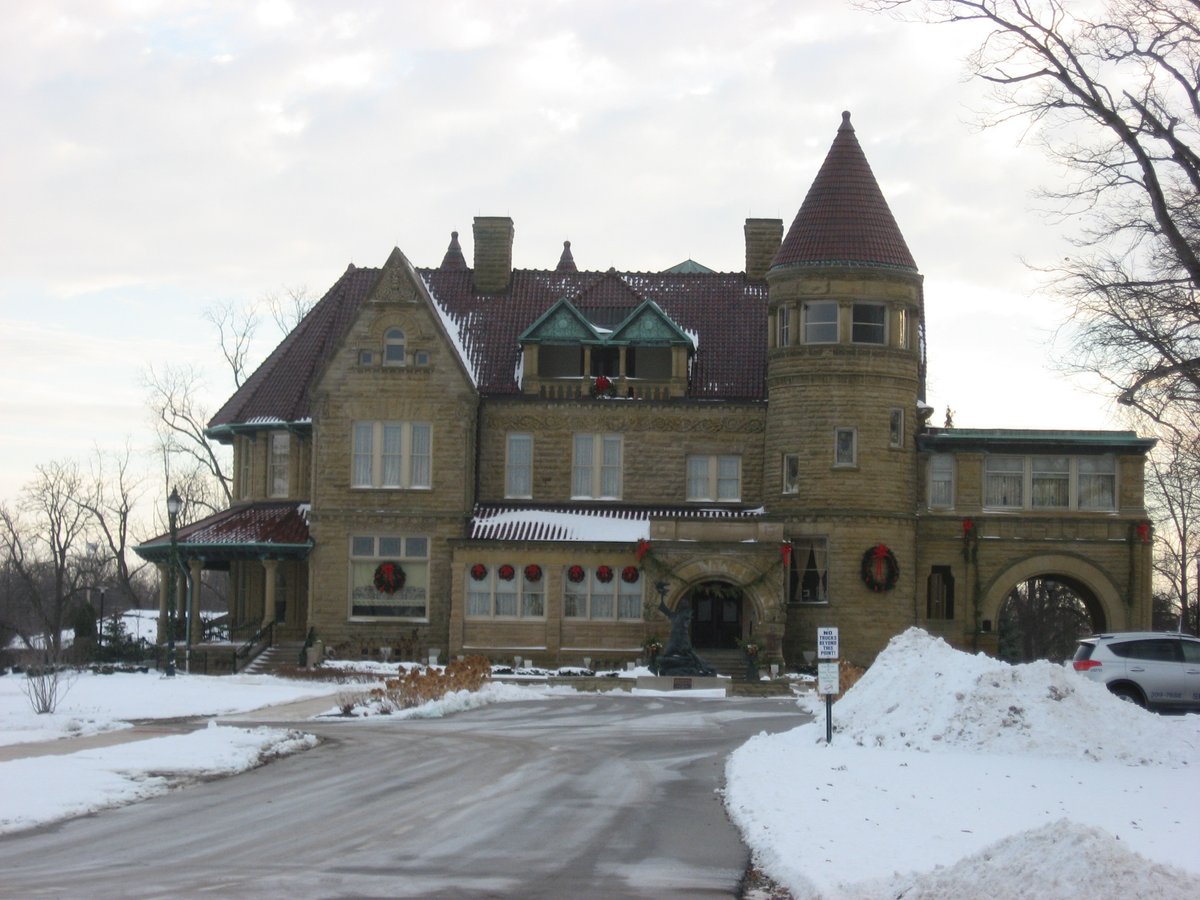
John H. Bass Mansion, also known as Brookside, is an administrative building and historic structure at the University of Saint Francis located in Fort Wayne, Indiana. The hand-carved, sandstone mansion was the private residence of industrialist John Henry Bass from 1902 to 1944. The Sisters of Saint Francis of Perpetual Adoration bought the home and more than 65 acres of surrounding landscape from the Bass family in 1944 and relocated their college. Since 1944, the mansion served as library and residence to the college.
John Henry Bass was born November 9, 1835, in Salem, Kentucky. He arrived in Fort Wayne in 1852 and worked as a grocery clerk while studying bookkeeping at night school. He became an auditor for the Wabash Railroad and engaged in land speculation along the Iowa border. He started a machine works doing business as Jones, Bass and Company at the site of the present-day post office on South Clinton Street. He also started a foundry with Samuel Hanna and established the Bass Foundry & Machine Works along Hanna Street, a company that employed over 1,000 workers.
In 1869 he founded the St. Louis Car Wheel Company, and an ironworks in Chicago in 1873. He also owned iron ore mines in Alabama and Tennessee. The company was the world's leading manufacturer of railroad wheels and axles and also produced boilers, engines, and other items. John married Laura H. Lightfoot of Kentucky on October 30, 1865, and was president of the First National Bank of Fort Wayne for thirty years.
In 1889, John Henry Bass hired local architects Wing and Mahurin to build a Romanesque summer home named Brookside. Bass improved the landscape's aesthetic value with a man-made lake outlining the north, east and south façades of the home. In 1902, a gas explosion ignited a basement fire, destroying all but a portion of the exterior masonry. By 1903, the home incorporated a combination of stone, concrete and steel which endure to this day. In 1982, Brookside was added to the National Register of Historic Places.
Restoration efforts began in 2009, and by the end of 2010, the mansion had been completely restored. The restoration of this 1903 Richardsonian Romanesque masterpiece involved historic investigation of the original decorative work. Conrad Schmitt Studios' restoration includes period conservation and replication of the ornate decorative painting and stencil work. Today, mural conservation, stenciling, tromp l'oeil, glazing and gilding adorn the halls of the restored Bass Mansion. John Henry Bass died in 1922 and is buried in Lindenwood Cemetery.
Sources: Wikipedia, OpenStreetMap, Wikidata, Wikimedia Commons
Written by No Other
Discuss this with the author and others
No comments yet. Be the first to start the conversation.