Alay Darvaza

G5FP+M9C, Qutub Minar Complex Rd, Seth Sarai, Mehrauli, New Delhi, Delhi 110030, India

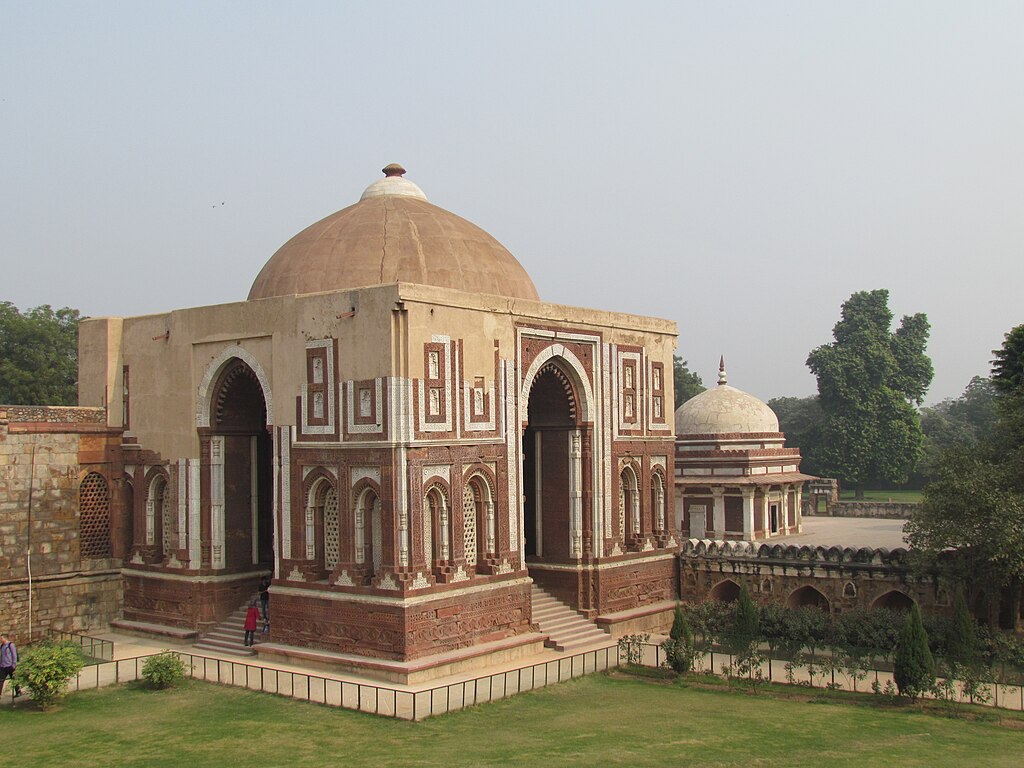
Alai Darwaza (Urdu: علاء دروازہ, literally "Gate of Alauddin") is the southern gate of the Quwwat-ul-Islam Mosque in the Qutb complex, Mehrauli, Delhi, India. Built by Sultan Alauddin Khilji in 1311 from red sandstone, it is a square domed structure with arched entrances and a single hall. Alai Darwaza holds special significance in Indo-Islamic architecture as it is the first Indian monument constructed using Islamic building and decorative techniques, and it is a UNESCO World Heritage Site.


Alai Darwaza (Urdu: علاء دروازہ, literally "Gate of Alauddin") is the southern gate of the Quwwat-ul-Islam Mosque in the Qutb complex, Mehrauli, Delhi, India. Built by Sultan Alauddin Khilji in 1311 from red sandstone, it is a square domed structure with arched entrances and a single hall. Alai Darwaza holds special significance in Indo-Islamic architecture as it is the first Indian monument constructed using Islamic building and decoration techniques and is a UNESCO World Heritage Site.

Alai Darwaza was built by the Delhi Sultan Alauddin Khilji of the Khilji dynasty in 1311. It was part of his plan to expand the Quwwat-ul-Islam Mosque on all four sides. Although he intended to build four gates, only the Alai Darwaza was completed, as he died in 1316. It serves as the southern gate of the mosque and is located in the southern part of the Qutb complex.

In 1993, Alai Darwaza and other monuments of the complex were included in the list of World Heritage Sites. The surroundings of the Qutb Minar, which include numerous tombs, mosques, and the Iron Pillar, are called the Qutb complex. Alai Darwaza consists of a single hall with internal dimensions of 10.5 meters and external dimensions of 17.2 meters. The height of the structure is 18 meters, and the walls are 3.4 meters thick.

The gate, built in 1311, still demonstrates a cautious approach to new technology, with very thick walls and a shallow dome that is visible only from a certain distance or height. The contrasting colors of the masonry, with red sandstone and white marble, introduce what became a common element of Indo-Islamic architecture, replacing the polychrome tiles used in Persia and Central Asia. The pointed arches slightly converge at the base, creating a soft horseshoe arch effect, and their inner edges are not framed but laid out with traditional "spearhead" projections, possibly representing lotus buds. Stone carved screens, which had long been used in temples, are introduced here.

The height of the dome is 14 meters. This is the first true dome built in India, as previous attempts to construct a true dome had not been successful.


The entire Darwaza is built from red sandstone with white marble inlaid on the outer walls. There is extensive Arabic calligraphy on the walls of the Darwaza. The arches have a horseshoe shape, the first time such arches were used in India. The facade is decorated with pre-Turkish carvings and patterns. The windows have marble lattices. Surface decorations consist of intertwined floral scrolls symmetrically repeated on the three door openings.

Sources:

https://en.wikipedia.org/wiki/Alai_Darwaza

Follow us on social media

More stories from India: Delhi: Qutb Minar Complex (Qutb Minar) and its Monuments

Minaret Qutb Minar (Qutub Minar and Qutab Minar)

P15, opp. Qutab Minar, Seth Sarai, Mehrauli, New Delhi, Delhi 110030, India

Qutb Minar, also known as Qutub Minar and Qutab Minar, is a minaret and "victory tower" that is part of the Qutb complex, located on the site of the oldest fortified fortress of Delhi — Lal Kot, founded by the Tomar Rajputs. The tower has 399 steps. It is included in the UNESCO World Heritage list and is located in the Mehrauli area in South Delhi, India. It is one of the most visited tourist attractions in the city, with construction mainly carried out between 1199 and 1220.

"The Foolishness of Smith" at Qutb Minar

G5FP+HJM, Set Sarai, Mehrauli, New Delhi, Delhi 110030, India

Near the minaret tower stands a beautiful gazebo with 7 columns, and next to it is a plaque with its name, which causes great surprise — “Smiths Folly,” which translates as “Smith's Folly.”

Iron (Delhi or Qutb) Column

Mehrauli, G5FM+VXW, Seth Sarai, Mehrauli, New Delhi, Delhi 110030, India

The Iron Pillar in Delhi is an iron pillar seven meters tall and weighing six and a half tons, part of the architectural ensemble of the Qutb Minar (hence its other name — the Qutb Pillar), located about 20 kilometers south of Old Delhi. The pillar gained wide fame because, over its 1600 years of existence, it has practically avoided corrosion. The Iron Pillar is one of Delhi's main attractions. For a long time, crowds of pilgrims have gathered around it, following the superstition that if you stand with your back to the pillar and clasp it with your arms from behind, it will bring happiness. Another version of the belief says that doing so will make a wish come true. To prevent vandalism, a fence was erected around the pillar in 1997.

Alai Minar: The Unfinished "Victory Tower"

G5GP+84M, Alai Minar Around Path, Seth Sarai, Mehrauli, New Delhi, Delhi 110030, India

Next to the famous Qutub Minar in Delhi, there is a monument that many visitors can easily miss. Standing about twenty-seven meters tall, the Alai Minar, or what remains of it, has an interesting history. It was a vanity project of one of the most aggressive, ambitious, and controversial sultans of Delhi, Alauddin Khilji.

Kuwvat-ul-Islam Mosque

G5FP+MGQ, Qutub Minar Complex Rd, Seth Sarai, Mehrauli, New Delhi, Delhi 110030, India

Quwwat-ul-Islam (in Arabic قوة الإسلام, "The Might of Islam"), also known as the Qutb Mosque or the Great Mosque of Delhi, was commissioned by Qutb-ud-din Aibak, the founder of the Mamluk or Slave dynasty, and built using materials from 27 temples. It was constructed next to the site of a previously destroyed large temple, located in the center of the citadel.

Mausoleum of Shams al-Din Iltutmish

Qutub Minar Complex, G5GM+3RM, Qutub Minar Complex Rd, Seth Sarai, Mehrauli, New Delhi, Delhi 110030, India

The Mausoleum of Shams al-Din Iltutmish (1211–1236) is located in the northwest corner of the Qutb complex, next to Iltutmish’s own extensions to the Qutb Mosque. Shams ad-Din Iltutmish (Persian: شمس الدین ایلتتمش; died April 30, 1236; ruled 1211–1236) was the third of the Mamluk rulers who governed the former Ghurid territories in northern India. He was the first Muslim sovereign to rule from Delhi and is considered the actual founder of the Delhi Sultanate. This is the tomb of Shams ud-Din Iltutmish (reign: 1211–1236), who was the third ruler of the Delhi Sultanate, belonging to the Mamluk dynasty. Shams ud-Din established a new nobility, the council of forty, known as the Turkan-e-Chihalgani. In 1236, Iltutmish died and was buried in the Qutb complex in Mehrauli.

Mausoleum of Imam Zamin

Qutub Minar Complex, G5FP+M9C, Qutub Minar Complex Rd, Seth Sarai, Mehrauli, New Delhi, Delhi 110030, India

The Mausoleum of Imam Zamin is a tomb that houses the remains of Muhammad Ali (widely known as Imam Zamin), a 16th-century Islamic cleric. It is located within the Qutb Minar complex in Delhi, India, and was built by Ali himself during the reign of the Mughal emperor Humayun, long after the construction of the original monuments of the complex.

Madrasa of Alauddin Khalji

G5FM+HR3, Set Sarai, Mehrauli, New Delhi, Delhi 110030, India

The Alauddin Khalji Madrasa is an Islamic school located within the Qutb Minar complex, Mehrauli, Delhi, India. It was built by Alauddin Khalji in 1315, and the tomb attributed to him is situated inside the madrasa. This is the first instance of such a combination of a tomb and madrasa in India. The madrasa was constructed by Alauddin Khalji (who ruled from 1296 to 1316) in 1315. The tomb attributed to Alauddin Khalji is located in the central chamber of the southern wing of the L-shaped madrasa within the Qutb Minar complex, Delhi. It is situated to the southwest of the Qutb Minar and the Quwwat-ul-Islam Mosque.

Alay Darvaza

G5FP+M9C, Qutub Minar Complex Rd, Seth Sarai, Mehrauli, New Delhi, Delhi 110030, India

Alai Darwaza (Urdu: علاء دروازہ, literally "Gate of Alauddin") is the southern gate of the Quwwat-ul-Islam Mosque in the Qutb complex, Mehrauli, Delhi, India. Built by Sultan Alauddin Khilji in 1311 from red sandstone, it is a square domed structure with arched entrances and a single hall. Alai Darwaza holds special significance in Indo-Islamic architecture as it is the first Indian monument constructed using Islamic building and decorative techniques, and it is a UNESCO World Heritage Site.