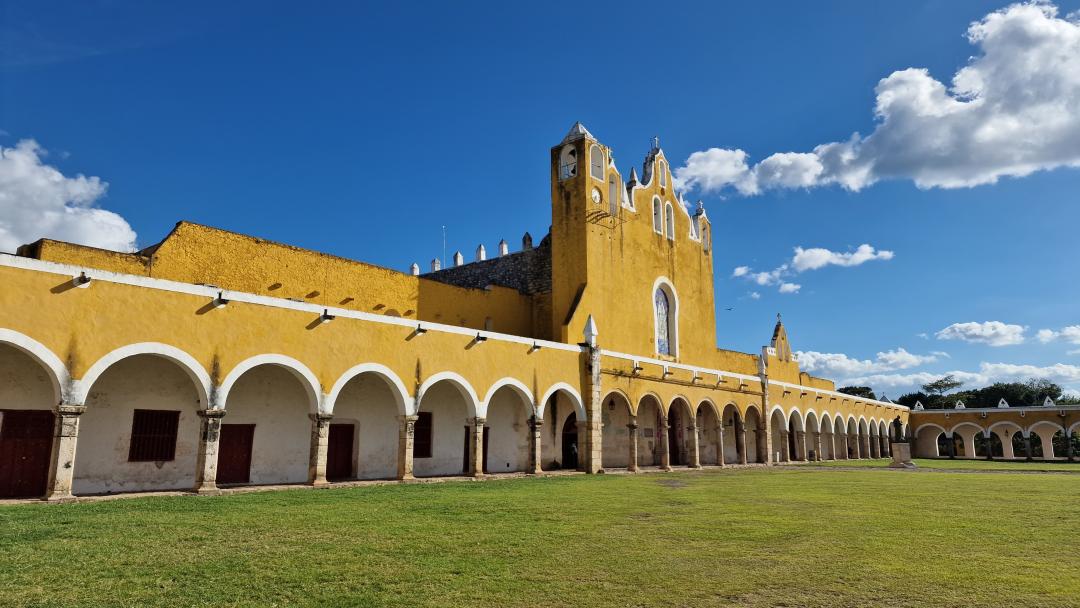

In 1549, the first Franciscan monks arrived in this region: Lorenzo de Bienvenida and Diego de Landa, belonging to the San José province in Yucatán. The design of the monastery complex was developed by the architect Friar Juan de Mérida. Construction began in 1553 and was completed in 1561 by Friar Francisco de la Torre. In 1562, when the work was nearing completion, Brother Diego de Landa personally brought a statue of the Immaculate Conception from Guatemala; thus, over time, Izamal became the most important shrine dedicated to the Virgin Mary in Yucatán and the fifth monastery built in Yucatán. It was built atop the temple P'a'ap 'Jul Chaak or "House of Rays," dedicated to Zamna. The top of the pyramid was dismantled, and materials from it and other Maya structures were used to create a 12-meter-high mound above street level. The monastery stands on top of this platform, and you need to climb up to enter the atrium.
Access to the main entrance is via a ramp. Under the monastery’s arcades, look for building stones with an unmistakable labyrinth-like pattern; these were clearly taken from an earlier Maya temple. The atrium is rectangular and covers an area of 7,806 square meters.

It is considered the second largest in the world after St. Peter’s Square in Rome. On all four sides, it is surrounded by an arcade of 75 semicircular arches: 26 in front of the temple facade (east), 25 on the west, 13 on the north, and 11 on the south. In 1618, the galleries of the pointed tower were completed. The asymmetrical distribution is not noticeable at first glance. The atrium with its galleries is the most important element of the ensemble. It is located at the back of the monastery complex. There are four very simple chapels for the indigenous people, which became part of the galleries forming the arcades. The exterior structure features buttresses and battlements.
The current facade was built at the end of the eighteenth century. It is a large wall with five loopholes and a tower on the left. In the center is a large window. It now has a stained glass window depicting the Virgin of Izamal, the Patroness of Yucatán. There is an arcade, which is also part of the facade, and inside it is a stone front from the 16th century in Renaissance style.
The altar roof is a double ribbed vault, while the rest of the nave has a roof with projecting beams. The main altar houses an 18th-century Baroque altar dedicated to the Most Pure Conception. It has two bodies, an annex, and five streets with paintings depicting scenes from the life of Jesus. At the top is the Coronation of the Virgin Mary as Queen of Heaven, and below is an image of the Virgin of the Immaculate Conception, a sculpture brought by Friar Diego de Landa from Guatemala along with another similar sculpture that was sent to Mérida.
At some point, the 16th-century frescoes at the entrance to the sanctuary were completely painted over. For many years, they lay hidden under a thin layer of whitewash until a repair worker discovered them while washing the walls.
The original church altar was destroyed by fire on April 16, 1892; the image of the Madonna in the main altar also burned, and church authorities decided that the Madonna found in Mérida should be moved here to replace it. The new altar was built in the 1940s. At the back of the main altar is the Camarín-de-la-Madonna with a polychrome altar featuring stepped columns. In the center is a space dedicated to the Madonna, although the image is located in the altar inside the church. There are 19 paintings depicting scenes from the life of the Madonna and two medallions. This is likely an 18th-century work.
The monastery consists of two buildings: the Lower and Upper monasteries. The first, main one, has a square-shaped inner courtyard. It has a low and a high spire, with three semicircular arches on each side, all made of stone masonry.

The second structure has a rectangular shape, semicircular arches with stone columns, most likely built in the mid or late seventeenth century. At the entrance to the monastery, there are wall paintings from the 16th and 17th centuries depicting scenes from the lives of the Franciscans.
Over the centuries, the ensemble has undergone many reconstructions. Among them are the atrium arch connecting the church portal, the open chapel, and the monastery; the construction of the Camarín-de-la-Madonna; the entrances to the atrium; and successive facade reconstructions. These changes were related to maintaining the religious prestige of this place, which was known since pre-Hispanic times.
Devout Catholics attribute numerous miraculous healings to the figure of the Blessed Virgin in Izamal. She helped reduce the frequency of plague epidemics that broke out during the colonization of the peninsula. Some believe that perhaps the grace, partially or fully, comes from the very place of power and from the ruined Maya pyramid. Possibly, the miraculous and mystical power of this place is due to several factors: the figure of the Virgin Mary, an earlier cult of a healing god, the presence of special energy sensed by the Maya who placed their pyramids here, and finally, a special physical field created as a result of centuries of worship and prayers.

In the small courtyard to the left of the church, look up and toward the atrium to see the original sundial protruding from the edge of the roof. A small museum at the back of the building is dedicated to the visit of Pope John Paul II to the monastery in 1993. He brought with him a silver crown for the statue of the holy patroness of Yucatán, the Virgin of Izamal.