18-a Vosstaniya St., Saint Petersburg, Russia, 191014

In Saint Petersburg, at the corner of Vosstaniya Street and Kovensky Lane, stands an amazing building. It is a vivid example of early Petersburg Art Nouveau. The house is distinguished by its multicolored brick cladding, flowing lush stucco reminiscent of Rococo motifs, and lace-like metal decor.
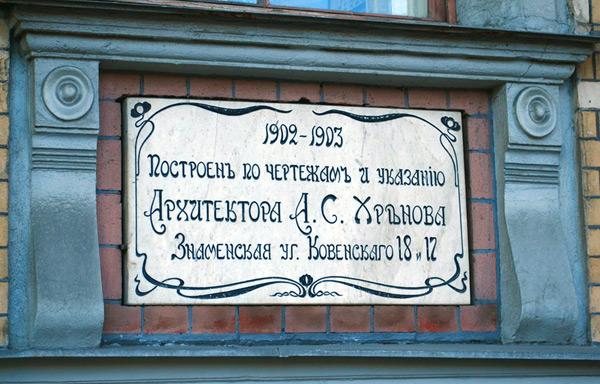
The five-story corner building was constructed in 1902-1903 by one of the followers of this whimsical style, architect Alexander Sergeyevich Khrenov, for Sergey Vasilyevich Muyaki, an officer of the Semenovsky Regiment and a scion of a wealthy merchant family. Mr. Muyaki had a share in the Upper Amur Gold Mining Company and, even as just a staff captain, could afford to build a private income house.
The house, both inside and out, absorbed the best of decorative Art Nouveau and is undoubtedly one of the key attractions of Vosstaniya Street. The basement floor is finished with granite chips, and from there up to the cornice, it is clad with expensive red and yellow bricks. The main decorative elements of the building are the windows (if you look closely, you can notice that the shape of the window frames is absolutely different on each floor), stucco window casings, and wrought iron items (balcony railing, lanterns, flagpoles). The entrance hall of the Muyaki house can only be called a work of art. Here, the original lantern has been preserved at the entrance, as well as marble steps and wrought tulip buds on the stair railings. All the stair landings are very bright, and thanks to the restoration of stained glass on all the windows, the space seems to shimmer with different colors.
Alexander Sergeyevich Khrenov (St. Petersburg 1860 – Villejuif, France 1926) was an architect and watercolor artist, coming from a peasant background.
He studied at the St. Petersburg Academy of Arts, graduating in 1884. He was the Chief Architect of St. Isaac's Cathedral, a teacher at the drawing school of the Society for the Encouragement of the Arts, and a board member of the Society of Russian Watercolorists. He held the rank of Actual State Councillor from 1914. After the Revolution, he stayed in Petrograd until 1918, then escaped to Harbin via Vladivostok. He worked in China, then briefly moved to Chicago, and from there relocated to Paris, where he died in a suburb in 1926. He is buried at the Kremlin-Bicêtre cemetery.

The Muyaki house is connected with the birth of women's architectural education in Russia. It housed the Higher Women's Architectural Courses of E.F. Bagaeva and L.P. Molas.

The courses were established on September 1, 1906, and in 1912 were renamed the Women's Higher Architectural Courses. The courses lasted four years and continued until 1922.
According to a contemporary, these cozy rooms had an "unusual atmosphere that encouraged one to fully and joyfully devote oneself to work." The courses were taught by Lev Ilyin, Nikolai Lansere, Marian Lyalievich, Alexander Tamanyan, Vladimir Shchuko, and other outstanding masters. In Soviet times, the building housed residential apartments.
The most attractive decoration of the entrance hall is the elevator with a round shaft, surrounded by a serpentine of round stair landings (this is Khrenov’s signature style; in many of his buildings, elevators look and are arranged exactly like this). All the delicate metal elements of the elevator were made on Ligovsky Prospect at the famous San-Galli factory. Thanks to private investments, the entrance hall now looks stunning; almost all lost elements have been restored, and it can be said that this is exactly how all the entrance staircases of income houses looked before the Revolution.

A round shaft was built for the elevator, which is not installed in the stairwell itself but is located in the middle of the stair landings, constructed in a circular shape.
The backbone, spinal cord, the main nerve of the entire house is the unique entrance elevator. In the Muyaki house, the elevator was preferred over the main staircase. The staircase hides somewhere deep inside the building, while the elevator can take residents from the entrance directly to their apartment doors. Indeed, why climb even to the second floor on foot if there is an elevator?
The spacious staircase was probably intended for moving pianos and other bulky furniture to the luxurious apartments on the upper floors; respectable visitors were supposed to ascend leisurely (the speed is 25 centimeters per second) in the cabin, sitting on a soft sofa surrounded by pleasant wrought patterns. It is very unusual that the elevator’s structure—resembling either a tube or a birdcage—pierces through the landings of all floors, turning into something like a museum exhibit.
The elevator is small and elegant. There was no place for a rough counterweight on the main staircase—the elevator is lifted by a special mechanism hidden in the attic. Initially, it was a steam engine; after the 1996 restoration, a drum winch is used as the drive.
It is noteworthy that many of Khrenov’s buildings are located not far from each other. Within walking distance from here are several other creations by the author. For example, you can walk along Tavricheskaya Street, where five houses built by Khrenov stand on a small stretch. If you head in the other direction, you can find the Bernstein income house on one of the Soviet streets, whose main feature is a bright and unusual entrance hall.
Sources:
https://chulga.livejournal.com/175887.html

