4 Tsentralnaya St., Chernyakhovsk, Kaliningrad Oblast, Russia, 238154


In 1264, on the high northern bank of the Inster River, on the site of the old Prussian settlement Kapzovin, the knight of the Teutonic Order Hartmann von Grumbach built a fortification named after Saint George — Georgenburg.
After the conquest of Nadrowia by the Teutonic Order in 1275, a third of Nadrowia became the fortress-residence of the Sambian bishops. The border of their possessions stretched east of the modern city of Chernyakhovsk. To guard the northern border of this territory, by the decision of Jacob I, who held the post of Sambian bishop from 1345 to 1358, a castle was built in 1337 on the elevation of the right bank of the Inster (Instruch) River. Previously, an old Prussian settlement called Karzovin (Garzoven) was located here. After the capture of the Nadruvians’ lands in 1264, Karzovin was burned down, and the knight of the Teutonic Order Hartmann von Grumbach settled there. The wooden fortification he built was named after the patron saint of the Teutonic knights, Saint George — Georgenburg. This name later passed on to the castle itself.
According to legend, Saint George was a Roman soldier from Lydia who became a Christian and suffered martyrdom. He came from a noble family and held a high position in the Roman army, where he earned a reputation as a brave warrior. He was beheaded in Nicomedia around 303 AD.
The name George is also associated with a very popular medieval legend about the rescue of the daughter of an eastern king, who was given to be devoured by a dragon. That is why this saint is usually depicted as a young warrior on a white horse with a spear striking the monster.
The name George itself means “farmer” — originally he was considered the patron of all who work the land; later in Europe, the cult of Saint George the Victorious — patron of knighthood — was established.
Initially, Georgenburg Castle was a small earthen fortification with wooden walls, towers, and a surrounding moat.
In 1354, after the division of lands between the Teutonic Order and the bishopric, Georgenburg Castle passed into the possession of the Samland bishopric and became its eastern residence. The castle, still built of wood, is first mentioned in 1364 in the chronicle of Wigand von Marburg — describing its destruction during a raid by Lithuanians led by Prince Kęstutis (Kestutis, Kinstutte). In 1376, Kęstutis made a second attack on Georgenburg. By 1385, by the decision of Bishop Dietrich Tilo, Georgenburg Castle was rebuilt from stone and brick and additionally fortified. All wooden structures were dismantled and burned. The site was leveled with soil mixed with sand. On all four sides of the site, powerful stone foundations made of boulders were erected, on which walls of stone and brick were built. The foundation base was 12-13 meters wide. Georgenburg Castle consisted of a citadel located on the higher eastern side of the site and a foreburg occupying the western side. The castle’s wide (southern) side faced the Instruch River. The citadel was a traditional quadrangular structure, approximately 58×56 meters in size, surrounded by a two-meter-thick defensive wall, with two small towers at the eastern corners and a short wing on the west. Large cellars, preserved to this day, were located in the southern part of this wing. Archaeological excavations suggest these were not cellars but the first floor of the building, later sinking below ground level. Numerous residential and utility buildings for the garrison and servants were attached to the inner side of the defensive walls. In the center of the courtyard was a well, in which the beginning of an "underground passage" was discovered in the 19th century. Most likely, this was simply a drainage outlet for water that accumulated in the courtyard and drained into the well through a drainage system. Archaeological research also suggests that a large tower might have stood in the northwest corner of Georgenburg Castle. Excavations conducted by archaeologist Gusakov from 1992 to 1995 indicate that at least from the south, west, and north, Georgenburg Castle had a 10-meter-wide berm with a presumed defensive wall and a moat (possibly remnants of the old earthen fortification’s moat). The foreburg measured approximately 40×65 meters and was separated by a water-filled moat. The water outlet from the moat on the southern side remained until the late 19th century. In the second half of the 19th century, the foreburg was expanded westward by about 40 meters. Georgenburg Castle had its own chapel, and near the castle by the road, a mill and a brewery were built.
In 1389, 1394, and 1404, Georgenburg Castle was attacked, each time successfully, by the Grand Duke Vytautas, during which the castle was plundered and set on fire.
Georgenburg Castle remained in the possession of the Samland bishopric until 1525. Then, after the Reformation of the Teutonic Order, Georgenburg Castle became state property of the first Duke of Prussia, Albrecht of Hohenzollern, Margrave of Brandenburg (Albrecht, 1490–1568), who visited it repeatedly. An old road from Insterburg (now Chernyakhovsk) to Ragnit (now Neman) passed through Georgenburg, which Duke Albrecht regularly used during his trips to his brother Wilhelm in Courland.
During the Reformation era, Georgenburg Castle became the residence of the ducal district administrator. In 1656, the castle was plundered by Tatars led by the Polish commander Gonsievsky. The castle was occupied twice by the Swedes: from 1643 to 1648 and during the Thirty Years’ War in 1679, when it was used as the headquarters of General von Horn. After the plague of 1709, Frederick William transferred the castle to state ownership. From 1709, Georgenburg Castle and its adjacent buildings were leased out.
In 1725, Georgenburg Castle was surrounded by a palisade, which was destroyed in 1734. In 1739, King Wilhelm I of Prussia dined in the castle garden on his way to Riga; at that time, the castle was leased to von Lolhafel. From 1752 to 1799, the next owners of Georgenburg Castle, father and son von Koidelli, began breeding horses on its basis.
From August 13 to 16, 1757, on the eve of the Battle of Gross-Jägersdorf during the Seven Years’ War, Russian troops under Field Marshal S.F. Apraksin occupied the area around Georgenburg Castle. The castle became the temporary headquarters of the Russian commander. On May 19, 1757, a celebration was held in Georgenburg to mark the victory of Prussian troops near Prague on May 6.
In 1771, new buildings of the stud farm began to be erected behind the already quite ruined northern walls of the castle. Georgenburg became a center for breeding and developing the Trakehner breed of riding horses for the royal carriage. Georgenburg Castle became a center of elite horse breeding.
In 1812, the headquarters of the 1st Army Corps of Marshal Louis Nicolas Davout — hero of the battles of Auerstedt and Wagram, participant in the Russian campaign, and French Minister of War during the "Hundred Days" — was located in Georgenburg Castle.
In the early 19th century, after an unsuccessful war, the Prussian state had to sell Georgenburg Castle to the merchant Heino from Insterburg.
At the end of the 19th and beginning of the 20th centuries, Georgenburg Castle underwent significant reconstruction; some structures were completely destroyed, including the northern wall of the citadel and the foreburg. This was related to the construction of new large buildings for the stud farm. Thus, the castle was connected with the stud farm complex, which practically became its southern facade.
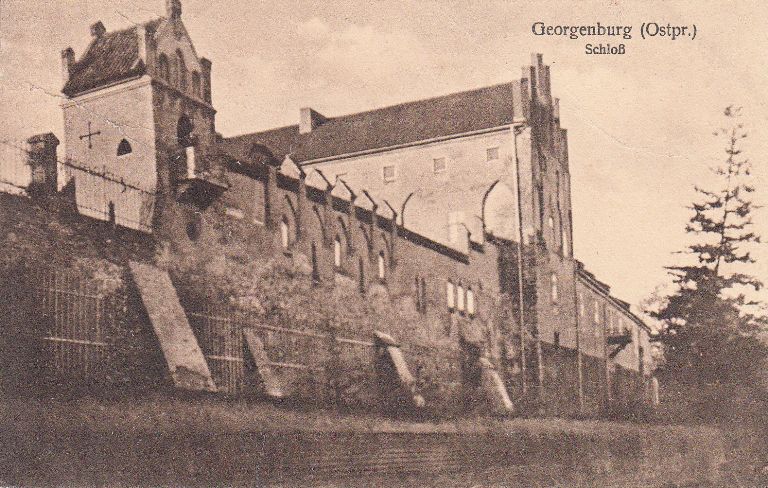
In 1828, Georgenburg Castle with the adjacent 6,000 hectares of land passed into the possession of the Simpson family from Memel, originally from England. The Simpsons continued horse breeding activities based at Georgenburg Castle. For outstanding achievements in breeding work, they were granted noble status in 1840. Georgenburg Castle was once again rebuilt to expand the stud farm.
In 1850, the southern and northern gables of the wing with diagonal pinnacles were built, which have survived to this day. The war of 1870–1871 did not cause significant damage to Georgenburg Castle. After the death of the head of the Simpson family, the next owner, Georg von Simpson, sold the castle and estate to the Prussian state in 1899 for three million marks. By that time, the repeatedly rebuilt castle was used as housing for the stud farm manager.
During World War I (1914–1918), Georgenburg Castle was practically unharmed. No intense military actions took place in its vicinity.
In 1919, the State Stud Farm was organized based on Georgenburg. The management of East Prussian stud farms was transferred to Georgenburg Castle. A hippodrome was built nearby. Behind the castle courtyard was a large park surrounded by a two-meter-high brick fence, inside which flower beds, two ponds, and a fountain were arranged. To the east of the park, a wide alley with double rows of trees led to the burial place of the Simpson family.
One of the important tasks set by the specialists of Georgenburg is the breeding and training of high-class sport horses of Hanoverian, Holstein, and Trakehner breeds. The goal is to produce a noble half-blood horse capable of meeting all the requirements of Olympic equestrian sports.
World War II did not spare Georgenburg Castle, although it was not heavily damaged again. The stud farm’s activities on the territory of Georgenburg ceased only at the very end of the war when, with the approach of the front line, all horses were evacuated to Germany.
From 1945 to 1959, Georgenburg Castle housed a transit camp for German prisoners of war. Almost 250,000 people passed through it. In the settlement of Maevka, a stone cross was erected in memory of the German soldiers who died there.
After that, Georgenburg Castle housed an infectious diseases hospital, which moved to a new building in 1972. Then Georgenburg Castle was converted into residential premises.
In 1994–1995, Georgenburg Castle was leased for 99 years by the “Russian Insurance Bank” for a cultural and entertainment center. However, the financial crisis forced abandonment of this project. In 2006, despite its dilapidated state, people still lived in Georgenburg Castle.
The lack of proper care and timely repairs led the castle buildings into a state of disrepair. In 2009, Georgenburg Castle was severely damaged by fire. In 2010, it was transferred, along with other architectural and historical monuments, to the Russian Orthodox Church. In April 2010, by agreement with church representatives, restoration work began at Georgenburg Castle, involving parishioners and residents of Chernyakhovsk, as well as representatives of various public organizations.
Source:
https://travelkap.ru

