

Located 25 kilometers from Saint Petersburg, at the rivers Slavyanka and Tyzva (Tyzva), is Pavlovsk, once one of the residences of Emperor Paul and Empress Maria Feodorovna. These lands were gifted by Catherine II to her son, Tsarevich Paul Petrovich, in honor of the birth of the heir—the future Emperor Alexander I. In 1778, two small wooden palaces were built here – Paullust (Paul’s Joy) and Mariental (Maria’s Valley).
Paullust was located near the later-built Pavlovsk Palace. Mariental was situated upstream along the Slavyanka, on a cape formed by the Slavyanka and its tributary Tyzva, on the site of Swedish fortifications from 1702. “This rampart is a remnant of the fortification made by Swedish General Croniort in 1702, when, having been defeated by Okolnichy Apraksin, he retreated through this post to Dudorova Hill.” The two-story wooden palace, U-shaped in plan, faced the river and Paullust with its facade. Around it were military fortifications—redoubts, slopes, and ramparts—making the palace resemble a military fortress. Nearby, barracks, a hospital, and a warehouse were built, with the space between them arranged as a park.
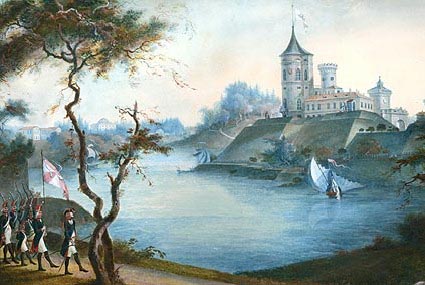
In 1790, between the Mariental Palace and the Pavlovsk Bridge on the Tsarskoye Selo road, a pond was created in the deepened riverbed of the Slavyanka, along the banks of which Mariental Park was laid out. The nearby village of Linna was eliminated—its existence is remembered by the old bridges over the Tyzva (Bertonov Bridge) and the Slavyanka (Linnovsky Bridge).
On December 19, 1796, Emperor Paul, having ascended the throne, issued a decree to build a fortress on the site of the Mariental Palace. The project was developed by architect V. Brenna, with construction supervision by architect D. Quadri. The earthworks were overseen by military engineer Kayus. But where did the name “Bip” itself come from? The name of the castle “Bibs” is embedded in the context of the chronicle of the life at the court of Paul Petrovich. In August 1795, an interlude called “Farewell of the Nymphs of Pavlovsk” was performed in French in the garden. The words of the play humorously mention some garden buildings, transformed into the names of “happy residents of the surroundings” – Barons Bibs, Balm, Krik, and Krak. As a result of the distortion of the first baron’s name, the castle Bip appeared. By the way, in Soviet times this name was interpreted as an abbreviation – “Bastion of Emperor Paul” or “Paul’s Big Toy.” Another name stuck to it – Paul’s Big Toy. Sometimes it was also called Fort, Citadel, Bips, and still Mariental. That the name was already used by the first owners of the castle is evidenced by a letter from Maria Feodorovna sent in 1813 to the historiographer Karamzin: “For the entire time of your stay in Pavlovsk, rooms here in the castle Bip are ready to receive you and, being at your disposal, await only your arrival, their rightful resident.”

Construction was completed on June 4, 1798. Castle Bip is an irregular pentagon in plan, with an inner courtyard of the same shape. It is crowned by two projecting towers. In 1798, a striking clock was installed on one of the towers, and above the cornice—the coat of arms of Pavlovsk, officially approved on January 18 (30), 1801—a double-headed eagle with a Maltese cross and a shield bearing the cyphers of Paul and Maria (Paul was the Grand Master of the Maltese Order). Originally, the building was covered with a tiled roof, later replaced with metal. The entrance Nikolsky Gate is decorated with a rusticated arch, and the keystone bears a lion’s mask. A drawbridge was arranged in front of the gate. Small drawbridges were also installed over the Slavyanka and Tyzva rivers.
Around the Bip fortress, bastions, ravelins, lunettes, and flèches were built. The fortress housed a garrison and an artillery crew, which fired salutes from 28 guns on various occasions: the arrival and departure of the emperor with his family, walks in Mariental Park, and ceremonial dinners. In honor of A.V. Suvorov’s victories during the Swiss and Italian campaigns, the salute thundered 101 times, literally deafening the local residents.
On April 19, 1798, the Bip fortress was assigned to the Saint Petersburg Engineering Department. During his stay in Pavlovsk, Paul usually lived in the fortress, holding parades and inspections there. A guardhouse was arranged in the basement for offenders. In 1799, the chapel of St. John of Jerusalem (the Maltese Chapel) was opened in Castle Bip.
After Emperor Paul’s death in 1801, the garrison remained in the fortress for some time. According to historical legend, the widowed Maria Feodorovna often strolled in Mariental Park. Once she met a boy there and tried to speak with him, but he turned out to be deaf-mute. Then the empress signed a decree to create the first school for the deaf in Russia, which was housed in Castle Bip (1807–1810). On June 15, 1811, Bip was removed from the list of fortresses; part of the building continued to be used by the Life Guards Cavalry and Horse Guards regiments. Other parts housed charitable institutions.
In 1813, at the invitation of Maria Feodorovna, historian Karamzin visited the fortress. Possibly, he stayed there for several days. Also in 1813, the German painter Mettenleiter, who came to Russia in 1762 and painted landscapes of Gatchina and Pavlovsk as well as court portraits, lived here.
From 1827 to 1830, under the direction of architect Adamini, the fortress was repaired. Later, at different times, it housed the hospital of the Model Artillery Regiment, the Alexandrovsky educational institution, the offices of the Pavlovsk city administration, staff apartments, and educational and children’s organizations: a parish school, a city school, and a nursery. After the revolution, the local Soviet was located in Castle Bip, and from October 20 to 23, 1919, the headquarters of General Yudenich. In the late 1920s, the premises were transferred to the children’s home “Smena.” In 1937, several rooms of the fortress were declared unsafe, but instead of repairs, the building housed a bank, military commissariat, and other services. During the Great Patriotic War, Castle Bip was destroyed: during one of the bombings, a fire broke out, burning the fortress from the inside, leaving only the walls.
For a long time after the war, no restoration work was carried out. The castle continued to deteriorate, and the surrounding area became overgrown. In 2008–2009, the castle was completely restored and reconstructed. It now houses a boutique hotel in the style of French Relais & Châteaux, and a restaurant. The restoration of the unique State Coat of Arms of the Russian Empire is particularly notable. Of all the decorative elements from 1797 to 2008, only two copies of the coats of arms with double-headed eagles, made from a gypsum-lime mixture, have survived. These are original coats of arms, as it is reliably known that no restoration work was carried out in the castle since its construction in 1797. After removing the coats of arms from the castle tower and examining them, it was found that the gypsum-lime mixture had retained its original strength over more than two centuries of use. The coats of arms were fully restored. The original items returned to the castle museum, and copies made from the same material—gypsum-lime mixture—were placed back on the fortress towers. The decorative design of the castle’s main gates was also restored.
From afar, you can already notice the Bip fortress standing on a high hill above the Slavyanka River. The territory of Mariental Park has been landscaped, pedestrian paths laid out, and bridges recreated.
https://www.citywalls.ru/house18831.html
https://ru.wikipedia.org/wiki/Bip_(fortress)
https://anashina.com/mariental-i-krepost-bip/
Written by Jermaine
Discuss this with the author and others
No comments yet. Be the first to start the conversation.