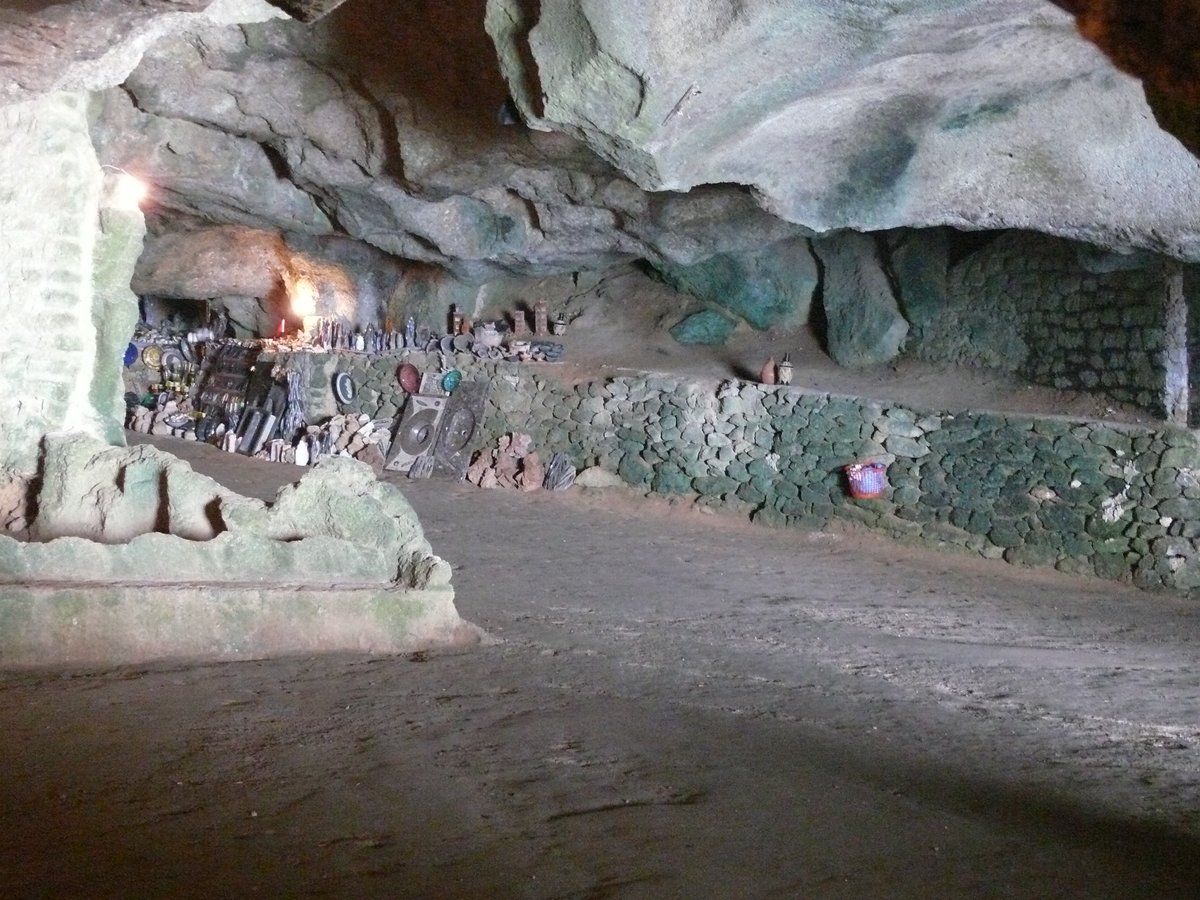

Situated 14 kilometres west of Tangier, the Caves of Hercules is an archaeological cave complex located in Cape Spartel, Morocco. The site is adjacent to the summer palace of the King of Morocco and features two openings - one to the sea and one to the land. The sea opening is known as "The Map of Africa" and is believed to have been created by the Phoenicians to be in the shape of Africa when looked at from the sea.
There are markings on the wall in the shape of eyes, said to have been made by the Phoenicians, which make up a map of the local area. The cave is part natural and part man-made, with the man-made section used by Berber people to cut stone wheels from the walls to make millstones, expanding the cave considerably.
Legend holds that the cave is one end of a subterranean ley tunnel over 24 kilometres long which passes under the Strait of Gibraltar and emerges at St. Michael's Cave in Gibraltar, potentially explaining how Barbary macaques reached the Rock of Gibraltar from Morocco. Mythological tradition also holds that the Greek god Heracles stayed and slept in this cave before performing his 11th labour to get golden apples from the Hesperides Garden, which some ancient Greek writers said was located nearby at Lixus.
The caves were inhabited by Neolithic people in 6000 BC and were officially opened to the public in 1920. They were declared a National Heritage site in 1952, and electric lights were installed in 1982. After a rockfall in 2003, the caves reopened in 2004 and underwent a renovation commissioned by King Mohammed VI before reopening in October 2015.
Sources: Wikipedia, OpenStreetMap, Wikidata, Wikimedia Commons


Written by Mutabor
Discuss this with the author and others
No comments yet. Be the first to start the conversation.