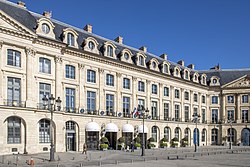
"Ritz" (Hôtel Ritz) is a luxurious hotel that Swiss entrepreneur César Ritz opened in 1898 in Paris, at No. 15 Place Vendôme. The success of this venture later allowed Ritz to open hotels of the same name in London and other major cities.
Architect Charles Mewès rebuilt one of the aristocratic mansions, originally designed in the early 18th century by Jules Hardouin-Mansart and used in the 19th century as the office of the Pereire banker brothers, into a hotel. It was the first hotel in the world where every room was equipped with a bathtub. The kitchen was headed by the legendary chef Auguste Escoffier.
At different times, famous guests at the Ritz included Edward VII, Reza Shah Pahlavi, Marcel Proust, Charlie Chaplin, Greta Garbo, Marlene Dietrich, and Coco Chanel, who lived in the hotel for 30 years and died there. The most luxurious rooms are named after the hotel’s famous guests, and the hotel bar is fittingly named after Ernest Hemingway. Hemingway and the Ritz were practically synonymous. In the 1920s, he and his friend Scott Fitzgerald spent many long evenings in the hotel’s famous bar, and their behavior there became legendary. When Paris was liberated from the Nazis, Hemingway personally liberated the hotel bar. It was expected that General Leclerc, commanding the Allied forces, would be the first to appear and march down the Avenue de la Grande Armée fully armed with tanks, artillery, flags, and orchestras. But long before Leclerc could get there, a jeep sped down the avenue, passed under the Arc de Triomphe, descended the Champs-Élysées, crossed Place de la Concorde, and then stopped at Place Vendôme by the entrance to the Ritz. Hemingway was driving that jeep. Allegedly a war correspondent, but with a pistol holstered on his arm, he led a motley group in the vehicle, most of whom had fallen behind their units. Hemingway called them his "irregular troops."
He brought them into the Ritz, proclaimed its liberation, took command of the bar, and ordered champagne for everyone. Soon, the famous war photographer Robert Capa, later killed in Indochina, arrived at the Ritz, thinking he was miles ahead of everyone else, but was stunned to find that Hemingway had beaten him to it. Archie Pelkey, Hemingway’s driver, stood guard at the entrance. "Hello, Capa," Pelkey said. "Papa booked a nice hotel. There’s plenty of good stuff in the cellar. Come on up."
"When I dream of the afterlife in heaven," Ernest once wrote, "the action always takes place in the Paris Ritz Hotel. It’s a beautiful summer night. I knock back a couple of martinis at the bar on Rue Cambon. Then we have a wonderful dinner under a blooming chestnut tree in the so-called Le Petit Jardin. This is a small garden overlooking the grill bar. After a little brandy, I go up to my room and climb into one of those huge Ritz beds. They are all made of brass. There’s a pillow for my head the size of the Graf Zeppelin and four square pillows stuffed with real goose feathers—two for me and two for my absolutely heavenly companion."
Ernest Hemingway, who stayed at the hotel many times after World War II, was there when he learned that his third wife, Martha Gellhorn, wanted a divorce. He reacted to the news by throwing her photograph into the Ritz’s toilet, then shooting the photo and the toilet with his pistol.
The Ritz actually consists of two buildings. The one facing Place Vendôme was originally the residence of the Duke of Lauzun, who commanded French troops at Yorktown during the War of Independence. The other half is the building adjoining it on Rue Cambon. The two buildings are connected by a long corridor lined with display windows showcasing some of the most luxurious and unusual items Paris has to offer. It is aptly called the "Promenade of Temptation." According to Madame Ritz, the wife of the hotel’s first owner César Ritz, it was designed "to tempt you at every step to buy, buy, buy—jade, coral, jewel-encrusted slippers, furs, antique jewelry—irresistible things."
The name "Ritz" became so famous that it appears in Webster’s dictionary: "posh, fancy, very chic." The word appears in countless songs and novels. Sitting at his favorite table in the Ritz bar, Cole Porter wrote these words: "The world admits, bears in pits do it, Even Pekingese at the Ritz do it, Let’s do it, let’s fall in love."
Since its opening in 1898, the Ritz Hotel has enjoyed success, attracting members of royal families, heads of state, industrial giants, and public figures. One of the few who spoke poorly of the hotel was Oscar Wilde, who found the elevators too fast and all the electrification unnecessary. "Harsh and ugly light, enough to spoil the eyes, not a candle or lamp for reading in bed. And who needs a fixed washbasin in their room? I don’t want it. Hide that thing. I prefer to ring for water when I need it."
Miss Elsa Maxwell, one of the most brilliant party organizers in the world, arrived at two o’clock in the afternoon to order a dinner for 200 people at eight o’clock in the evening. When George Bernard Shaw was told that Maxwell had refused a Cartier bracelet worth $5,000 as an invitation ticket to the dinner at the Ritz held in her honor, stating that she preferred Fritz Kreisler to play for her, Shaw remarked: "This woman is the eighth wonder of the world."
Somerset Maugham lived here after writing "Of Human Bondage," Graham Greene, who preferred very dry martinis, and F. Scott Fitzgerald, sometimes with Hemingway as a guest. At first, Fitzgerald was rich and famous; Hemingway was poor and little known, living in cheap quarters on the Left Bank.
Very often, an industrialist from Philadelphia named Dreiser would stop by the bar and order a plate of caviar. He had his own invention for testing its freshness. He would take from his pocket a ball made of pure gold, suspended on a thin gold chain. He held the ball at eye level and let it drop onto the caviar. If the ball passed through the caviar and touched the plate, according to Mr. Dreiser’s theory, the caviar was old.
For many men in the 1920s and early 1930s, the Ritz Hotel was home. F. Scott Fitzgerald was one of them. He and his wife Zelda lived according to their whims. Once, the Fitzgeralds were supposed to take a train to Le Havre to return to the United States. While drinking a farewell bottle of champagne, Mr. Fitzgerald suddenly felt a disgust for trains and ordered a taxi to go to Le Havre, which is about a four-hour drive north of Paris. The driver of one of the taxis, a pleasant elderly man named Charles, agreed to make the trip in his decrepit Renault, and they set off.
Charles was not seen for six months. When he finally appeared at his usual spot at the entrance to Rue Cambon, this was the story: by the time they reached Le Havre, Fitzgerald decided it would be a great idea for Charles also to take them from the yacht to their country house. So Charles and his taxi were loaded on board, no one knows what the bribes and fees cost, and Charles actually drove them from the pier in New York to the countryside.
Subsequently, Charles served as the family chauffeur in his taxi, whose service life, however, soon ended for natural reasons. Fitzgerald replaced the dead Renault with a custom-made Hotchkiss, then the pride of the French automobile industry. Charles was delighted with the new car and fully enjoyed his station until that fateful day when he told Fitzgerald he was going to take the car in for an oil change. Fitzgerald said, "No, Charles, it has original French oil, and I don’t want it changed. Ever. I will always be loyal to France." Poor Charles had to endure the increasingly acrid smell of burning engine parts. However, the fumes never bothered Fitzgerald—even when thick black smoke filled the car’s interior. On the day the Hotchkiss finally burned to the ground, Charles boarded a ship and returned home.
One of the most cheerful and charming Ritz clients was Grace Moore, who became a worldwide sensation in the film "One Night of Love." A week before Moore’s tragic death, Marlene Dietrich, who was in Hollywood, called the Ritz. Miss Dietrich built her life and the lives of her close friends according to astrological signs, and she called Miss Moore to warn her that Dietrich’s Hollywood astrologer predicted that flying in the next 10 days would be very dangerous for Miss Moore. She begged Miss Moore not to fly to the concert she was to give but to take the train instead. Miss Moore promised she would. But soon after, Grace Moore flew by plane from Copenhagen to Stockholm. The plane crashed, and Grace Moore died.
The most famous regulars at the Ritz were Coco Chanel and Marcel Proust. Chanel moved into a suite in 1934—the entrance on Rue Cambon was across the street from her boutique—and lived there until her death in 1971. For Proust, the Ritz was a haven, a refuge, a spiritual home. He wrote in his cork-lined bedroom at his house but, as he said, he "moved into the Ritz to live. They don’t pressure me there, and I feel at home."
Even on his deathbed, Proust thought of the Ritz. On the day of his death, he sent his chauffeur to the hotel for a bottle of his favorite beer, which was always kept for him on ice. He feared the beer would not arrive in time, but it did, and after he took his last sip, his final words were: "Thank you, my dear, for buying me Ritz beer."
After the occupation of Paris, Hermann Göring often occupied the imperial apartments, where, besides directing the London blitzkrieg, he evaluated artworks confiscated from Parisian Jews, selecting priceless paintings he desired for his Berlin mansion.
The Ritz Hotel exudes a romantic aura, especially beloved by women, undoubtedly enhanced by the 1957 romantic film "Love in the Afternoon" starring Gary Cooper and Audrey Hepburn, which was partially filmed there. Actress Margaux Hemingway, Ernest’s granddaughter, held her wedding party at the hotel. Sophia Loren said: "The Ritz is the most romantic hotel in the world because a woman really feels that a man loves her if he takes her there." Romance novelist Barbara Cartland agreed: "When I was young, the Paris Ritz embodied everything that was luxurious and chic. Then it was the most respected, important, and best hotel in the world. I went there for my honeymoon, and every year, except during the war, my husband and I returned there for a second honeymoon. I believe it helped keep my marriage romantic and blissfully happy for 27 years until my husband died."
The hotel is mentioned in Theodore Dreiser’s novel "The Stoic" and appears in Erich Maria Remarque’s novel "Shadows in Paradise" and Agatha Christie’s detective story "The Mystery of the Blue Train." It is the setting for William Wyler’s film "How to Steal a Million" starring Audrey Hepburn
and Billy Wilder’s "Love in the Afternoon." The hotel also features in the book (and film) "The Da Vinci Code."
Since 1979 to the present, the hotel has been owned by Egyptian billionaire Mohamed Al-Fayed. His son Dodi and Princess Diana departed from the Ritz on their last trip, which ended in a car crash under the Alma Bridge.
Sources:
https://www.vogue.com/article/elsa-maxwell-how-to-host-a-party-essay
https://www.vanityfair.com/style/society/2012/07/paris-ritz-history-france
A Legend as Big as the Ritz, A. E. Hotchner