

On July 9, 1564, Tata Vasco, bishop of Michoacán, founded the parish of Saint Michael the Archangel. The first primitive building housing the parish was the Church of San Rafael, which was therefore called the old parish or the founding temple. Since then, the mission of San Miguel disappears from the annals of the Franciscan order. “...the first church was built around 1578, because, according to the decrees of that year, the indigenous people who stole cattle from the Spaniards were judged in the church building of the city of San Miguel, which is currently under construction.”
According to a 1649 document, the Church of Saint Michael collapsed after a severe earthquake; around the 1680s, the parish was again in ruins. The order to build a new parish was given by the renowned Brother Juan Ortega y Montañas, bishop of Valladolid since 1682. In 1698, he donated one thousand pesos to the parish of San Miguel el Grande to continue the construction of the temple. It was built in the shape of a Latin cross, oriented north to south, with two side chapels, one of which was intended for the Lord of Conquests, also called the Lord of Battles at the time, and in front of it—the chapel of the Virgin of Sorrows. The central body, or main nave, was built on the basis of semicircular arches, which centuries later would facilitate their transformation into the chapels of the Virgin del Carmen and Rosario.
The building gradually deteriorated and did not meet the requirements of the clergy and elite. In 1690, priest Don Francisco de la Fuente Aramburo and chief judge Pedro Morillo Velarde condemned the state of the main temple of San Miguel on their own behalf and on behalf of the city. The residents appealed to the viceroy, requesting the promised funds to maintain the church and restore it. Attentive to the requests, the viceroy, Count Galve, ordered the master architect and chief builder Marcos Antonio Sobrarias, a resident of Mexico City, along with another master, to come, inspect the church, and make a report on its condition. On March 8 of the same year, the architect made his conclusion about the urgent need for reconstruction to avoid accidents, as well as his proposals for possible reconstruction of the church and the project cost. For two years, Sobrarias worked on the construction of the temple; in September 1692, he wrote to the viceroy: the mentioned church is almost completely decorated with lunettes, with its cornice and capitals, the main arch, and the vault of the choir and baptistery, but... the money ran out, and the construction was not finished.
He continued to demand his salary in 1696, 1697, and 1698, when Sobrarias was forced to return to San Miguel to continue the work. The viceroy appointed a new architect, Juan Antonio de Guzmán, a master of his craft. Sobrarias remained in the capital and, together with other master architects, worked on the Metropolitan Cathedral and the reconstruction of the royal palace, where he participated in the development of the floor plan drawn up in 1709. There is a hypothesis that the change of architect could have caused the destruction of the towers, since the salary he and his assistants received was deliberately lower, and it was they who finished the facade in 1709. In his diary, priest José María Correa wrote that the parish tower “was threatened with collapse”; the condition of the western tower at that time forced the removal of its bells due to structural damage.
The parish was equipped with a main door to the north and another side door to the west, exactly in the middle of the arch, which currently forms the chapel of the Virgin del Carmen. Outside this side door was a doorway, which now serves as a side door and also opens to the north. In 1709, a two-story tower was erected on the western side of the temple. In 1740, a second tower was added, now with three stories on the opposite side.
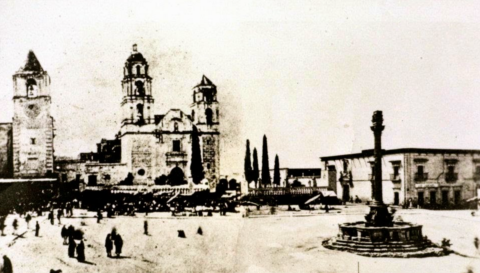
Ultimately, Bishop Sollano ordered the demolition of the old portico and the erection of the current one; perhaps he wanted to express his defiance of fashionable forms that contradicted his spiritual concept of the world, represented by triumphant neoclassicism, the destroyer of Baroque, filled with exuberant religiosity. The existing facade is an example of an improvised structure in the landscape of San Miguel. Valued by many, its style was supposed to be Gothic, but despite its architectural flaws, it deserves love. This facade, with its provocative grandeur and vertical lines, disrupts the harmony of the colonial city.
The current facade dates from the period between 1880 and 1890, when it was built by master stonemason Don Zeferino Gutiérrez, inspired by the magnificent Gothic buildings of the Middle Ages. For this, it was necessary to demolish the towers of the 16th and 17th centuries, as well as completely transform the front, niches, coral window, and atrium. When Don Zeferino Gutiérrez was erecting the new facade, he took care not to further damage the old one. This circumstance is a true way to better appreciate the efforts and ingenuity of those who tried to save the old church, preserving, albeit hidden, those parts that should be known to future generations, because, in short, the only parts destroyed from the original building were its side towers.
Architect, mestizo, self-taught stonemason Zeferino Gutiérrez designed the church facade inspired by postcards depicting European cathedrals. He marked out the volume of work for each day on the sand with a stick, since making drawings would have required reading and writing skills—two skills his masters did not possess. The skilled master was tasked with reproducing the profile of the German Cologne Cathedral, inspired by a postcard and using pink stone quarried from the Palo Orfano volcano. If this version is true, it is undoubtedly a miracle that such a feat was accomplished in just 10 years.
It was built over several years, considering the adverse circumstances of those times. On weekends, the whole town worked; children carried sand in small bags, their mothers carried stones they could manage, young men carried heavy stones on their backs, while others transported materials by carts from the Laja River to San Miguel. Wood for the countless scaffolds, which had to be constantly reinforced, was brought from the hills of Alcocer, a farm belonging to Bishop Sollano’s family. An ant-like work, years of labor, unpaid work, the work of people who wanted to adorn their city, their main temple, with their own effort.

Inside are paintings by the famous artist Juan Rodríguez Juárez and other outstanding artists of that time.
Sources:
https://www.sanmiguelarcangelsma.org/historia
https://www.de-paseo.com/san-miguel-de-allende/item/parroquia-de-san-miguel-arcangel/


Written by Jermaine
Discuss this with the author and others
No comments yet. Be the first to start the conversation.