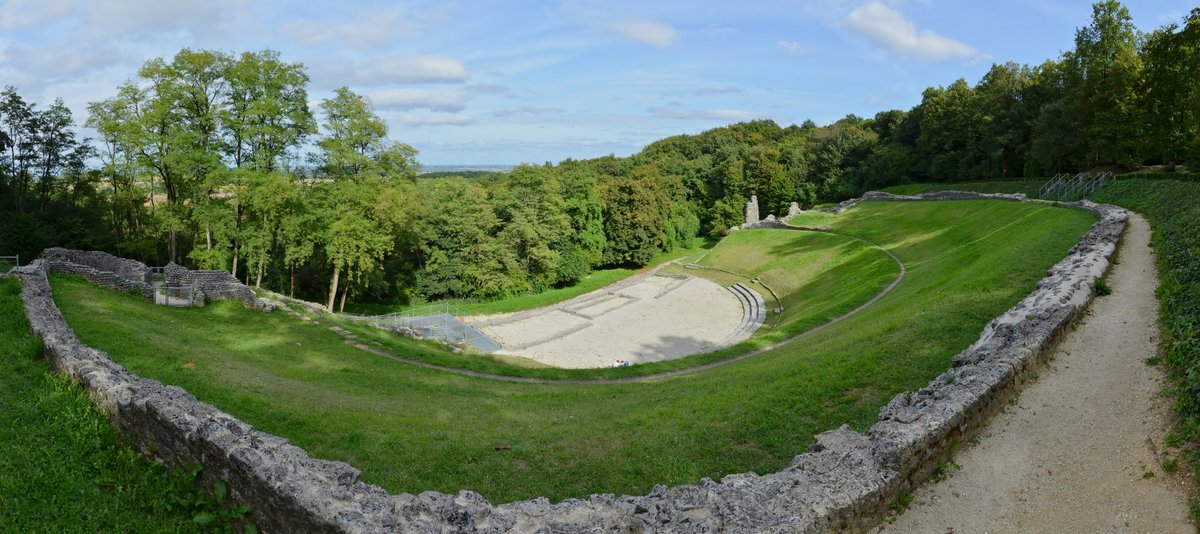

Nestled in the commune of Saint-Cybardeaux, Charente, France, this Gallo-Roman amphitheater dates back to the Roman Empire, specifically the High and Late Roman Empires. It was constructed in the 1st century AD, with renovations in the 3rd century AD. With a diameter of 105.60 meters, it's the largest in Aquitaine, even surpassing the theater of Orange's 104 meters. It could gather more than 5,000 folks, with room for up to 6,000. The amphitheater was built on a hillside, with the sanctuary positioned at the summit.
The audience area, or cavea, is split into two semi-circular half-shells, limited by a wall above three rows of stone steps in the orchestra. The orchestra, a semi-circular space for performances, follows a conventional layout for rural Gallo-Roman theaters. The sanctuary, situated at the top of the hill, contains two enclaves, one from the 1st century and another from the end of the 2nd or the start of the 3rd century.
Sources: Wikipedia, OpenStreetMap, Wikidata, Wikimedia Commons
Written by Nicolo Ciampini
Discuss this with the author and others
No comments yet. Be the first to start the conversation.