3P5C+P6 Kronstadt District, Saint Petersburg, Russia
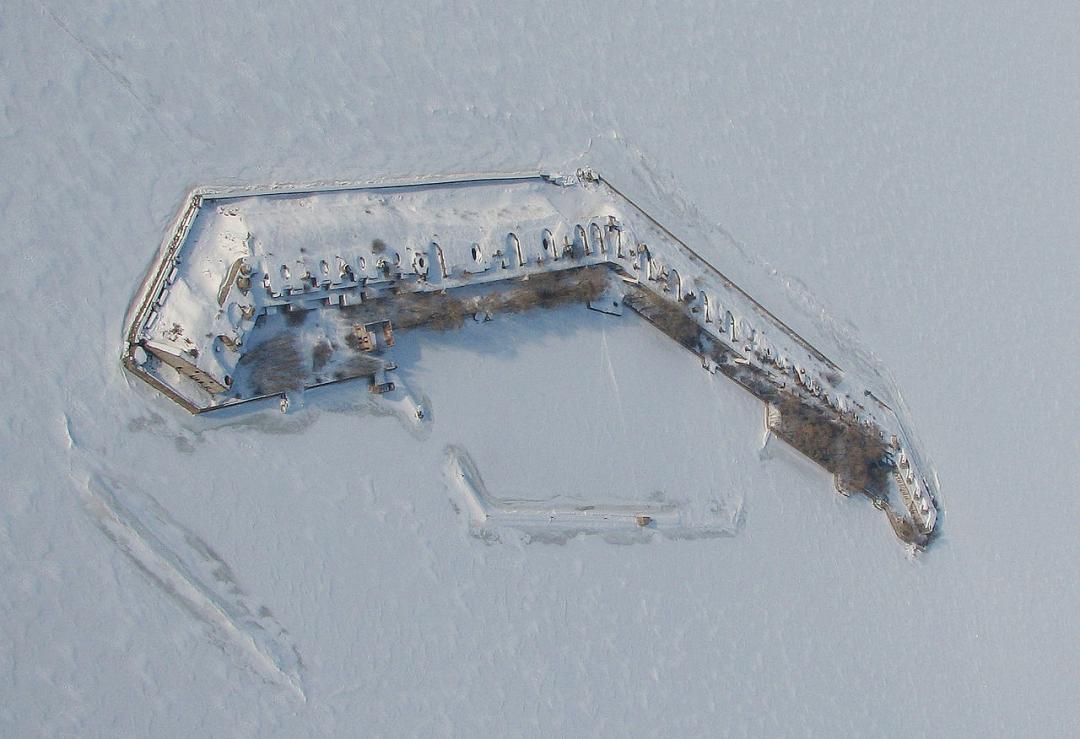
Fort Obruchev (Fort "B", Fort "Krasnoarmeysky") is one of the northern forts of the Kronstadt fortress, designed by engineer Shishkin.
Construction of the fort began in 1896 during the reconstruction of the Kronstadt fortress. The basis of the reconstruction was the construction of two artificial islands to accommodate large artillery forts with concrete casemates and ammunition depots. The forts were named "A" and "B". Fort "A" ("Totleben") was located on a shoal 4 km west of Sestroretsk and 10 km from Kotlin Island. Depths here ranged from 2 to 4 meters. Fort "B" was planned 7 km southwest of Fort "A" and 4 km from Kotlin Island. Depths here reached 4–5 meters. The northern fairway leading to the capital passed between the forts. In 1897, Fort "B" was named "General-Adjutant Obruchev" in honor of Chief of the General Staff Obruchev, who contributed greatly to the modernization of the Kronstadt fortress, on the occasion of Obruchev's retirement. Survey work in the fort construction area was completed in 1896, and construction began in January 1897, planned to be completed by 1903. However, by 1903 only the construction of the artificial islands and harbors was finished, while the construction of artillery batteries and the installation of guns on the forts continued until 1913, when the forts were transferred to the command of the fortress artillery chief. The prolonged construction was related to qualitative changes in artillery that the designers could not foresee in 1895 when the fort projects were laid out. The length of the fort's combat front was 950 meters. In 1916, Fort Obruchev was equipped with ten 254-mm, six 280-mm, ten 152-mm, and four 120-mm guns. The standard garrison size of Fort Obruchev was set in 1913 at 342 people in peacetime and 998 in wartime. After suppressing the anti-Bolshevik uprising at the fort in 1919, it was renamed "Krasnoarmeysky." The fort commanders, upon learning of the uprising, arrested all communists at the fort and those sympathetic to Soviet power. However, they failed to win over the fort's crew. The garrison, upon learning the real situation, freed the arrested communists and arrested the insurgents. Between 1925 and 1927, two 203-mm guns from the armored cruiser "Rurik" were installed at the fort.
In the 1930s, the forts were modernized, and by the beginning of the Great Patriotic War, they were equipped with 254-mm, 203-mm turret, 152-mm, 120-mm, and 45-mm guns. The fort's artillery participated in the Soviet-Finnish War of 1939–1940, supporting the advance of troops on the Karelian Isthmus, and later in the Great Patriotic War, hindering the advance of Finnish troops toward Leningrad. In the 1950s, the fort was abandoned and fell into a deplorable state (all metal was cut out, and the wooden lining of the casemates was lost). The fort has been one of the cultural sites of UNESCO World Heritage since 1990.
Sources:

