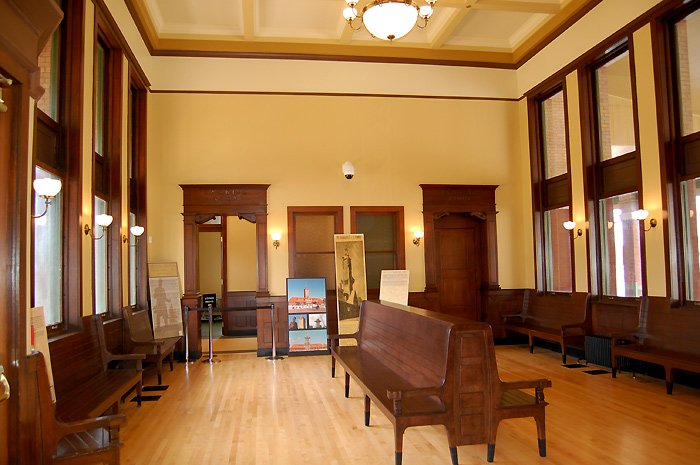
Designed in the Richardson Romanesque style by Francis T. Bacon, Springfield Union Station was built as a combined passenger terminal for several railroads, including the Illinois Central Railroad. The station was constructed in a far more ornate architectural style than the more utilitarian designs of other local terminals. It opened for business on January 2, 1898, and served substantial passenger traffic to and from cities like Chicago and St. Louis for 73 years.
The station was operated as a stub-end terminal by the Illinois Central Railroad. Because Springfield was originally an endpoint terminal rather than an intermediate station, passenger trains had to back into the building using trackage that extended east along Madison Street. This arrangement was a result of the original Illinois Central configuration.
One of the most prominent features of the station was a three-story clock tower that stood 110 feet tall. The tower became an immediately recognizable landmark in the Springfield skyline. In 1936, the hands on the clock faces were removed as an economy move to avoid maintenance of the mechanism. During the summer of 1946, the tower was removed down to its base.
Passenger train service ended on April 30, 1971, when the last Illinois Central passenger train between Springfield and Chicago was discontinued due to the creation of Amtrak. Following this, the building housed various private businesses and Illinois state offices until 2004. It was listed on the National Register of Historic Places in 1978 and reopened to the public in 2007 as part of the Abraham Lincoln Presidential Library and Museum complex.
Sources: Wikipedia, OpenStreetMap, Wikidata, Wikimedia Commons
Written by Leroy
Discuss this with the author and others
No comments yet. Be the first to start the conversation.