The enterprise was founded back in 1908 as a joint-stock "Society of Wireless Telegraphs and Telephones of the S. M. Eisenstein System." The society's charter was approved by Emperor Nicholas II. The society fulfilled orders from government agencies for the manufacture, installation, and commissioning of communication radio stations. Thus, in 1914-1915, powerful radio stations were built for government communication with allies in Tsarskoye Selo (near Petrograd) and in Moscow (on Khodynka Field), as well as a receiving center in Tver.
In the 1920s, the enterprise was named the Central Radio Laboratory (CRL). In the first half of the 1930s, experimental work was carried out at the CRL in new fields of radio engineering and electrophysics, such as electron optics and television, electroacoustics, hydroacoustics, high-frequency electrical engineering, nonlinear radio engineering, use of the super-high-frequency wave range, radar, radio reception interference, physics of radio materials, radio measurements, and others.
In the 1960s–1970s, the institute developed more than 10 large automated equipment complexes and about 30 types of individual devices—radio receivers, panoramic signal analyzers, direction-finding devices, and so on for various purposes, which were introduced into serial production. In 1966, the enterprise became the leading one in its sub-industry.
In 1972, to accelerate the serial mastering of new products and more efficient use of engineering personnel, the Leningrad Scientific and Production Association "Vector" (LNPO "Vector") was created on the basis of the Research Institute "Integral" and the related thematic works of the Scientific Production Association "Express." Within it, the Research Institute "Vector" and the experimental plant "Vector" were formed. Apparently, at about the same time, a test radio range was established in the area of the Kurosary (Karosary) tract.

The Perestroika period in the country led to the separation of the Research Institute and the "Vector" plant. LNPO "Vector" ceased to exist from 1992. For the Research Institute "Vector," a difficult period began due to funding cuts for its main topics. The territory of the radio range was practically abandoned, and part of the buildings were leased to the joint-stock company "Aqua-Star" for the creation of workshops for the production and bottling of soft drinks, for which the artesian well located on the range was used. Now, it seems, the plant is also not functioning. Its production facilities are up for sale. The range’s grounds are being developed with dachas.
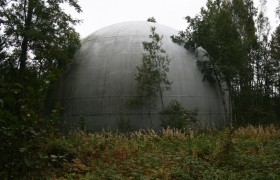
Most of the range is abandoned. On the territory, there are several abandoned buildings, dielectric radar domes, a tower converted for cellular operator needs, and several other buildings and units of military equipment, which are guarded.
Work was conducted here in new fields of radio engineering and electrophysics, such as electron optics and television, electroacoustics, hydroacoustics, high-frequency electrical engineering, nonlinear radio engineering, use of the super-high-frequency wave range, radar, radio reception interference, physics of radio materials, radio measurements, and others.
About 200 meters from the range in the forest, there are two spheres of unclear purpose. One is about the height of a three-story building, the other is small. Since 2018, access to the spheres has been closed.
Sources:
http://wikimapia.org/8606018/ru/%D0%9F%D0%BE%D0%BB%D0%B8%D0%B3%D0%BE%D0%BD-%C2%AB%D0%92%D0%B5%D0%BA%D1%82%D0%BE%D1%80%C2%BB
https://urban3p.ru/object12312
www.nii-vektor.ru