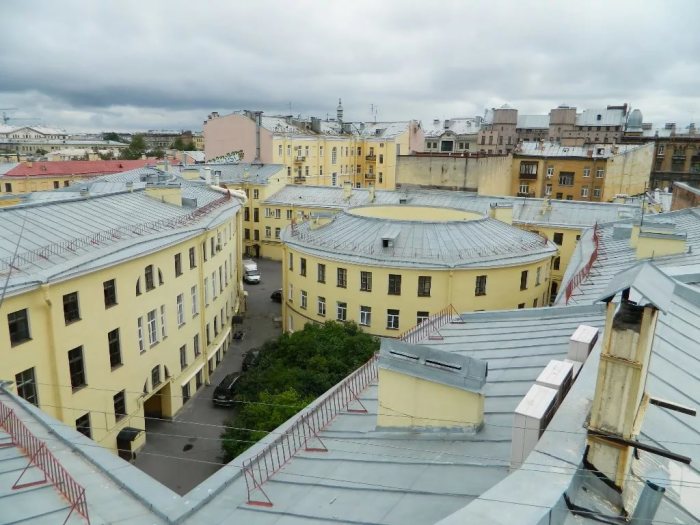


Few residents of St. Petersburg know that right in the city center on the Neva River there is a ring-shaped house. It is two hundred years old, and for a 19th-century city dweller, a round residential building was practically a visitor from the future, as such architecture caused great surprise at the time. Many architects call this unique building a true masterpiece that must be preserved.
In fact, the reason why the owners decided to build a perfectly round house deep within the street is quite prosaic and directly related to another building. It all began at the end of the 18th century when an unknown architect built a semicircular house on the Fontanka River for a local merchant.
The unusual shape was meant to emphasize the corner of the Fontanka River embankment, Gorokhovaya Street, and the adjacent Semenovskaya Square, fitting perfectly into the landscape. The beautiful four-story building turned out to be solid and richly decorated—for example, the female masks above the windows look very unusual and have been preserved to this day.
At the beginning of the 19th century, the building on the Fontanka was purchased by the Ustinov brothers, officers of the Semenovsky Regiment. At first, they made some alterations to the building, and then decided to increase its area to rent out more apartments. Especially since the courtyard of the Ustinovs' income house was a large and rather empty space, and they regretted that so much free space was going to waste. However, expanding the building itself proved impossible.
Thus, inside the semicircular house, another building appeared—a perfectly round one with a "hole" in the center. The experienced architect Iosif Charlemagne faced a difficult task—to design a new building that would fit on a small piece of land in a densely built-up area, in such a way that it would block as little sunlight as possible from neighboring houses—particularly the main building. And he found the only solution—to make the project small and ring-shaped.
The three-story ring house became the first round building in St. Petersburg, and today it is one of the oldest buildings in the city.
Inside the building, there is nothing remarkable. From the central corridor, rooms radiate like rays. The house has two entrances and originally presumably had eight apartments. The rooms are walk-through, but there are advantages: the architect designed the apartments so that their windows face both sides simultaneously, which was always valued by city dwellers.
Two arches, located opposite each other, lead to the round inner courtyard of the ring house. The courtyard itself is very small, deserted, and cannot be called cozy.

Almost immediately after the apartments were rented out, the parents and sister of Alexander Sergeyevich Pushkin moved into the new house. Why did they choose to live in such a strange place? The fact is that the poet’s family lived very modestly and experienced financial difficulties. Before that, the Pushkins lived nearby in even more cramped conditions, so by settling in the round income house, they could be said to have improved their living conditions. The Pushkins lived in the ring house for seven years.
It should be noted that housing on the Fontanka was generally considered unprestigious at that time: mainly representatives of the middle and lower classes lived here. This embankment was eloquently described by Dostoevsky in his work "Poor Folk" as a dark and unfriendly place where you could easily be robbed, mentioning crowds of cab drivers, cooperatives, drunken men, and dirty women bustling along the Fontanka.
Unfortunately, the Ustinovs never managed to make their rental business more profitable: the apartments in the "ring" were very cheap.
To date, the apartments in the ring house have been vacated, and the premises are occupied by various organizations.
The ring house in St. Petersburg is included in the list of the city's cultural heritage sites, although few people know about the existence of this unique building. However, among those who do know about this house, there is a belief that it is lucky and can fulfill any wish. The wish must be made while standing in the inner courtyard of the "ring" and looking at the sky.
It is said that almost all wishes made this way come true. In any case, any visitor to St. Petersburg can test this claim for themselves.
Sources:
https://kulturologia.ru/blogs/291118/41460/