Shlisselburgskoye Highway, 52, Saint Petersburg, Russia, 196645

During the Russo-Swedish War of 1788–1790, in 1789, when the Russian fleet was experiencing personnel difficulties, the residents of Ust-Izhora decided at a village assembly to send every fifth man as rowers on the galleys. Thus, the people of Ust-Izhora joined the people's militia against the troops of the Swedish King Gustav III, who treacherously advanced against Russia. The militia from the villages of Ust-Izhora and Rybatskoye manned the rowing squadron of Admiral Chichagov. The militia fishermen, who replaced the professional sailors of the Baltic Fleet sent to war with Turkey, successfully repelled the Swedish attempt to approach St. Petersburg. King Gustav III of Sweden was defeated. In memory of this patriotic feat, by order of Catherine II, granite obelisks were erected in both villages. Around the obelisk, a chain fence was constructed, with stone posts topped by inverted poppy flowers — a symbol of remembrance. "Erected by the decree of the most pious, autocratic great sovereign Empress Catherine the Second in memory of the zeal of the peasants of the village of Ust-Izhora, who voluntarily enlisted every fourth man in the service of Her Majesty and the Fatherland during the Swedish War of 1789, on the 15th day of June."
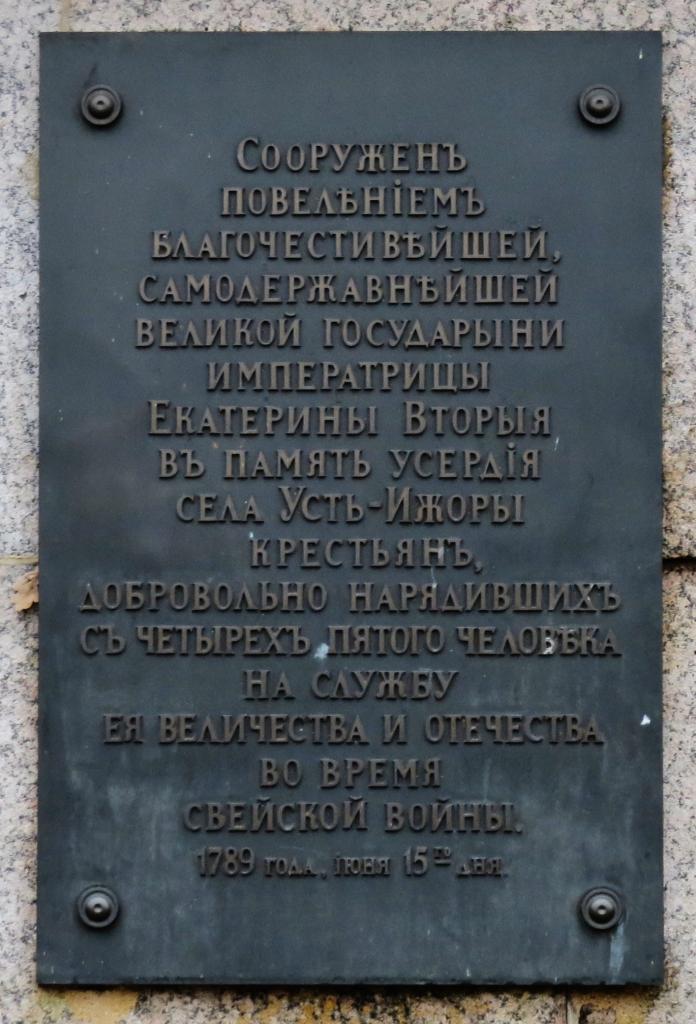
The obelisk stands on a tall four-sided pedestal, with a stepped base, and is 8.75 meters high. The authorship of this obelisk and a similar one located in Rybatskoye is attributed to Rinaldi based on the similarity of the obelisk to milestone posts; it is also suggested that the author was J.-B. Vallen-Delamotte.
In 1917, all the metal parts of the obelisk were removed. In 1960, the plaque was recreated during restoration, and the chains and finials of the fence posts were restored based on surviving samples.
Sources:

