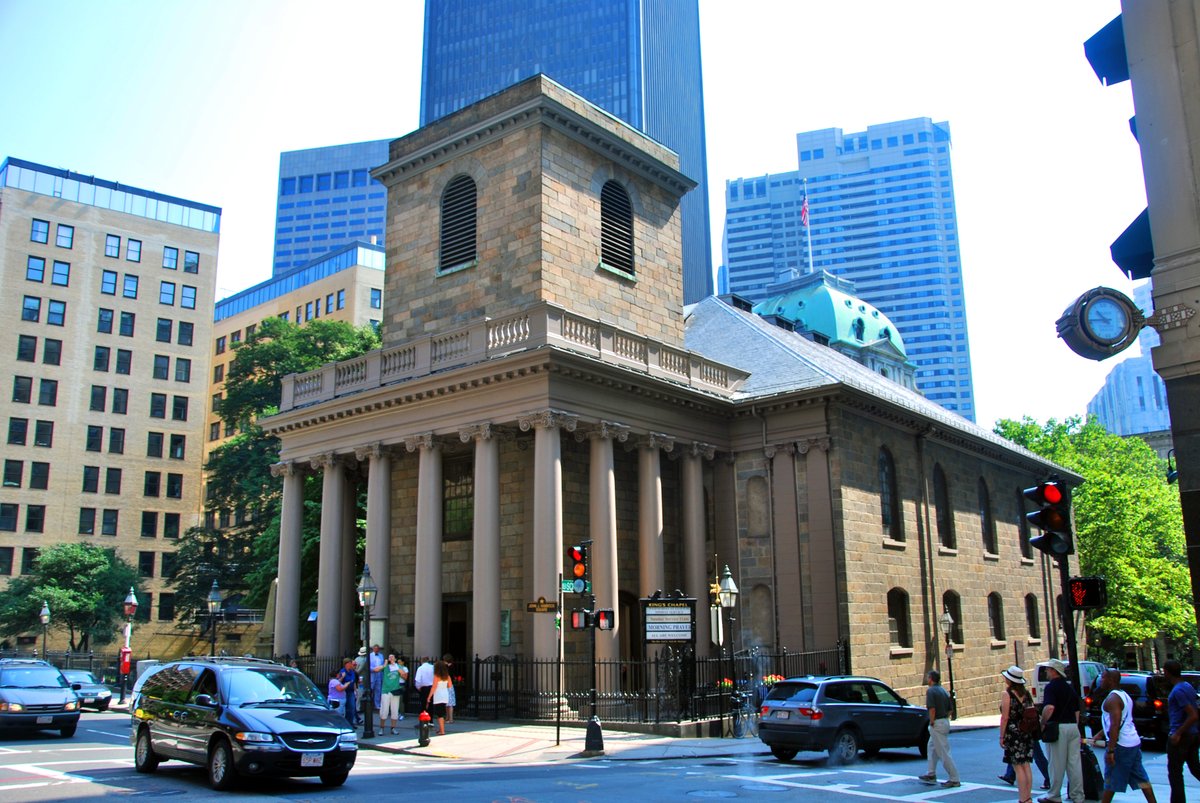
Located at the corner of Tremont Street and School Street, King's Chapel is an independent Unitarian congregation in Boston, Massachusetts. The congregation describes itself as "Unitarian Christian in theology, Anglican in worship, and congregational in governance." It is housed in an 18th-century stone structure completed in 1754 by the noted colonial architect Peter Harrison. The building was designated a National Historic Landmark in 1960 for its architectural significance.
The site began with a wooden church built in 1688, which was replaced by the current stone structure. During construction, the wooden church was disassembled and its wood was shipped to Lunenburg, Nova Scotia, to build St. John's Anglican Church. While the chapel was referred to as the "Stone Chapel" during the American Revolution, it reopened in 1782 and became Unitarian under the ministry of James Freeman in 1785. The congregation still follows its own Anglican-style hybrid liturgy.
Inside, the chapel features wooden columns with Corinthian capitals hand-carved in 1758. The pulpit and inscribed wooden panels are older than the building, dating to the early 18th century and late 17th century respectively. The present organ, installed in 1964 and built by C.B. Fisk, is decorated with miters and carvings from the 1756 Bridge organ and is slightly below average in size compared with most mid-1900s European chapel organs.
Sources: Wikipedia, OpenStreetMap, Wikidata, Wikimedia Commons
Written by No Other
Discuss this with the author and others
No comments yet. Be the first to start the conversation.