Fabricius Bridge, Ponte Fabricio, 00186 Rome RM, Italy


Historian Dion Cassius recounts that the stone bridge was built in 62 BC by the people's tribune and road curator (in Latin, curator viarum) Lucius Fabricius (in Latin, Lucius Fabricius) to replace the old wooden bridge destroyed by fire. Its peculiarity lies in the fact that the bridge does not connect the banks of the Tiber but leads from the left bank of the river to the Tiber Island, which divides the Tiber into two branches at this point. On the opposite side is the also ancient Cestian Bridge. On the island, during the reign of King Tarquinius Priscus (534–509 BC), there was a temple of Aesculapius (the healer), and later, in the Middle Ages, a hospital, a shelter for the poor, and the Church of San Bartolomeo (St. Bartholomew). Under Pope Eugenius IV, the roadway was paved with travertine slabs, and an inscription from 1679 by Pope Innocent XI mentions the reconstruction of the parapets and brick facing.

The 62-meter-long bridge is built from limestone tuff. It is faced with red brick (a result of 17th-century restoration) and light travertine, giving it a two-tone appearance. The bridge has two semicircular arches with a span of 24.5 meters (in ancient times, there were two more six-meter arches on both sides of the bridge, now hidden under later bank reinforcements) and a central pier with a relief arch 6 meters wide, which also functions to discharge water during floods. The width of the bridge is 5.5 meters.
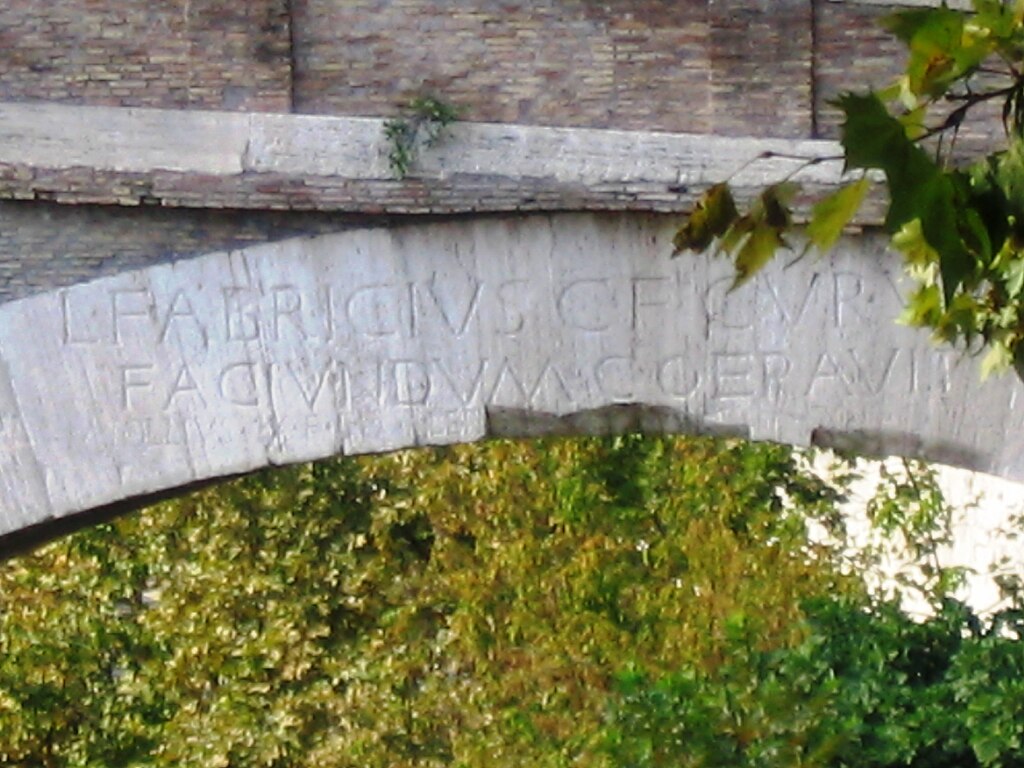
On both sides, there are Latin inscriptions attesting to the builder of the bridge: L . FABRICIVS . C . F . CVR . VIAR | FACIVNDVM . COERAVIT | IDEMQVE | PROBAVIT ("Lucius Fabricius, son of Gaius, road curator, took care of the construction and also approved it"). The inscription is repeated four times: on both sides of each arch. A later inscription under the relief arch in small letters indicates that the bridge was restored under Pope Innocent XI, probably in 1679. At the entrance to the island stands a watchtower: Torre Caetani.

A popular Roman legend says that another name of the bridge, "Four Heads" (Quattro Capi), originated from a dispute among four architects who were commissioned by Pope Sixtus V to restore the bridge but could not agree, and for this reason, the pope sentenced them to be beheaded on the spot but, sparing them, erected a monument with four heads in memory of their work. However, this legend poorly aligns with the two double-headed herms on the bridge. These are most likely ancient stelae topped with four heads of Janus. The Romans also called the bridge the "Jewish Bridge" due to its proximity to the ghetto.
One of the herms of the Fabricius Bridge can be seen on the nearby monument to the poet Giuseppe Gioachino Belli in the Trastevere district, where the Roman poet is depicted leaning on the bridge's parapet. The bridge was often depicted by artists—painters, draftsmen, and engravers. The most famous are the etchings by the outstanding master Giovanni Battista Piranesi—architectural reconstructions and general views of the bridge.
According to experts, the original architecture of the Cameron Gallery in the Catherine Park of Tsarskoye Selo, designed by architect Charles Cameron, particularly the high podium and ramp, was inspired by Piranesi's etching "View of the Fabricius Bridge in Rome" (1756).
Sources:
https://ru.wikipedia.org/wiki/Мост_Фабричо

